


doi: 10.1038/srep03497.
Discovery of 505-million-year old chitin in the basal demosponge Vauxia gracilenta
Affiliations
- PMID: 24336573
- PMCID: PMC3861796
- DOI: 10.1038/srep03497
Item in Clipboard
Discovery of 505-million-year old chitin in the basal demosponge Vauxia gracilenta
Sci Rep.
.
Abstract
Sponges are probably the earliest branching animals, and their fossil record dates back to the Precambrian. Identifying their skeletal structure and composition is thus a crucial step in improving our understanding of the early evolution of metazoans. Here, we present the discovery of 505-million-year-old chitin, found in exceptionally well preserved Vauxia gracilenta sponges from the Middle Cambrian Burgess Shale. Our new findings indicate that, given the right fossilization conditions, chitin is stable for much longer than previously suspected. The preservation of chitin in these fossils opens new avenues for research into other ancient fossil groups.
Figures
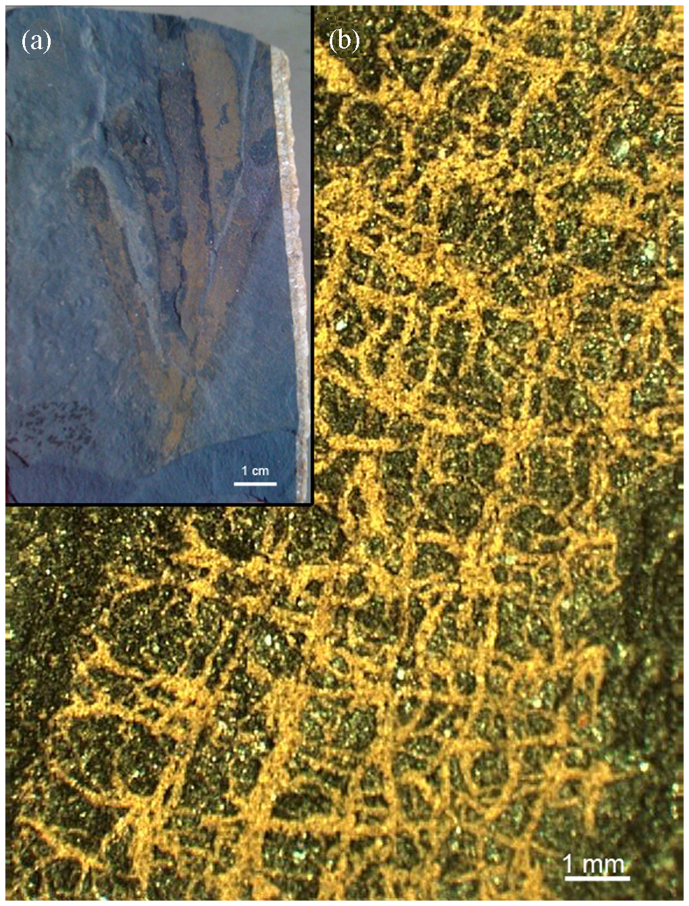
Burgess Shale sample with the fossil demosponge V. gracilenta (a) with detail of the exceptionally preserved skeleton (b).
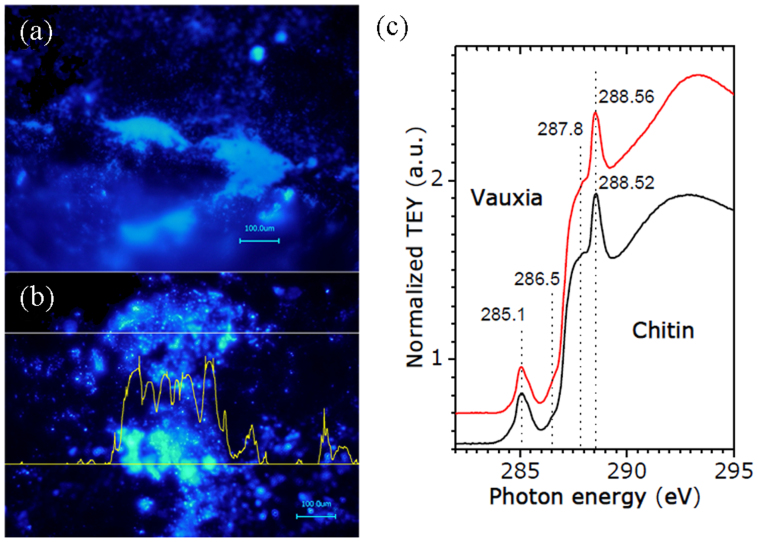
Calcofluor white staining of the cleaned surface of V. gracilenta with fluorescence, indicating the presence of polysaccharide-based compounds (a, b). Isolated and HF-demineralized fibers were identified as chitin using NEXAFS spectroscopy (c).
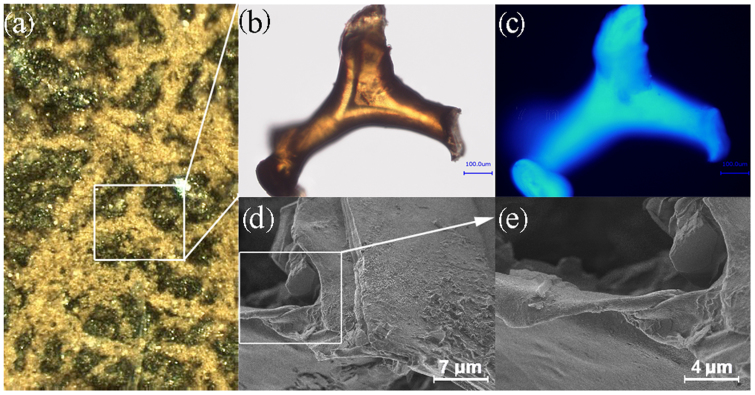
A selectively isolated fragment (b) of the aspiculate fibrous skeleton of V. gracilenta (a) shows autofluorescence (c) that is characteristic for chitin. The non-homogenous fluorescence can be explained by the presence of a residual mineral phase observed using SEM (d, e).
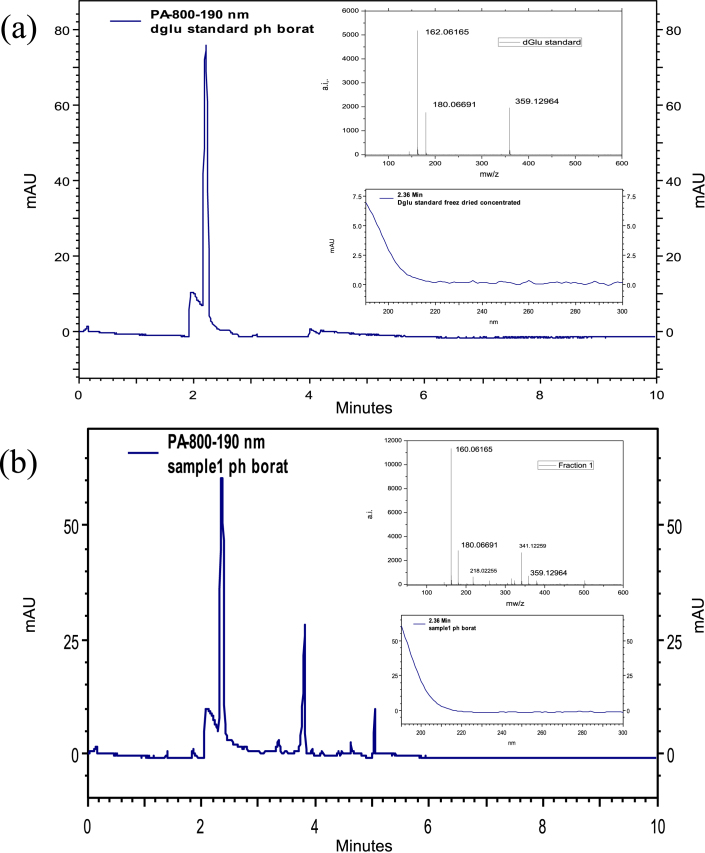
HPCE chromatograms as well as ESI-MS results give unambiguous evidence that D-glucosamine is present in the investigated samples (b) when compared with results from a chitin standard (a).
References
-
- Stankiewicz B. A., Briggs D. E. G., Evershed R. P., Flannery M. B. & Wuttke M. Preservation of chitin in 25-millionyear old fossils. Science 276, 1541–1543, 10.1126/science.276.5318.1541 (1997).
-
- Harvey T. H. P., Ortega−Hernández J., Lin J.-P., Zhao Y. & Butterfield N. J. Burgess Shale−type microfossils from the middle Cambrian Kaili Formation, Guizhou Province, China. Acta Palaeontologica Polonica 57, 423–436 (2012).
-
- Redecker D., Robin Kodner R. & Graham L. E. Glomalean Fungi from the Ordovician. Science 289, 1920–1921 (2009). - PubMed
-
- Cody G. D. et al. Molecular signature of chitin-protein complex in Paleozoic arthropods. Geology 39, 255–258, 10.1130/G31648.1 (2011).
Publication types
MeSH terms
Substances
LinkOut - more resources
Full Text Sources
Other Literature Sources
Molecular Biology Databases
