


Metabolic rates of ATP transfer through creatine kinase (CK Flux) predict clinical heart failure events and death
- PMID: 24337482
- PMCID: PMC4440545
- DOI: 10.1126/scitranslmed.3007328
Metabolic rates of ATP transfer through creatine kinase (CK Flux) predict clinical heart failure events and death
Abstract
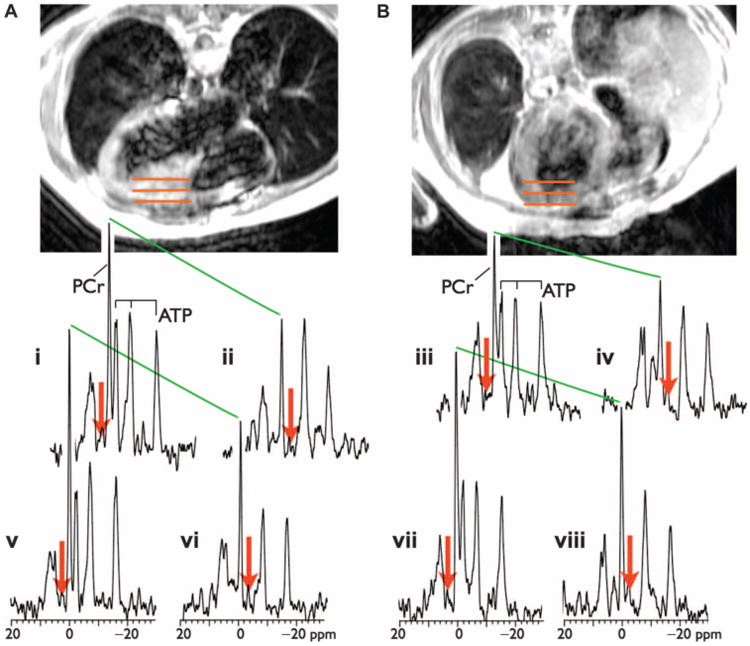
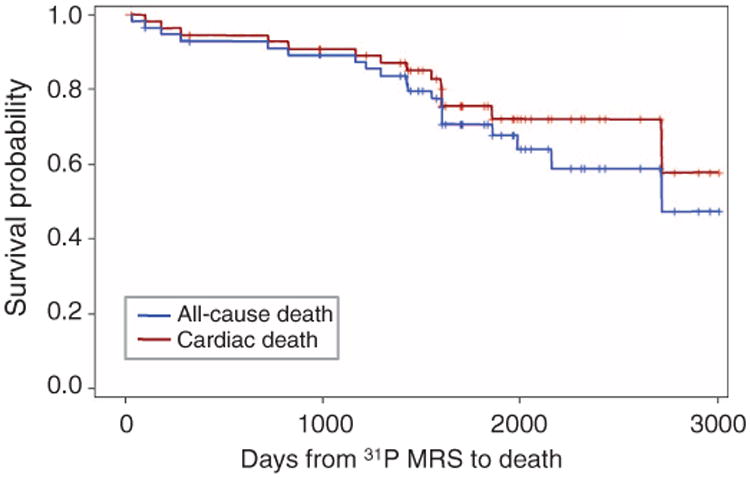
Morbidity and mortality from heart failure (HF) are high, and current risk stratification approaches for predicting HF progression are imperfect. Adenosine triphosphate (ATP) is required for normal cardiac contraction, and abnormalities in creatine kinase (CK) energy metabolism, the primary myocardial energy reserve reaction, have been observed in experimental and clinical HF. However, the prognostic value of abnormalities in ATP production rates through CK in human HF has not been investigated. Fifty-eight HF patients with nonischemic cardiomyopathy underwent ³¹P magnetic resonance spectroscopy (MRS) to quantify cardiac high-energy phosphates and the rate of ATP synthesis through CK (CK flux) and were prospectively followed for a median of 4.7 years. Multiple-event analysis (MEA) was performed for HF-related events including all-cause and cardiac death, HF hospitalization, cardiac transplantation, and ventricular-assist device placement. Among baseline demographic, clinical, and metabolic parameters, MEA identified four independent predictors of HF events: New York Heart Association (NYHA) class, left ventricular ejection fraction (LVEF), African-American race, and CK flux. Reduced myocardial CK flux was a significant predictor of HF outcomes, even after correction for NYHA class, LVEF, and race. For each increase in CK flux of 1 μmol g⁻¹ s⁻¹, risk of HF-related composite outcomes decreased by 32 to 39%. These findings suggest that reduced CK flux may be a potential HF treatment target. Newer imaging strategies, including noninvasive ³¹P MRS that detect altered ATP kinetics, could thus complement risk stratification in HF and add value in conditions involving other tissues with high energy demands, including skeletal muscle and brain.
Figures
Comment in
-
Metabolic flux as a predictor of heart failure prognosis.Circ Res. 2014 Apr 11;114(8):1228-30. doi: 10.1161/CIRCRESAHA.114.303551. Circ Res. 2014. PMID: 24723654 Free PMC article.
References
-
- Writing Group Members; Lloyd-Jones D, Adams RJ, Brown TM, Carnethon M, Dai S, De Simone G, Ferguson TB, Ford E, Furie K, Gillespie C, Go A, Greenlund K, Haase N, Hailpern S, Ho PM, Howard V, Kissela B, Kittner S, Lackland D, Lisabeth L, Marelli A, Mc Dermott MM, Meigs J, Mozaffarian D, Mussolino M, Nichol G, Roger VL, Rosamond W, Sacco R, Sorlie P, Thom T, Wasserthiel-Smoller S, Wong ND, Wylie-Rosett J American Heart Association Statistics Committee and Stroke Statistics Subcommittee. Heart disease and stroke statistics—2010 update: A report from the American Heart Association. Circulation. 2010;121:e46–e215. - PubMed
-
- Ingwall JS. Is cardiac failure a consequence of decreased energy reserve? Circulation. 1993;87:VII-58–VII-62.
-
- Katz AM. Is the failing heart energy depleted? Cardiol Clin. 1998;16:633–644. - PubMed
-
- Ingwall JS, Kramer MF, Fifer MA, Lorell BH, Shemin R, Grossman W, Allen PD. The creatine kinase system in normal and diseased human myocardium. N Engl J Med. 1985;313:1050–1054. - PubMed
-
- Wallimann T, Dolder M, Schlattner U, Eder M, Hornemann T, O'Gorman EO, Rück AR, Brdiczka D. Some new aspects of creatine kinase (CK): Compartmentation, structure, function and regulation for cellular and mitochondrial bioenergetics and physiology. Biofactors. 1998;8:229–234. - PubMed
Publication types
MeSH terms
Substances
Grants and funding
LinkOut - more resources
Full Text Sources
Other Literature Sources
Medical
Research Materials
Miscellaneous
