


The influence of genetic ancestry and ethnicity on breast cancer survival associated with genetic variation in the TGF-β-signaling pathway: The Breast Cancer Health Disparities Study
- PMID: 24337772
- PMCID: PMC3946243
- DOI: 10.1007/s10552-013-0331-9
The influence of genetic ancestry and ethnicity on breast cancer survival associated with genetic variation in the TGF-β-signaling pathway: The Breast Cancer Health Disparities Study
Abstract
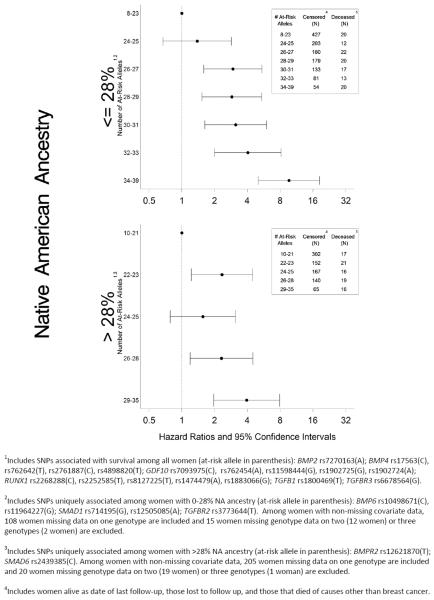
The TGF-β signaling pathway regulates cellular proliferation and differentiation. We evaluated genetic variation in this pathway, its association with breast cancer survival, and survival differences by genetic ancestry and self-reported ethnicity. The Breast Cancer Health Disparities Study includes participants from the 4-Corners Breast Cancer Study (n = 1,391 cases) and the San Francisco Bay Area Breast Cancer Study (n = 946 cases) who have been followed for survival. We evaluated 28 genes in the TGF-β signaling pathway using a tagSNP approach. Adaptive rank truncated product (ARTP) was used to test the gene and pathway significance by Native American (NA) ancestry and by self-reported ethnicity (non-Hispanic white (NHW) and Hispanic/NA). Genetic variation in the TGF-β signaling pathway was associated with overall breast cancer survival (P ARTP = 0.05), especially for women with low NA ancestry (P ARTP = 0.007) and NHW women (P ARTP = 0.006). BMP2, BMP4, RUNX1, and TGFBR3 were significantly associated with breast cancer survival overall (P ARTP = 0.04, 0.02, 0.002, and 0.04, respectively). Among women with low NA, ancestry associations were as follows: BMP4 (P ARTP = 0.007), BMP6 (P ARTP = 0.001), GDF10 (P ARTP = 0.05), RUNX1 (P ARTP = 0.002), SMAD1 (P ARTP = 0.05), and TGFBR2 (P ARTP = 0.02). A polygenic risk model showed that women with low NA ancestry and high numbers of at-risk alleles had twice the risk of dying from breast cancer as did women with high NA ancestry. Our data suggest that genetic variation in the TGF-β signaling pathway influences breast cancer survival. Associations were similar when the analyses were stratified by genetic ancestry or by self-reported ethnicity.
Figures

References
-
- Gordon KJ, Blobe GC. Role of transforming growth factor-beta superfamily signaling pathways in human disease. Biochim Biophys Acta. 2008;1782(4):197–228. - PubMed
-
- Wharton K, Derynck R. TGFbeta family signaling: novel insights in development and disease. Development. 2009;136(22):3691–3697. - PubMed
-
- Buck MB, Knabbe C. TGF-beta signaling in breast cancer. Annals of the New York Academy of Sciences. 2006;1089:119–126. - PubMed
-
- Blyth K, Cameron ER, Neil JC. The RUNX genes: gain or loss of function in cancer. Nat Rev Cancer. 2005;5(5):376–387. - PubMed
-
- Lee KS, Hong SH, Bae SC. Both the Smad and p38 MAPK pathways play a crucial role in Runx2 expression following induction by transforming growth factor-beta and bone morphogenetic protein. Oncogene. 2002;21(47):7156–7163. - PubMed
Publication types
MeSH terms
Substances
Grants and funding
- CA77305/CA/NCI NIH HHS/United States
- CA078682/CA/NCI NIH HHS/United States
- R01 CA078552/CA/NCI NIH HHS/United States
- HHSN261201000036C/CA/NCI NIH HHS/United States
- R01 CA078762/CA/NCI NIH HHS/United States
- 1U58 DP000807-01/DP/NCCDPHP CDC HHS/United States
- R01 CA140002/CA/NCI NIH HHS/United States
- R01 CA063446/CA/NCI NIH HHS/United States
- CA078552/CA/NCI NIH HHS/United States
- N01-PC-67000/PC/NCI NIH HHS/United States
- CA078802/CA/NCI NIH HHS/United States
- U58 DP000807/DP/NCCDPHP CDC HHS/United States
- R01 CA078802/CA/NCI NIH HHS/United States
- R01 CA078682/CA/NCI NIH HHS/United States
- CA14002/CA/NCI NIH HHS/United States
- CA078762/CA/NCI NIH HHS/United States
LinkOut - more resources
Full Text Sources
Other Literature Sources
Medical
