


Wound drainage for caesarean section
- PMID: 24338262
- PMCID: PMC12206554
- DOI: 10.1002/14651858.CD004549.pub3
Wound drainage for caesarean section
Abstract
Background: Subcutaneous and sub rectus sheath wound drains are sometimes used in women who have undergone caesarean section. The indications for using drains vary by clinician.
Objectives: To compare the effects of using a wound drain with not using a wound drain at caesarean section, and of different types of drain, on maternal health and healthcare resource use.
Search methods: In November 2013, for this second update, we searched the Cochrane Wounds Group Specialised Register; The Cochrane Central Register of Controlled Trials (CENTRAL) (The Cochrane Library); Ovid Medline; Ovid Medline - In-Process & Other Non-Indexed Citations; Ovid Embase; and EBSCO CINAHL. No date, language or publication status limits were applied
Selection criteria: Studies were included if they allocated women to groups at random and they compared any type of wound drain with no wound drainage, or with any other type of drain, in women undergoing caesarean section.
Data collection and analysis: Trials were evaluated for appropriateness for inclusion and methodological quality without consideration of their results. This was done by two reviewers according to pre-stated eligibility criteria.
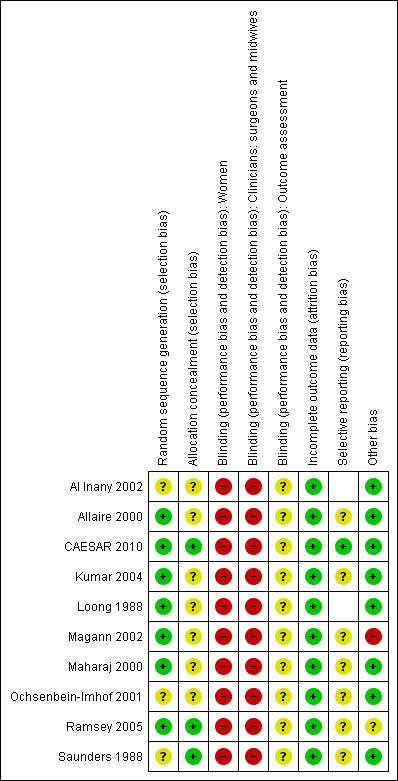
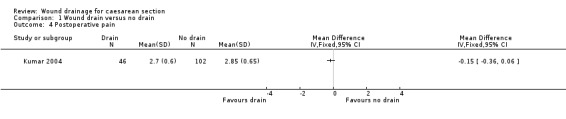
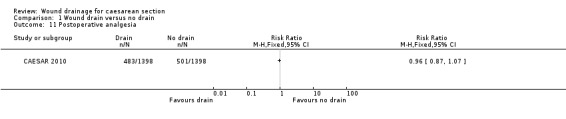
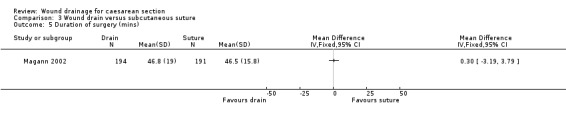
Main results: Ten trials that recruited 5248 women were included in the review. Meta-analysis found no evidence of a difference in the risk of wound infection, other wound complications, febrile morbidity or pain in women who had wound drains compared with those who did not. There was some evidence from one trial that a subcutaneous drain may increase wound infection compared to a sub-sheath drain (RR 5.42, 95% CI 1.28 to 22.98). No differences in outcomes were found between subcutaneous drainage and subcutaneous suturing in the three trials that made this comparison.
Authors' conclusions: Existing evidence suggests that the routine use of wound drains at caesarean section does not confer any substantial benefit to the women involved. However, neither moderate benefit nor harm are excluded.
Conflict of interest statement
Both review authors were involved in the conduct of the CAESAR trial, which is included in this review, while they were employed at the National Perinatal Epidemiology Unit, University of Oxford, UK. Neither of the authors was involved in the analysis or reporting of this trial.
Figures









Update of
-
Wound drainage for caesarean section.Cochrane Database Syst Rev. 2005 Jan 25;(1):CD004549. doi: 10.1002/14651858.CD004549.pub2. Cochrane Database Syst Rev. 2005. Update in: Cochrane Database Syst Rev. 2013 Dec 13;(12):CD004549. doi: 10.1002/14651858.CD004549.pub3. PMID: 15674952 Updated.
References
References to studies included in this review
Al Inany 2002 {published data only}
-
- Al Inany H, Youssef G, Maguid AA, Hamid MA, Naguib A. Value of subcutaneous drainage system in obese females undergoing cesarean section using Pfannenstiel incision. Gynecologic and Obstetric Investigation 2002;53(2):75‐8. - PubMed
Allaire 2000 {published data only}
-
- Allaire A, Fisch J, McMahon M. A prospective randomized trial of subcutaneous drain versus subcutaneous suture in obese women undergoing cesarean section. American Journal of Obstetrics and Gynecology 1998;178(1 (Pt 2)):S78.
-
- Allaire AD, Fisch J, McMahon MJ. Subcutaneous drain vs. suture in obese women undergoing cesarean delivery: A prospective, randomized trial. Journal of Reproductive Medicine 2000;45(4):327‐31. - PubMed
CAESAR 2010 {published data only}
-
- CAESAR study collaborative group. Caesarean section surgical techniques: a randomised factorial trial (CAESAR). BJOG 2010;117(11):1366‐76. - PubMed
Kumar 2004 {published data only}
-
- Kumar SA. Subcutaneous drain versus subcutaneous stitch closure to prevent wound disruption after cesarean section. Journal of Obstetrics and Gynecology of India 2004;54(3):237‐42.
Loong 1988 {published data only}
-
- Loong R, Rogers M, Chang A. A controlled trial on wound drainage in Caesarean section. Australian and New Zealand Journal of Obstetrics and Gynaecology 1988;28(4):266‐9. - PubMed
Magann 2002 {published data only}
-
- Magann E, Chauhan S, Rodts Palenik S, Bufkin L, Martin JN Jr, et al. Subcutaneous stitch closure versus subcutaneous drain to prevent wound disruption after cesarean delivery: A randomized clinical trial. American Journal of Obstetrics and Gynecology 2002;186(6):1119‐23. - PubMed
Maharaj 2000 {published data only}
-
- Maharaj D, Bagratee JS, Moodley J. Drainage at caesarean section ‐ A randomised prospective study. South African Journal of Surgery 2000;38(1):9‐12. - PubMed
Ochsenbein‐Imhof 2001 {published data only}
-
- Imhof N, Hebisch G, Huch A, Huch R, Zimmerman R. Use of drainage vs no drain for caesarean section. Gynäkologisch‐geburtshilfliche Rundschau 1999;39:164.
-
- Ochsenbein‐Imhof N, Huch A, Huch R, Zimmermann R. No benefit from post‐caesarean wound drainage. Swiss Medical Weekly 2001;131(17‐18):248‐50. - PubMed
Ramsey 2005 {published data only}
-
- Ramsey PS, White AM, Duinn DA, Lu GC, Ramin SM, Davies JK, et al. Subcutaneous tissue re approximation, alone or in combination with drain, in obese women undergoing cesarean delivery. Obstetrics and Gynecology 2005;105(5 Part 1):967‐73. - PubMed
Saunders 1988 {published data only}
-
- Saunders NJ, Barclay C. Closed suction wound drainage and lower‐segment caesarean section. British Journal of Obstetrics and Gynaecology 1988;95(10):1060‐2. - PubMed
References to studies excluded from this review
Bose 2006 {published data only}
-
- Bose M, Pannigrahi R, Mohapatra K, Patel O, Sahoo LN. Subcutaneous drain versus subcutaneous stitch closure to reduce postoperative morbidity following cesarean section [abstract]. 49th All India Congress of Obstetrics and Gynaecology; Jan 6‐9 2006; Cochin, Kerala, India. 2006.
Additional references
Deeks 2001
-
- Deeks JJ, Altman DG, Bradburn MJ. Statistical methods for examining heterogeneity and combining results from several studies in meta‐analysis. In: Egger M, Davey Smith G, Altman DG editor(s). Systematic reviews in health care: meta‐analysis in context. London: BMJ Books, 2001.
Enkin 1995
-
- Enkin MW. Closed suction wound drainage at caesarean section. Cochrane Database of Systematic Reviews 1995, Issue Disk Issue 2.
Higgins 2002
-
- Higgins J, Thompson SG. Quantifying heterogeneity in a meta‐analysis. Statistics in Medicine 2002;21(11):1539‐58. - PubMed
Higgins 2009b
Higgins 2011a
-
- Higgins JPT and Altman DG on behalf of the Cochrane Statistical Methods Group and the Cochrane Bias Methods Group (Editors). Chapter 8: Assessing risk of bias in included studies. In: Higgins JPT, Green S (editors). Cochrane Handbook for Systematic Reviews of Interventions Version 5.1.0 [updated March 2011]. The Cochrane Collaboration, 2011. Available from www.cochrane‐handbook.org.
Hofmeyr 2008
Lefebvre 2011
-
- Lefebvre C, Manheimer E, Glanville J, on behalf of the Cochrane Information Retrieval Methods Group. Chapter 6: Searching for studies. In: Higgins JPT, Green S (editors). Cochrane Handbook for Systematic Reviews of Interventions Version 5.1.0 [updated March 2011]. The Cochrane Collaboration, 2011. Available from www.cochrane‐handbook.org.
SIGN 2009
-
- Scottish Intercollegiate Guidelines Network (SIGN). Search filters. http://www.sign.ac.uk/methodology/filters.html#random (accessed 9 June 2009).
Tully 2002
-
- Tully L, Gates S, Brocklehurst P, McKenzie‐McHarg K, Ayers S. Surgical techniques used during caesarean section operations: results of a national survey of practice in the UK. European Journal of Obstetrics & Gynecology and Reproductive Biology 2002;102(2):120‐6. - PubMed
Publication types
MeSH terms
Grants and funding
LinkOut - more resources
Full Text Sources
Other Literature Sources
Medical
