. 2014 Jun 1;209(11):1764-72.
doi: 10.1093/infdis/jit817. Epub 2013 Dec 13.

IsdB-dependent hemoglobin binding is required for acquisition of heme by Staphylococcus aureus

Affiliations

IsdB-dependent hemoglobin binding is required for acquisition of heme by Staphylococcus aureus

Gleb Pishchany et al. J Infect Dis. .

Abstract

Staphylococcus aureus is a Gram-positive pathogen responsible for tremendous morbidity and mortality. As with most bacteria, S. aureus requires iron to cause disease, and it can acquire iron from host hemoglobin. The current model for staphylococcal hemoglobin-iron acquisition proposes that S. aureus binds hemoglobin through the surface-exposed hemoglobin receptor IsdB. IsdB removes heme from bound hemoglobin and transfers this cofactor to other proteins of the Isd system, which import and degrade heme to release iron in the cytoplasm. Here we demonstrate that the individual components of the Isd system are required for growth on low nanomolar concentrations of hemoglobin as a sole source of iron. An in-depth study of hemoglobin binding by IsdB revealed key residues that are required for hemoglobin binding. Further, we show that these residues are necessary for heme extraction from hemoglobin and growth on hemoglobin as a sole iron source. These processes are found to contribute to the pathogenicity of S. aureus in a murine model of infection. Together these results build on the model for Isd-mediated hemoglobin binding and heme-iron acquisition during the pathogenesis of S. aureus infection.

Keywords: Staphylococcus aureus; heme; hemoglobin; infection; iron; iron-regulated surface determinant system; pathogenesis.


Figures
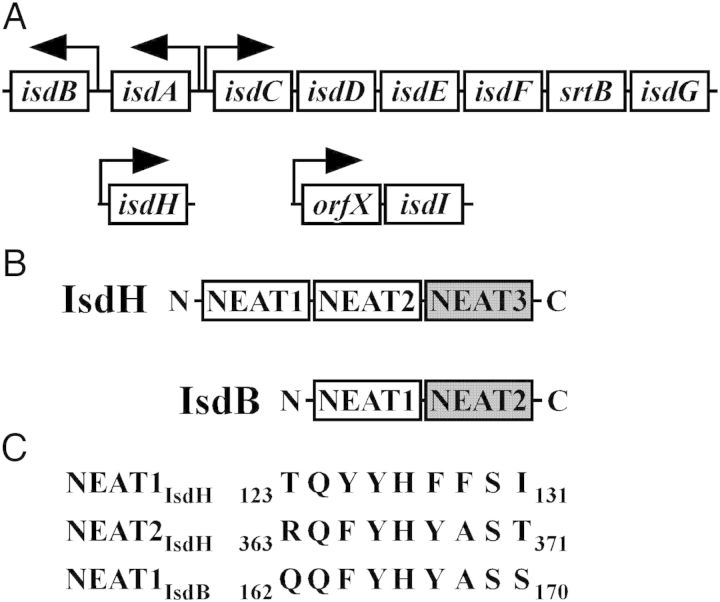
Figure 1.
Figure 1.
S. aureus iron regulated surface determinant system (Isd). (A) Genomic arrangement of the genes encoding the Isd system. Arrows denote promoter regions and the direction of transcription. (B) IsdB and IsdH hemoglobin-binding (white) and heme-binding (grey) NEAT domains. (C) Alignment of the hemoglobin binding motifs from IsdH and IsdB.
Figure 2.
Figure 2.
Hemoglobin-dependent growth of Staphylococcus aureus Newman WT, its isogenic isd mutants, and corresponding complemented strains. Strains were cultured in RPMI chelated with 1 μM EDDHA and 5, 10, 20, or 100 nM of human hemoglobin was supplied as the sole source of iron. Culture densities were assessed at 12, 24, and 36 h by determining OD600. Data shown are representative of at least 3 experiments, where samples were performed in quintuplicate and error bars represent standard error of the mean. Statistical analysis was performed using a 2-way analysis of variance coupled with Bonferroni post hoc tests where the wild type was set as the comparator; a, P < .001; b, P < .01, and c, P < .05.
Figure 3.
Figure 3.
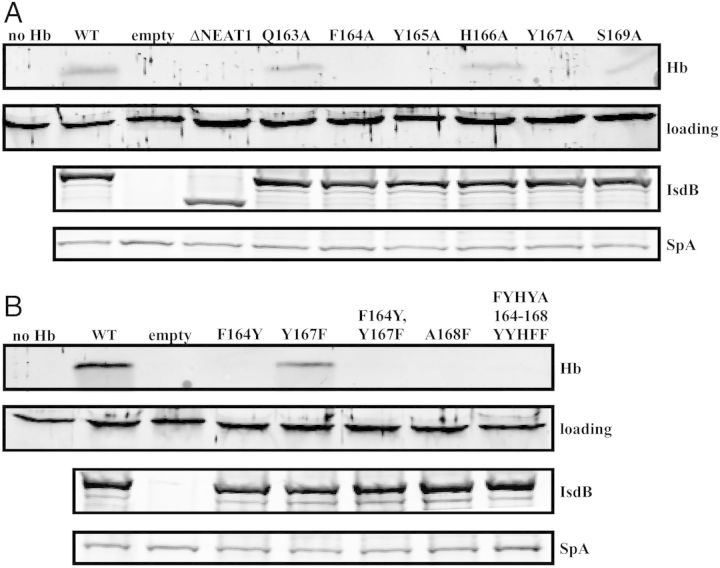
Identification of residues within NEAT1IsdB required for hemoglobin binding to Staphylococcus aureus. A, Hemoglobin bound by S. aureus IsdB mutants containing alanine substitutions of individual residues of the hemoglobin-binding motif. B, Hemoglobin bound by S. aureus IsdB mutants containing a chimeric IsdB/IsdH hemoglobin-binding motif. For both (A) and (B), IsdB was expressed in S. aureus ΔisdB from pOS1 under iron-limiting conditions. S. aureus was incubated with 15 nM hemoglobin and washed to remove unbound hemoglobin. Cell wall-associated proteins were eluted and analyzed by SDS-PAGE. Bound hemoglobin was detected by immunoblotting (top panel). Equal loading of the hemoglobin-containing samples was controlled with a cross-reactive protein (second panel). To detect IsdB the cell wall proteins were liberated through cell wall digestion, resolved with SDS-PAGE, and immunoblotted (third panel). The bottom panel depicts protein A (Spa), which nonspecifically binds antibodies and is a loading control for cell wall proteins.
Figure 4.
Figure 4.
IsdB polymorphisms across Staphylococcus aureus strains. A, Hotspots of polymorphisms in the isdB gene as revealed by the analysis of 3,277 S. aureus strains from the NCBI SRA database compared to N315 reference genome. B, Frequency distribution of all the SNPs across 3,277 strains. The horizontal blue line above the x-axis indicates 645-amino acids long IsdB protein, vertical lines being the polymorphic positions shown in Figure 4A. The NEATIsdB region (aa 162-170) is indicated. Abbreviation: SNP, single-nucleotide polymorphism.
Figure 5.
Figure 5.
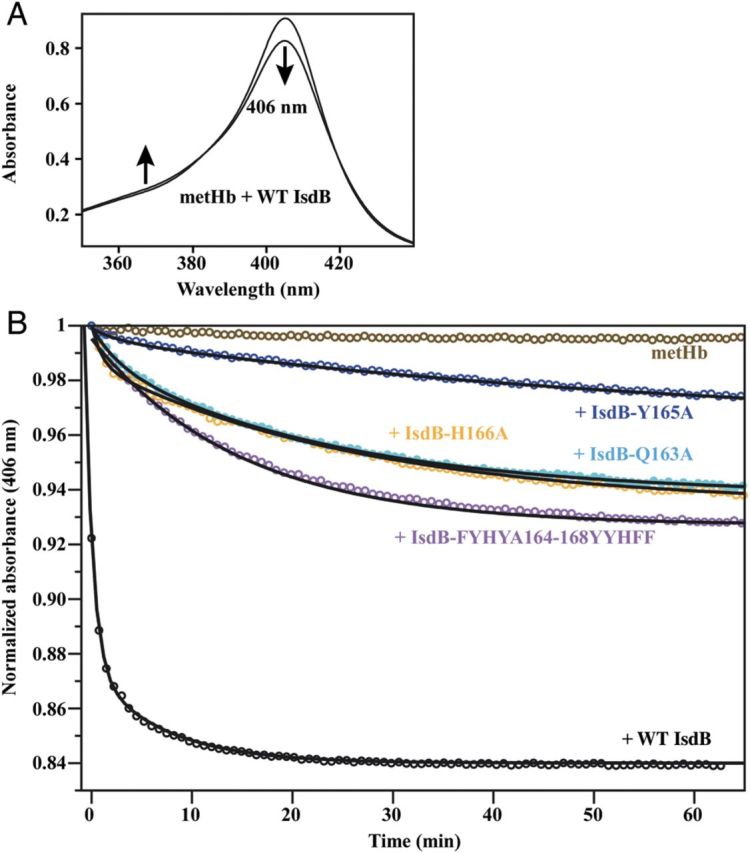
Effect of mutations in the hemoglobin-binding motif of NEAT1IsdB on heme extraction from hemoglobin. A, A change in the UV-visible absorption spectrum of rIsdB-hemoglobin mixtures indicates heme transfer to rIsdB. B, Spectral change at 406 nm was monitored for mixtures of hemoglobin with rIsdB.
Figure 6.
Figure 6.
isdBY165A pathogenicity in a systemic murine model of infection. Seven week-old female αHβA mice were retro-orbitally infected with approximately 1 × 10⁷ CFUs of Staphylococcus aureus. Ninety-six hours postinoculation the mice were killed. The number of CFUs in (A) kidneys, (B) heart, and (C) liver was quantified by serial dilutions followed by plating on growth media. D, Weight loss was quantified by weighing the mice before inoculation and after death. Error bars denote standard deviation. Asterisks indicate statistically significant differences as determined by Student t test (P ≤ .05). Abbreviation: CFU, colony-forming unit.

References

    1. Mazmanian SK, Skaar EP, Gaspar AH, et al. Passage of heme-iron across the envelope of Staphylococcus aureus. Science. 2003;299:906–9. - PubMed
    1. Mazmanian SK, Ton-That H, Su K, Schneewind O. An iron-regulated sortase anchors a class of surface protein during Staphylococcus aureus pathogenesis. Proc Natl Acad Sci U S A. 2002;99:2293–8. - PMC - PubMed
    1. Pishchany G, Dickey SE, Skaar EP. Subcellular localization of the Staphylococcus aureus heme iron transport components IsdA and IsdB. Infect Immun. 2009;77:2624–34. - PMC - PubMed
    1. Torres VJ, Pishchany G, Humayun M, Schneewind O, Skaar EP. Staphylococcus aureus IsdB is a hemoglobin receptor required for heme iron utilization. J Bacteriol. 2006;188:8421–9. - PMC - PubMed
    1. Muryoi N, Tiedemann MT, Pluym M, Cheung J, Heinrichs DE, Stillman MJ. Demonstration of the iron-regulated surface determinant (Isd) heme transfer pathway in Staphylococcus aureus. J Biol Chem. 2008;283:28125–36. - PMC - PubMed

Publication types

MeSH terms