


Racial variation in the quality of surgical care for bladder cancer
- PMID: 24339051
- PMCID: PMC3961490
- DOI: 10.1002/cncr.28520
Racial variation in the quality of surgical care for bladder cancer
Abstract
Background: Differences in quality of care may contribute to racial variation in outcomes of bladder cancer (BCa). Quality indicators in patients undergoing surgery for BCa include the use of high-volume surgeons and high-volume hospitals, and, when clinically indicated, receipt of pelvic lymphadenectomy, receipt of continent urinary diversion, and undergoing radical cystectomy instead of partial cystectomy. The authors compared these quality indicators as well as adverse perioperative outcomes in black patients and white patients with BCa.
Methods: The Healthcare Cost and Utilization Project State Inpatient Databases for New York, Florida, and Maryland (1996-2009) were used, because they consistently included race, surgeon, and hospital identifiers. Quality indicators were compared across racial groups using regression models adjusting for age, sex, Elixhauser comorbidity sum, insurance, state, and year of surgery, accounting for clustering within hospital.
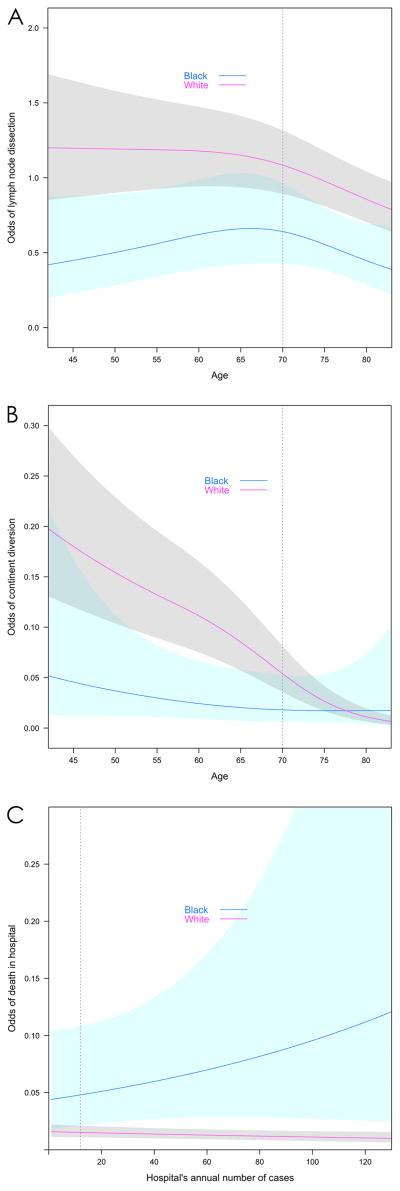
Results: Black patients were treated more often by lower volume surgeons and hospitals, they had significantly lower receipt of pelvic lymphadenectomy and continent diversion, and they experienced higher rates of adverse outcomes compared with white patients. These associations remained significant for black patients who received treatment from surgeons and at hospitals in the top volume decile.
Conclusions: Black patients with BCa had lower use of experienced providers and institutions for BCa surgery. In addition, the quality of care for black patients was lower than that for whites even if they received treatment in a high-volume setting. This gap in quality of care requires further investigation.
Keywords: bladder cancer; health disparities; quality of care; surgery.
© 2013 American Cancer Society.
Conflict of interest statement
Figures
Comment in
-
Commentary on "Racial variation in the quality of surgical care for bladder cancer." Barocas DA, Alvarez J, Koyama T, Anderson CB, Gray DT, Fowke JH, You C, Chang SS, Cookson MS, Smith JA Jr, Penson DF, Department of Urologic Surgery, Vanderbilt University, Nashville, Tennessee; Center for Surgical Quality and Outcomes Research, Vanderbilt University, Nashville, Tennessee.: Cancer. 2014 Apr 1;120(7):1018-25. doi:10.1002/cncr.28520. [Epub 2013 Dec 11].Urol Oncol. 2016 May;34(5):251-2. doi: 10.1016/j.urolonc.2015.02.018. Epub 2015 Jun 20. Urol Oncol. 2016. PMID: 26100328
References
-
- Riesl . Cancer of the Urinary Bladder - SEER Survival Monograph. 2007. pp. 1–12.
-
- Mallin K, David KA, Carroll PR, Milowsky MI, Nanus DM. Transitional cell carcinoma of the bladder: racial and gender disparities in survival (1993 to 2002), stage and grade (1993 to 2007) J Urol. 2011;185:1631–1636. - PubMed
-
- Jacobs BL, Montgomery JS, Zhang Y, Skolarus TA, Weizer AZ, Hollenbeck BK. Disparities in bladder cancer. Urol Oncol. 2012;30:81–88. - PubMed
-
- Herr HW, Faulkner JR, Grossman HB, et al. Surgical factors influence bladder cancer outcomes: a cooperative group report. J Clin Oncol. 2004;22:2781–2789. - PubMed
Publication types
MeSH terms
Grants and funding
LinkOut - more resources
Full Text Sources
Other Literature Sources
Medical
Miscellaneous
