


Diabetic retinopathy and its risk factors at the university hospital in Jamaica
- PMID: 24339682
- PMCID: PMC3841950
- DOI: 10.4103/0974-9233.120017
Diabetic retinopathy and its risk factors at the university hospital in Jamaica
Abstract
Purpose: To determine the frequency of diabetic retinopathy and its risk factors in diabetic patients attending the eye clinic at the University Hospital of the West Indies (UHWI).
Materials and methods: This was a prospective cohort study of diabetic outpatients attending the Eye Clinic at the UHWI. Data were collected on age, gender, type of diabetes mellitus (DM), type of diabetic retinopathy, other ocular diseases, visual acuity, blood glucose and blood pressure.
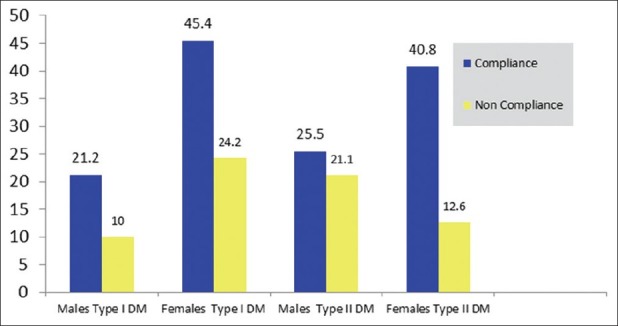
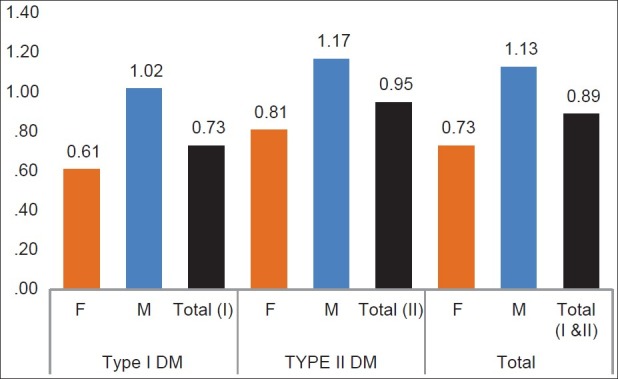
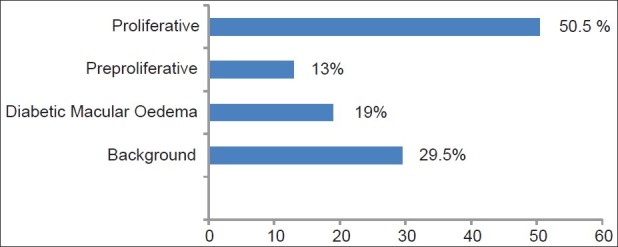
Results: There were 104 patients (208 eyes) recruited for this study. There were 58.6% (61/104) females (mean age 53.6 ± 11.9 years) and 41.4% (43/104) males (mean age 61.7 ± 12.1 years). Type II DM was present in 68.3% (56% were females) of the patients and Type I DM was present in 31.7% (69.7% were females). Most patients (66%) were compliant with their diabetic medications. The mean blood glucose was 11.4 ± 5.3 mmol/L. Elevated blood pressure (<130/80) was present in 82.7% of patients. The mean visual acuity was 20/160 (logMAR 0.95 ± 1.1). The frequency of diabetic retinopathy was 78%; 29.5% had background retinopathy, and 50.5% of eyes had proliferative diabetic retinopathy (PDR) of which 34% had tractional retinal detachments. The odds ratio of developing PDR was 1.88 (95% confidence intervals (CI): 1.02-3.3) for Type I DM compared to 0.74 (95% CI: 0.55-0.99) for Type II DM. PDR was more prevalent in females (χ(2), P = 0.009) in both Type I and II DM.
Conclusions: Jamaica has a high frequency of PDR which is more common in Type I diabetics and females. This was associated with poor glucose and blood pressure control.
Keywords: Compliance; Diabetic Control; Diabetic Retinopathy; Hypertension; Jamaica.
Conflict of interest statement
Figures
References
-
- Bloomgarden ZT. Diabetic retinopathy. Diabetes Care. 2008;31:1080–3. - PubMed
-
- King H, Aubert RE, Herman WH. Global burden of diabetes, 1995-2005: Prevalence, numerical estimates, and projections. Diabetes Care. 1998;21:1414–31. - PubMed
-
- Government of Jamaica. Statistics: Demography: Population. 2012. [Last accessed 2012 Dec 14]. Available from: http://statinja.gov.jm/Demo_SocialStats/population.aspx .
-
- Barcelo A, Rajpathak S. Incidence and prevalence of diabetes mellitus in the America. Rev Panam Salud Publica. 2001;10:300–8. - PubMed
-
- Wint YB, Duff EM, McFarlane-Anderson N, O’Connor A, Bailey EY, Wright-Pascoe RA. Knowledge, motivation and barriers to Diabetic control in Adults in Jamaica. West Indian Med J. 2006;55:330–3. - PubMed
MeSH terms
Substances
LinkOut - more resources
Full Text Sources
Other Literature Sources
Medical
