


Pregnant mothers with resolved anxiety disorders and their offspring have reduced heart rate variability: implications for the health of children
- PMID: 24340091
- PMCID: PMC3858358
- DOI: 10.1371/journal.pone.0083186
Pregnant mothers with resolved anxiety disorders and their offspring have reduced heart rate variability: implications for the health of children
Abstract
Objective: Active anxiety disorders have lasting detrimental effects on pregnant mothers and their offspring but it is unknown if historical, non-active, maternal anxiety disorders have similar effects. Anxiety-related conditions, such as reduced autonomic cardiac control, indicated by reduced heart rate variability (HRV) could persist despite disorder resolution, with long-term health implications for mothers and children. The objective in this study is to test the hypotheses that pregnant mothers with a history of, but not current anxiety and their children have low HRV, predicting anxiety-like offspring temperaments.
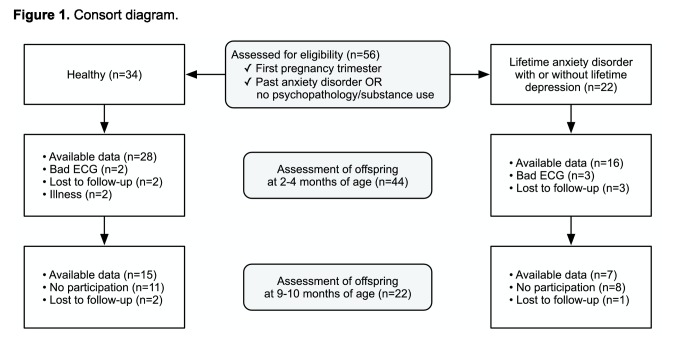
Methods: The participants in this case-control study consist of 56 women during their first trimester and their offspring (15 male, 29 female). Women had a history of an anxiety disorder (n=22) or no psychopathology (n=34) determined using the Mini-International Neuropsychiatric Interview. The main outcome measures were indices of autonomic cardiac control including root mean square of successive differences (RMSSD) and high frequency (HF) variability. Children's fearfulness was also assessed using the Laboratory Temperament Assessment Battery (Lab-TAB)-Locomotor Version.
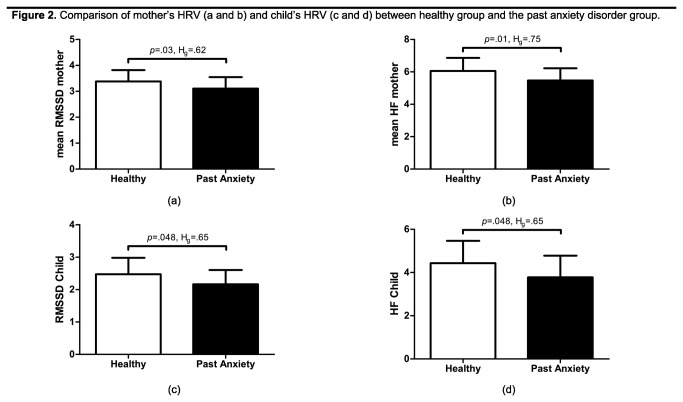
Results: HRV was lower in women and children in the past anxiety group compared to controls. HRV measures for mothers and children were positively correlated in the anxiety group only. In all children, low HRV measures at 2-4 months were associated with a higher chance of fearful behavior at 9-10 months.
Conclusions: Pregnant women with previous but not current anxiety and their children have low HRV. Children with low HRV tend to show more fearfulness. These findings have implications for identifying children at risk of anxiety disorders and point to possible underlying mechanisms of child psychopathology.
Conflict of interest statement
Figures
References
Publication types
MeSH terms
LinkOut - more resources
Full Text Sources
Other Literature Sources
Medical
Research Materials
Miscellaneous
