Salivary biomarkers of physical fatigue as markers of sleep deprivation
- PMID: 24340295
- PMCID: PMC3836344
- DOI: 10.5664/jcsm.3280
Salivary biomarkers of physical fatigue as markers of sleep deprivation
Abstract
Study objective: Determine whether a salivary biomarker of physical fatigue, referred to as the fatigue biomarker index (FBI), can discriminate a control group from a sleep deprived group when saliva is collected under controlled conditions. The study expands on previous work examining changes in the composition of saliva during periods of prolonged exercise.
Methods: Thirty (30) young adults (14 Control [CON]; 16 Sleep Deprived [SDEP]) were monitored for mood state (Profile of Mood States [POMS]), cognitive performance (Stroop Color-Conflict Tests), and salivary biomarkers of physical fatigue over a 48-h period with sampling at 3-h intervals. Trials lasted from 06:00 on day 1 (time = -3 h) to 09:00 on day 3 (time = 48 h). Levels of salivary biomarkers were calculated from liquid chromatography-mass spectrometry (LC-MS) data. Statistical comparisons were made using Wilcoxon rank sum tests with a Bonferroni correction to limit type 1 error. Receiver-operator characteristic (ROC) analysis was used to evaluate the ability of the various parameters to distinguish the SDEP population from the CON population.
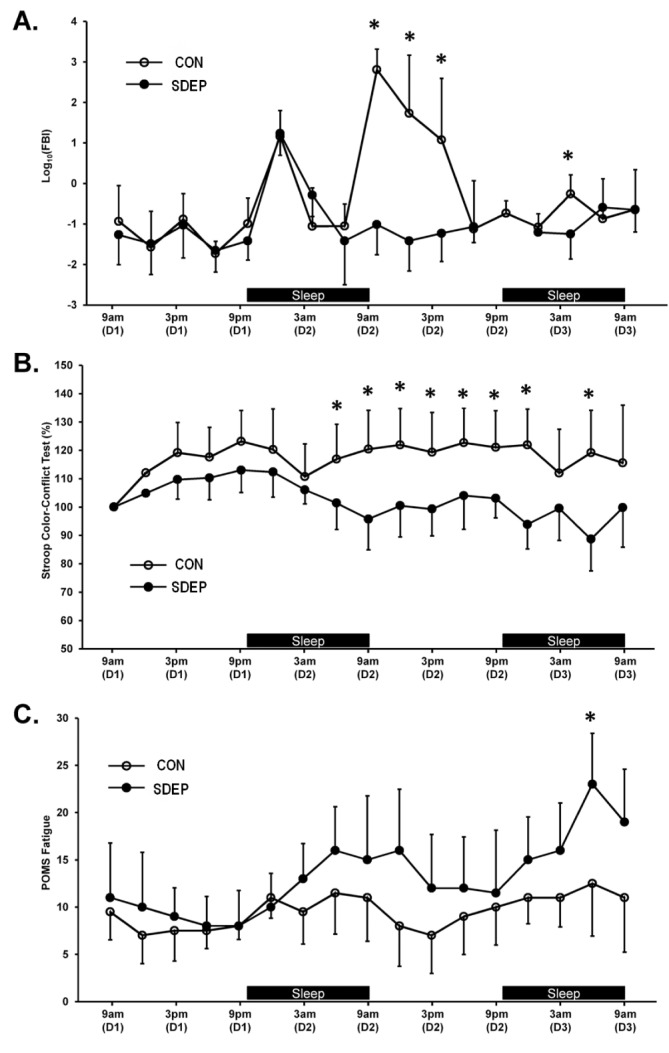
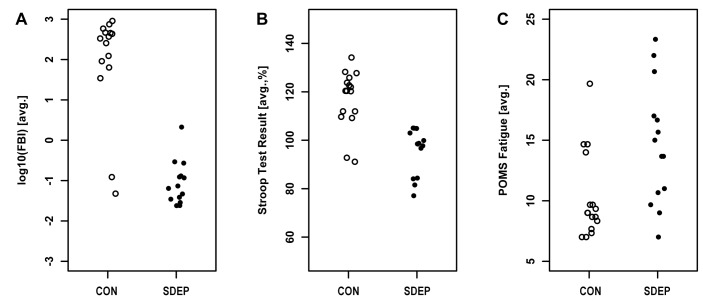
Results: Longitudinal analysis demonstrated significant between-group differences in all three parameters. ROC analysis demonstrated that cognitive performance tests and salivary biomarkers of physical fatigue distinguish the SDEP population from the CON population.
Conclusions: A previously identified salivary biomarker of physical fatigue may provide an alternative method for discriminating sleep deprived from rested individuals. The salivary biomarker of physical fatigue holds promise as an objective measure of sleep deprivation, perhaps eventually removing the reliance on self-reported sleep diaries and/or repeated polysomnographs for longitudinal tracking of sleep quality and/or diagnosis of sleep disorders.
Keywords: Sleep deprivation; analytical chemistry methods; biomarkers; chromatography; fatigue; liquid; mass spectrometry.
Figures
References
-
- American Academy of Sleep Medicine. The international classification of sleep disorders, revised: diagnostic and coding manual. Chicago, IL: American Academy of Sleep Medicine; 2001.
-
- Edinger JD, Bonnet MH, Bootzin RR, et al. Derivation of research diagnostic criteria for insomnia: Report of an American Academy of Sleep Medicine work group. Sleep. 2004;27:1567–96. - PubMed
Publication types
MeSH terms
Substances
LinkOut - more resources
Full Text Sources
Other Literature Sources
Medical