Review
. 2014 Feb;19(2):79-89.
doi: 10.1016/j.tplants.2013.10.009. Epub 2013 Dec 14.

Ancient signals: comparative genomics of green plant CDPKs

Affiliations
Review

Ancient signals: comparative genomics of green plant CDPKs

Louis-Philippe Hamel et al. Trends Plant Sci. 2014 Feb.

Abstract

Calcium-dependent protein kinases (CDPKs) are multifunctional proteins that combine calcium-binding and signaling capabilities within a single gene product. This unique versatility enables multiple plant biological processes to be controlled, including developmental programs and stress responses. The genome of flowering plants typically encodes around 30 CDPK homologs that cluster in four conserved clades. In this review, we take advantage of the recent availability of genome sequences from green algae and early land plants to examine how well the previously described CDPK family from angiosperms compares to the broader evolutionary states associated with early diverging green plant lineages. Our analysis suggests that the current architecture of the CDPK family was shaped during the colonization of the land by plants, whereas CDPKs from ancestor green algae have continued to evolve independently.

Keywords: CDPKs; calcium signaling; evolution; green plant lineages.


Figures

Figure I
Figure I
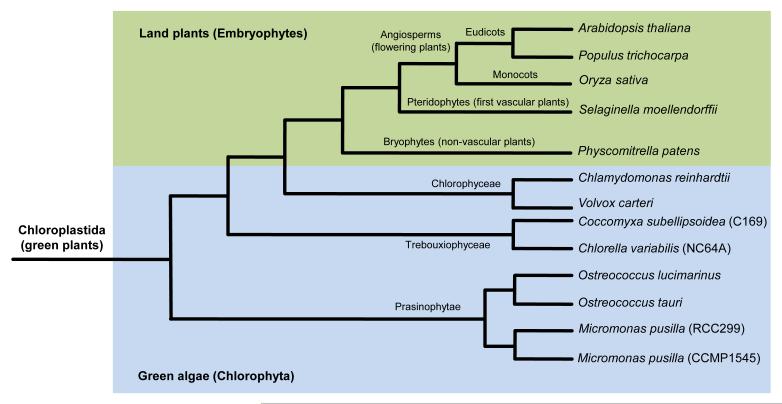
Relationships among green plant lineages used to study the evolution of CDPKs. Histones are among the most highly conserved genes and were therefore used to reflect the evolutionary path of green plant lineages used in this study. The genome assembly of each of the indicated species was searched using the predicted amino acid sequence of the Arabidopsis histone H4 gene (AT1G07660) as a query. Full-length coding sequence (CDS) of histone H4 homologs were next aligned with ClustalW, using the following alignment parameters: for pairwise alignment, gap opening, 10.0, and gap extension, 0.1; for multiple alignment, gap opening, 10.0, and gap extension, 0.20. Resulting alignments were submitted to the MEGA4 software to generate a neighbor-joining tree derived from 5000 replicates. Because the tree only depicts topology among the various taxa, branch size is not proportional to the extent of primary sequence divergence. The blue section comprises species of the Chlorophyta division, a taxonomically diverse group of green algae from which Streptophyta diverged 725 Mya–1200 Mya. Streptophyta includes a number of green algae collectively known as the streptophyte algae (not shown here), as well as embryophytes (also referred to as land plants). The green section comprises various species of land plants that represent some of the most important evolutionary milestones characterizing the evolution of terrestrial plants: colonization of the land by bryophytes; differentiation of vascular tissues in pteridophytes; seeds enclosed in fruits for protection in angiosperms.
Figure 1
Figure 1
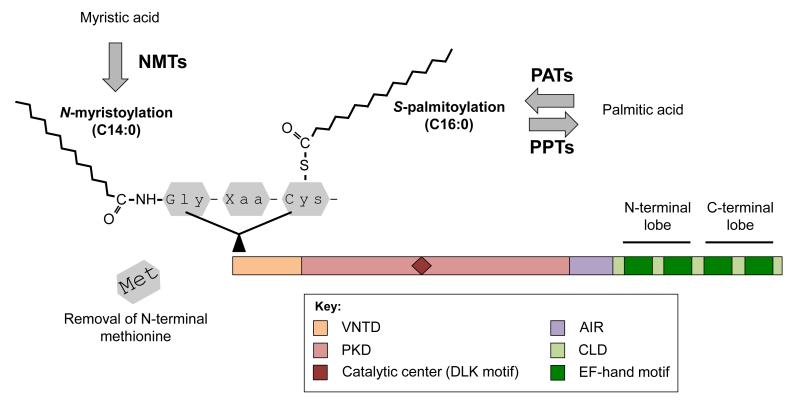
Topology of a prototypical CDPK protein. Schematic view of a prototypical CDPK and organization of its conserved domains (see color-coded legend). The N-terminus of CDPKs is often targeted for N-acylation. N-myristoyl transferases (NMTs) catalyze the covalent attachment of myristic acid (a C14:0 fatty acid) to the N-terminal Gly residue (irreversible N-myristoylation). Stable anchoring to membranes also requires S-palmitoylation, which is performed by palmitoyl acyl transferases (PATs) and palmitoyl protein thioesterases (PPTs). These enzymes catalyze the reversible attachment of palmitic acid (a C16:0 fatty acid) to Cys residues. Abbreviations: AIR, autoinhibitory region; CLD, calmodulin-like domain; PKD, protein kinase domain; VNTD, variable N-terminal domain; Xaa, any amino acid.
Figure 2
Figure 2
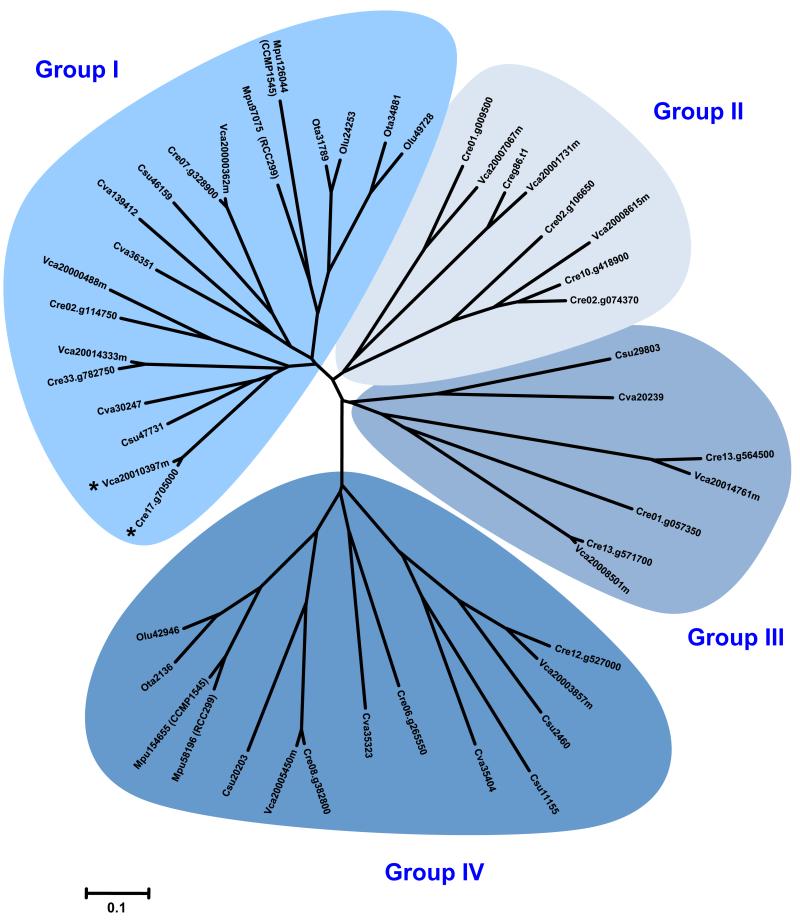
Phylogenetic relationships among green alga CDPKs. The genome assembly of various green algae was searched using the amino acid sequence of Arabidopsis CDPKs as queries. Retrieved gene models were accepted only if the corresponding protein had consensus sequences of the Ser/Thr PKD, including conserved Asp and Lys residues within the active site (D[L/I/V]K motif), and a CLD comprising at least one consensus EF-hand motif. Full-length CDPKs (see supplementary material online) were next aligned with ClustalW, using the following alignment parameters: for pairwise alignment, gap opening, 10.0, and gap extension, 0.1; for multiple alignment, gap opening, 10.0, and gap extension, 0.20. Resulting alignments were submitted to the Molecular Evolutionary Genetics Analysis 4 (MEGA4) software [72] to generate a neighbor-joining tree derived from 5000 replicates. To emphasize the clustering of the various CDPK clades, the unrooted distance tree visualization mode was selected. Branch size is proportional to the extent of primary sequence divergence, with the scale of ‘0.1’ representing a 10% change. The four CDPK clades are highlighted in shades of blue and a species acronym denotes the origin of each protein (Cre, Chlamydomonas reinhardtii; Csu, Coccomyxa subellipsoidea; Cva, Chlorella variabilis; Mpu, Micromonas pusilla; Olu, Ostreococcus lucimarinus; Ota, Ostreococcus tauri; Vca, Volvox carteri.). Asterisks denote unusual CDPK homologs that harbor a C2 domain at the N-terminus.
Figure 3
Figure 3
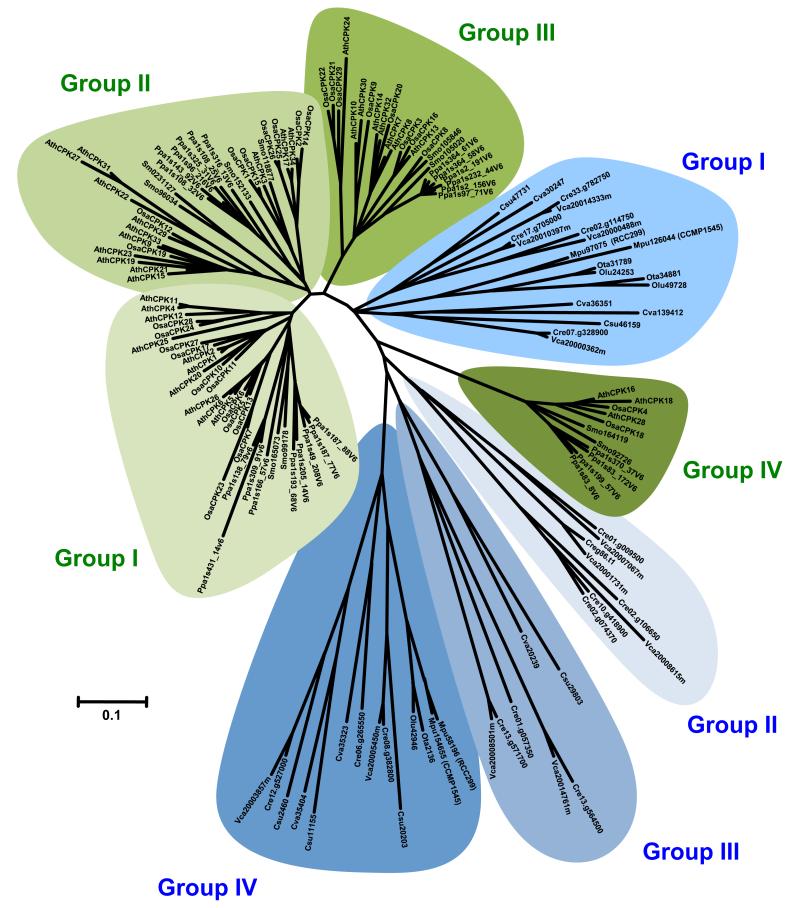
Phylogenetic relationships among green plant CDPKs. The genome assembly of various green plants was searched using the amino acid sequence of Arabidopsis CDPKs as queries. Retrieved gene models were accepted only if the corresponding protein had consensus sequences of the Ser/Thr PKD, including conserved Asp and Lys residues within the active site (D[L/I/V]K motif), and a CLD comprising at least one consensus EF-hand motif. Full-length CDPKs (see supplementary material online) were next aligned with ClustalW, using the following alignment parameters: for pairwise alignment, gap opening, 10.0, and gap extension, 0.1; for multiple alignment, gap opening, 10.0, and gap extension, 0.20. Resulting alignments were submitted to the MEGA4 software to generate a neighbor-joining tree derived from 5000 replicates. To emphasize the clustering of the various CDPK clades, the unrooted distance tree visualization mode was selected. Branch size is proportional to the extent of primary sequence divergence, with the scale of ‘0.1’ representing a 10% change. CDPK clades from green algae and land plants are highlighted in shades of blue and green, respectively. A species acronym identifies the origin of each protein (Ath, Arabidopsis thaliana; Cre, Chlamydomonas reinhardtii; Csu, Coccomyxa subellipsoidea; Cva, Chlorella variabilis; Mpu, Micromonas pusilla; Olu, Ostreococcus lucimarinus; Osa, Oryza sativa ssp. japonica; Ota, Ostreococcus tauri; Ppa, Physcomitrella patens; Smo, Selaginella moellendorffii; Vca, Volvox carteri). For clarity purposes, CDPK homologs from poplar were not included in this analysis.

References

    1. Kudla J, et al. Calcium signals: the lead currency of plant information processing. Plant Cell. 2010;22:541–563. - PMC - PubMed
    1. Wheeler GL, Brownlee C. Ca2+ signalling in plants and green algae-changing channels. Trends Plant Sci. 2008;13:506–514. - PubMed
    1. Batistič O, Kudla J. Analysis of calcium signaling pathways in plants. Biochim. Biophys. Acta. 2012;1820:1283–1293. - PubMed
    1. Hashimoto K, Kudla J. Calcium decoding mechanisms in plants. Biochimie. 2011;93:2054–2059. - PubMed
    1. McCormack E, et al. Handling calcium signaling: Arabidopsis CaMs and CMLs. Trends Plant Sci. 2005;10:383–389. - PubMed

Publication types

Substances