


Attention bias modification treatment augmenting effects on cognitive behavioral therapy in children with anxiety: randomized controlled trial
- PMID: 24342386
- PMCID: PMC4629236
- DOI: 10.1016/j.jaac.2013.09.016
Attention bias modification treatment augmenting effects on cognitive behavioral therapy in children with anxiety: randomized controlled trial
Abstract
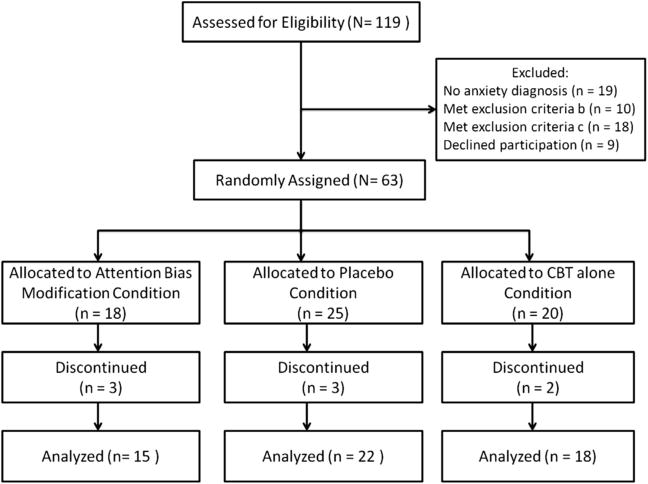
Objective: Attention bias modification treatment (ABMT) is a promising novel treatment for anxiety disorders, but clinical trials have focused largely on stand-alone formats among adults. This randomized controlled trial examined the augmenting effects of threat-based ABMT on cognitive behavioral therapy (CBT) in clinically anxious youth.
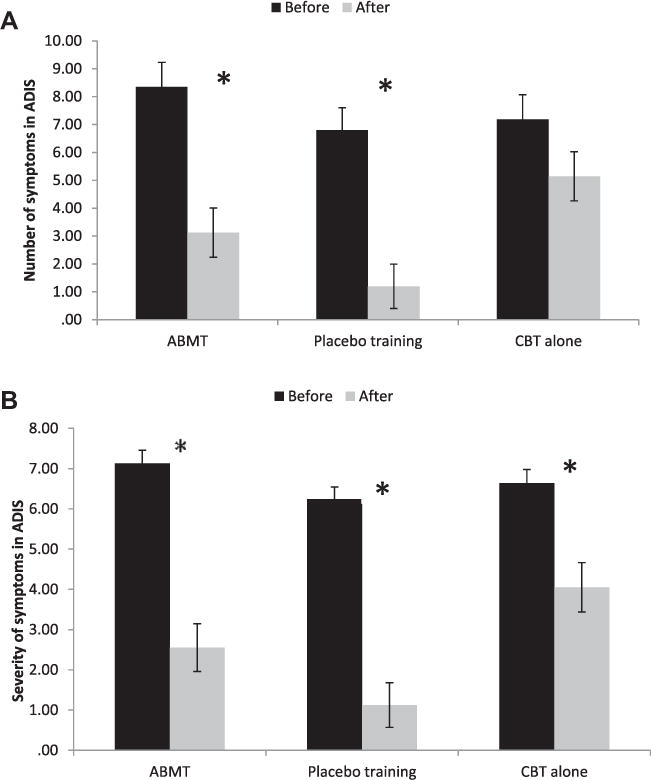
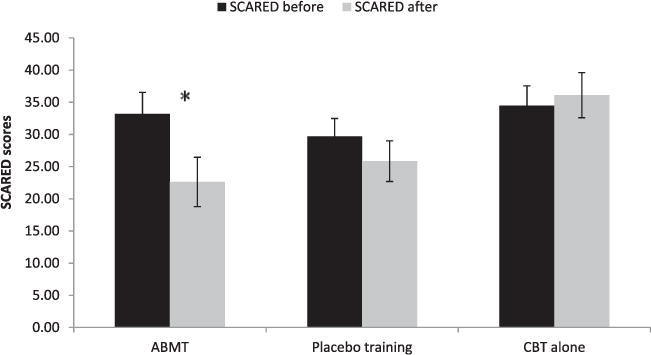
Method: Sixty-three treatment-seeking children with anxiety disorder were randomly assigned to 1 of the following 3 treatment groups: ABMT + CBT; ABMT placebo + CBT; and CBT-alone. Participants in the 2 ABMT conditions received repeated training on dot-probe tasks either designed to shift attention away from threats (active) or designed to induce no changes in attention patterns (placebo). Primary outcome measures were frequency and severity of anxiety symptoms as determined by a clinician using a semi-structured interview. Self- and parent-rated anxiety measures and threat-related attention bias scores were also measured before and after treatment.
Results: Both the active and placebo ABMT groups showed greater reductions in clinician-rated anxiety symptoms than the CBT-alone group. Furthermore, only the active ABMT group showed significant reduction in self- or parent-rated anxiety symptoms. Finally, all groups showed a shift in attention patterns across the study, starting with a bias toward threat at baseline and shifting attention away from threat after treatment.
Conclusions: Active and placebo ABMT might augment the clinical response to CBT for anxiety. This effect could arise from benefits associated with performing computer-based paradigms such as the dot-probe task. Given the absence of group differences in attention-bias changes during treatment, possible mechanisms and methodological issues underlying the observed findings are discussed. Clinical trial registration information-Augmenting Effects of ABMT on CBT in Anxious Children: A Randomized Clinical Trial; http://clinicaltrials.gov/; NCT01730625.
Keywords: anxiety; attention bias; attention bias modification treatment (ABMT); cognitive behavioral therapy (CBT).
Copyright © 2014 American Academy of Child and Adolescent Psychiatry. All rights reserved.
Conflict of interest statement
Disclosure: Drs. Shechner, Britton, Apter, Bliese, Pine, and Bar-Haim, and Ms. Rimon-Chakir and Mr. Lotan report no biomedical financial interests or potential conflicts of interest.
Figures
References
-
- Bar-Haim Y. Attention bias modification (ABM): a novel treatment for anxiety disorders [research review] J Child Psychol Psychiatry. 2010;51:859–870. - PubMed
-
- Bar-Haim Y, Lamy D, Pergamin L, Bakermans-Kranenburg MJ, van IMH. Threat-related attentional bias in anxious and nonanxious individuals: a meta-analytic study. Psychol Bull. 2007;133:1–24. - PubMed
-
- Schmidt NB, Richey JA, Buckner JD, Timpano KR. Attention training for generalized social anxiety disorder. J Abnorm Psychol. 2009;118:5–14. - PubMed
Publication types
MeSH terms
Associated data
Grants and funding
LinkOut - more resources
Full Text Sources
Other Literature Sources
Medical
