


Real-time RT-PCR assays to differentiate wild-type group A rotavirus strains from Rotarix(®) and RotaTeq(®) vaccine strains in stool samples
- PMID: 24342877
- PMCID: PMC4130254
- DOI: 10.4161/hv.27388
Real-time RT-PCR assays to differentiate wild-type group A rotavirus strains from Rotarix(®) and RotaTeq(®) vaccine strains in stool samples
Abstract
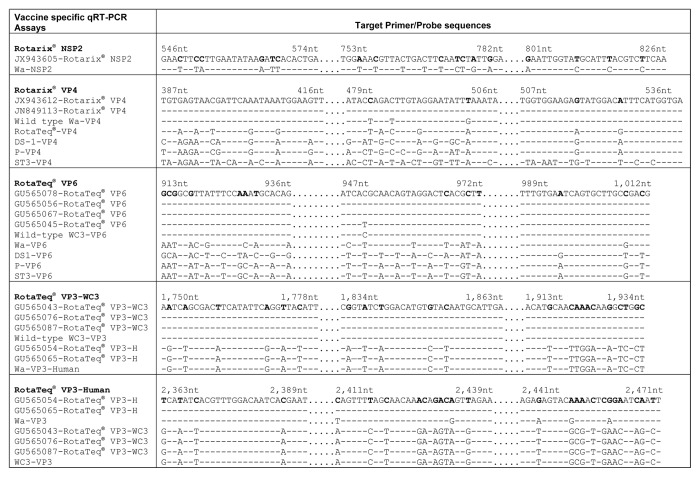
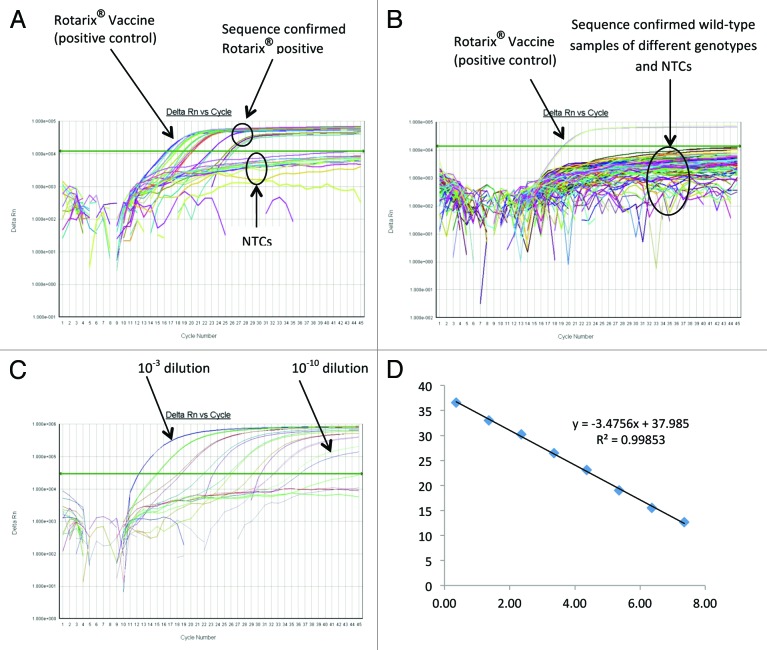
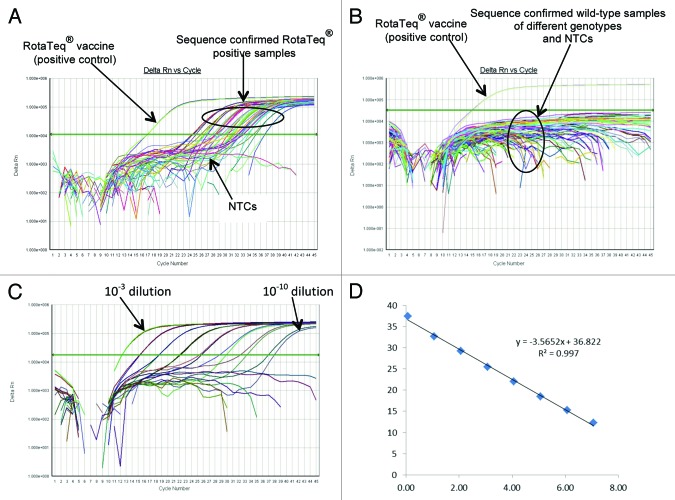
Group A rotaviruses (RVA) are the leading cause of severe diarrhea in young children worldwide. Two live-attenuated RVA vaccines, Rotarix(®) and RotaTeq(®) are recommended by World Health Organization (WHO) for routine immunization of all infants. Rotarix(®) and RotaTeq(®) vaccines have substantially reduced RVA associated mortality but occasionally have been associated with acute gastroenteritis (AGE) cases identified in vaccinees and their contacts. High-throughput assays are needed to monitor the prevalence of vaccine strains in AGE cases and emergence of new vaccine-derived strains following RVA vaccine introduction. In this study, we have developed quantitative real-time RT-PCR (qRT-PCR) assays for detection of Rotarix(®) and RotaTeq(®) vaccine components in stool samples. Real-time RT-PCR assays were designed for vaccine specific targets in the genomes of Rotarix(®) (NSP2, VP4) and RotaTeq(®) (VP6, VP3-WC3, VP3-human) and validated on sequence confirmed stool samples containing vaccine strains, wild-type RVA strains, and RVA-negative stools. For quantification, standard curves were generated using dsRNA transcripts derived from RVA gene segments. Rotarix(®) NSP2 and VP4 qRT-PCR assays exhibited 92-100% sensitivity, 99-100% specificity, 94-105% efficiency, and a limit of detection of 2-3 copies per reaction. RotaTeq(®) VP6, VP3-WC3, and VP3-human qRT-PCR assays displayed 100% sensitivity, 94-100% specificity, 91-102% efficiency and limits of detection of 1 copy, 2 copies, and 140 copies, respectively. These assays permit rapid identification of Rotarix(®) and RotaTeq(®) vaccine components in stool samples from clinical and surveillance studies and will be helpful in determining the frequency of vaccine strain-associated AGE.
Keywords: acute gastroenteritis; qRT-PCR; rotavirus vaccine.
Figures
References
-
- Tate JE, Burton AH, Boschi-Pinto C, Steele AD, Duque J, Parashar UD, WHO-coordinated Global Rotavirus Surveillance Network 2008 estimate of worldwide rotavirus-associated mortality in children younger than 5 years before the introduction of universal rotavirus vaccination programmes: a systematic review and meta-analysis. Lancet Infect Dis. 2012;12:136–41. - PubMed
-
- Gentsch JR, Laird AR, Bielfelt B, Griffin DD, Banyai K, Ramachandran M, Jain V, Cunliffe NA, Nakagomi O, Kirkwood CD, et al. Serotype diversity and reassortment between human and animal rotavirus strains: implications for rotavirus vaccine programs. J Infect Dis. 2005;192(Suppl 1):S146–59. doi: 10.1086/431499. - DOI - PubMed
-
- Vesikari T, Karvonen A, Prymula R, Schuster V, Tejedor JC, Cohen R, Meurice F, Han HH, Damaso S, Bouckenooghe A. Efficacy of human rotavirus vaccine against rotavirus gastroenteritis during the first 2 years of life in European infants: randomised, double-blind controlled study. Lancet. 2007;370:1757–63. doi: 10.1016/S0140-6736(07)61744-9. - DOI - PubMed
Publication types
MeSH terms
Substances
LinkOut - more resources
Full Text Sources
Other Literature Sources
Medical
