


Hyperbaric oxygen therapy for treating acute surgical and traumatic wounds
- PMID: 24343585
- PMCID: PMC11529725
- DOI: 10.1002/14651858.CD008059.pub3
Hyperbaric oxygen therapy for treating acute surgical and traumatic wounds
Abstract
Background: Hyperbaric oxygen therapy (HBOT) is used as a treatment for acute wounds (such as those arising from surgery and trauma). However, the effects of HBOT on wound healing are unclear.
Objectives: To determine the effects of HBOT on the healing of acute surgical and traumatic wounds.
Search methods: We searched the Cochrane Wounds Group Specialised Register (searched 9 August 2013); the Cochrane Central Register of Controlled Trials (CENTRAL) (The Cochrane Library 2012, Issue 12); Ovid MEDLINE (2010 to July Week 5 2013); Ovid MEDLINE (In-Process & Other Non-Indexed Citations, August 08, 2013); Ovid EMBASE (2010 to 2013 Week 31); EBSCO CINAHL (2010 to 8 August 2013).
Selection criteria: Randomised controlled trials (RCTs) comparing HBOT with other interventions such as dressings, steroids, or sham HOBT or comparisons between alternative HBOT regimens.
Data collection and analysis: Two review authors conducted selection of trials, risk of bias assessment, data extraction and data synthesis independently. Any disagreements were referred to a third review author.
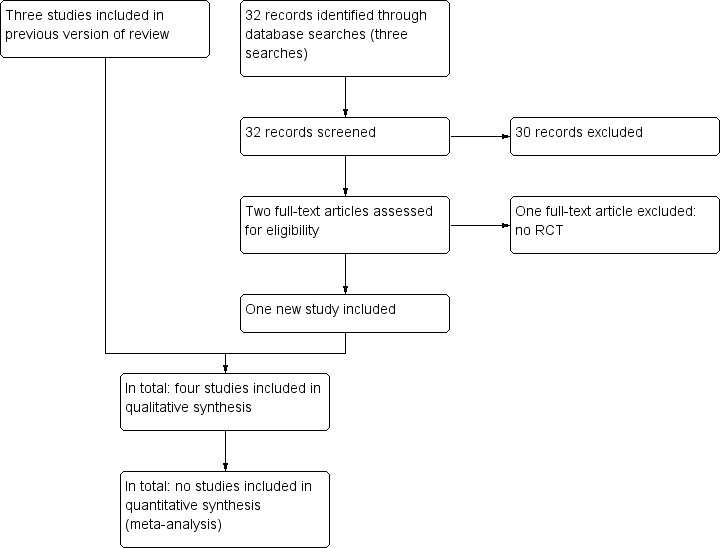
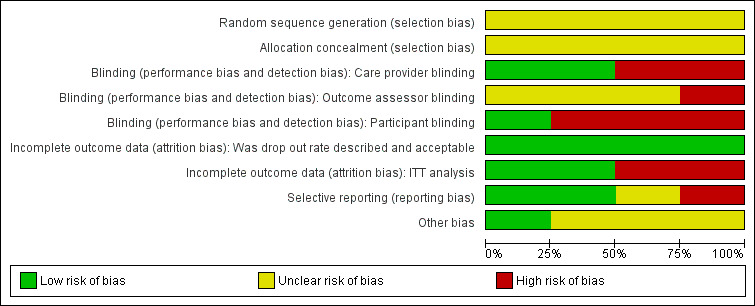
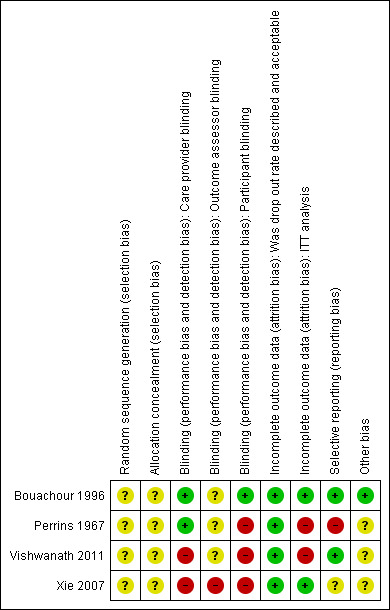
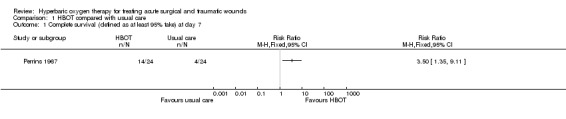
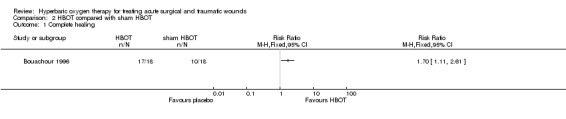
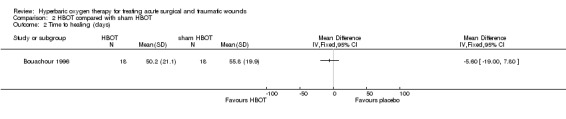
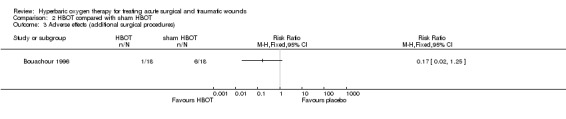
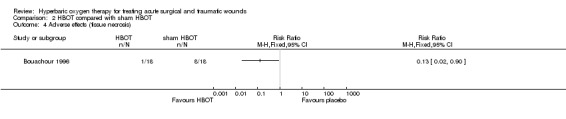
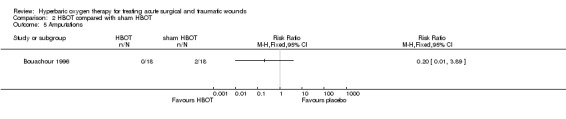
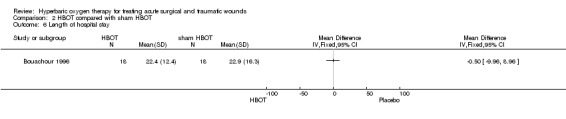
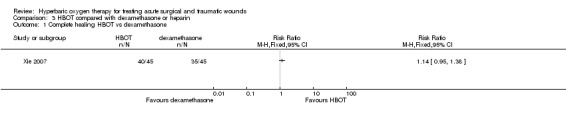
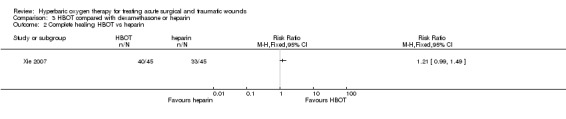
Main results: Four trials involving 229 participants were included. The studies were clinically heterogeneous, which precluded a meta-analysis.One trial (48 participants with burn wounds undergoing split skin grafts) compared HBOT with usual care and reported a significantly higher complete graft survival associated with HBOT (95% healthy graft area risk ratio (RR) 3.50; 95% confidence interval (CI) 1.35 to 9.11). A second trial (10 participants in free flap surgery) reported no significant difference between graft survival (no data available). A third trial (36 participants with crush injuries) reported significantly more wounds healed (RR 1.70; 95% CI 1.11 to 2.61), and significantly less tissue necrosis (RR 0.13; 95% CI 0.02 to 0.90) with HBOT compared to sham HBOT. The fourth trial (135 people undergoing flap grafting) reported no significant differences in complete graft survival with HBOT compared with dexamethasone (RR 1.14; 95% CI 0.95 to 1.38) or heparin (RR 1.21; 95% CI 0.99 to 1.49).Many of the predefined secondary outcomes of the review were not reported. All four trials were at unclear or high risk of bias.
Authors' conclusions: There is a lack of high quality, valid research evidence regarding the effects of HBOT on wound healing. Whilst two small trials suggested that HBOT may improve the outcomes of skin grafting and trauma, these trials were at risk of bias. Further evaluation by means of high quality RCTs is needed.
Conflict of interest statement
None of the authors have any conflict of interest.
Figures
Update of
-
Hyperbaric oxygen therapy for treating acute surgical and traumatic wounds.Cochrane Database Syst Rev. 2010 Oct 6;(10):CD008059. doi: 10.1002/14651858.CD008059.pub2. Cochrane Database Syst Rev. 2010. Update in: Cochrane Database Syst Rev. 2013 Dec 16;(12):CD008059. doi: 10.1002/14651858.CD008059.pub3. PMID: 20927771 Updated.
References
References to studies included in this review
Bouachour 1996 {published data only}
-
- Bouachour G, Cronier P, Gouello JP, Toulemonde JL, Talha A, Alquier P. Hyperbaric oxygen therapy in the management of crush injuries: a randomized double‐blind placebo‐controlled clinical trial. Journal of Trauma 1996;41(2):333‐9. - PubMed
Perrins 1967 {published data only}
-
- Perrins DJ. Influence of hyperbaric oxygen on the survival of split skin grafts. Lancet 1967;289(7495):868‐71. - PubMed
Vishwanath 2011 {published data only}
Xie 2007 {published data only}
-
- Xie Z‐X, Li C‐Y. Changes in arterial flow after flap grafting under various tensions. Journal of Clinical Rehabilitative Tissue Engineering Research 2007;11(25):5004‐5.
References to studies excluded from this review
Brannen 1997 {published data only}
-
- Brannen AL, Still J, Haynes M, Orlet H, Rosenblum F, Law E, et al. A randomized prospective trial of hyperbaric oxygen in a referral burn center population. The American Surgeon 1997;63(3):205‐8. - PubMed
Hart 1974 {published data only}
-
- Hart GB, O'Reilly RR, Broussard ND, Cave RH, Goodman DB, Yanda RL. Treatment of burns with hyperbaric oxygen. Surgery, Gynecology and Obstetrics 1974;139(5):693‐6. - PubMed
Jian 2011 {published data only}
-
- Jian W, Liang D. Zhang H. Shang W, Wang P, Li W. The effect of hyperbaric oxygen therapy on treatment of late healed wounds after pharyngeal and laryngeal surgery. Lin Chung Er Bi Yan Hou Tou Jing Wai Ke Za Zhi 2011;25(1):14‐15. - PubMed
Niezgoda 1997 {published data only}
-
- Niezgoda JA, Cianci P, Folden BW, Ortega RL, Slade JB, Storrow AB. The effect of hyperbaric oxygen therapy on a burn wound model in human volunteers. Plastic and Reconstructive Surgery 1997;99(6):1620‐5. - PubMed
Xu N 1999 {published data only}
-
- Xu N, Li Z, Luo X. Effects of hyperbaric oxygen therapy on the changes in serum sIL‐2R and Fn in severe burn patients. Zhonghua Zheng Xing Shao Shang Wai Ke Za Zhi 1999;15(3):220‐3. - PubMed
References to ongoing studies
Brismar {published data only}
-
- NCT01002209Postoperative Hyperbaric Oxygen Treatments to Reduce Complications in Diabetic Patients Undergoing Vascular Surgery (HODiVA). Ongoing study October 2009 ‐ Anticipated end date: October 2014.
Millar {published data only}
-
- NCT00264511Hyperbaric Oxygen in Lower Leg Trauma. Ongoing study February 2006 ‐ Anticipated end date: December 2013.
Sires {published data only}
-
- NCT01605110 Effects of Hyperbaric Oxygen Therapy on Surgical Wound Healing (BLEPH). Ongoing study August 2011 ‐ Anticipated end date: November 2013.
Additional references
Altman 2001
Bennett 2005a
Bennett 2005b
Bennett 2008
Boerema 1964
Boerema 1965
-
- Boerema I. The use of hyperbaric oxygen. American Heart Journal 1965;69:289‐92. - PubMed
Deeks 2011
-
- Deeks JJ, Higgins JPT and Altman DG on behalf of the Cochrane Statistical Methods Group and the Cochrane Bias Methods Group (Editors). Chapter 9: Analysing data and undertaking meta‐analyses. In: Higgins JPT, Green S (editors). Cochrane Handbook for Systematic Reviews of Interventions Version 5.1.0 [updated March 2011]. The Cochrane Collaboration, 2011. Available from www.cochrane‐handbook.org.
Eskes 2010
Eskes 2012
-
- Eskes AM, Brölmann FE, Sumpio BE, Mayer D, Moore Z, Agren MS, et al. Fundamentals of randomized clinical trials in wound care: design and conduct. Wound Repair and Regeneration 2012;20(4):449‐55. - PubMed
FDA 2006
-
- Food, Drug Administration. Guidance for Industry ‐ Chronic Cutaneous Ulcer and Burn Wounds ‐ Developing Products for Treatment. http://www.fda.gov/downloads/Drugs/GuidanceComplianceRegulatoryInformati... 2006. - PubMed
Franz 2007
-
- Franz MG, Steed DL, Robson MC. Optimizing healing of the acute wound by minimizing complications. Current Problems in Surgery 2007;44(11):691‐763. - PubMed
Goldman 2009
-
- Goldman RJ. Hyperbaric oxygen therapy for wound healing and limb salvage: a systematic review. PM&R: The Journal of Injury, Function, and Rehabilitation 2009;1(5):471‐89. - PubMed
Hess 2003
-
- Hess CL, Howard MA, Attinger CE. A review of mechanical adjuncts in wound healing: hydrotherapy, ultrasound, negative pressure therapy, hyperbaric oxygen, and electrostimulation. Annals of Plastic Surgery 2003;51(2):210‐8. - PubMed
Higgins 2011
-
- Higgins JPT, Altman DG, Sterne JAC on behalf of the Cochrane Statistical Methods Group and the Cochrane Bias Methods Group (Editors). Chapter 8: Assessing risk of bias in included studies. In: Higgins JPT, Green S (editors). Cochrane Handbook for Systematic Reviews of Interventions Version 5.1.0 [updated March 2011]. The Cochrane Collaboration, 2011. Available from www.cochrane‐handbook.org.
Ioannidis 2008
Jull 2008
Kindwall 2002
-
- Kindwall EP. Hyperbaric Medicine Practice. 2nd Edition. Best Publishing Company, 2002:4‐8.
Kranke 2012
Lazarus 1994
-
- Lazarus GS, Cooper DM, Knighton DR, Margolis DJ, Pecoraro RE, Rodeheaver G, et al. Definitions and guidelines for assessment of wounds and evaluation of healing. Archives of Dermatology 1994;130(4):489‐93. - PubMed
Lefebvre 2011
-
- Lefebvre C, Manheimer E, Glanville J. Chapter 6: Searching for studies. In: Higgins JPT, Green S (editors). Cochrane Handbook for Systematic Reviews of Interventions Version 5.1.0 [updated March 2011]. The Cochrane Collaboration, 2011. Available from www.cochrane‐handbook.org.
MacFarlane 2001
-
- MacFarlane C, Cronjé FJ. Hyperbaric oxygen and surgery. South African Journal of Surgery 2001;39(4):117‐21. - PubMed
Niinikoski 2003
-
- Niinikoski J. Hyperbaric oxygen therapy of diabetic foot ulcers, transcutaneous oxymetry in clinical decision making. Wound Repair and Regeneration 2003;11(6):458‐61. - PubMed
RevMan 2011 [Computer program]
-
- The Nordic Cochrane Centre, The Cochrane Collaboration. Review Manager (RevMan). Version 5.1.7. Copenhagen: The Nordic Cochrane Centre, The Cochrane Collaboration, 2008.
Roeckl‐Wiedmann 2005
-
- Roeckl‐Wiedmann I, Bennett M, Kranke P. Systematic review of hyperbaric oxygen in the management of chronic wounds. British Journal of Surgery 2005;92(1):24‐32. - PubMed
Ruiz‐Canela 2000
Schulz 2002a
-
- Schulz KF, Grimes DA. Allocation concealment in randomised trials: defending against deciphering. Lancet 2002;359(9306):614‐8. - PubMed
Schulz 2002b
-
- Schulz KF, Grimes DA. Blinding in randomised trials: hiding who got what. Lancet 2002;359(9307):696‐700. - PubMed
Sign 2012
-
- Scottish Intercollegiate Guidelines Network (SIGN). Search filters. http://www.sign.ac.uk/methodology/filters.html#random (accessed 6 November 2012).
Ubbink 1997
-
- Ubbink DT, Tulevski II, Hartog D, Koelemay MJ, Legemate DA, Jacobs MJ. The value of non‐invasive techniques for the assessment of critical limb ischaemia. European Journal of Vascular and Endovascular Surgery 1997;13(3):296‐300. - PubMed
Vermeulen 2004
Villanueva 2004
Wang 2003
-
- Wang C, Schwaitzberg S, Berliner E, Zarin DA, Lau J. Hyperbaric oxygen for treating wounds: a systematic review of the literature. Archives of Surgery 2003;138(3):272‐9. - PubMed
Publication types
MeSH terms
Grants and funding
LinkOut - more resources
Full Text Sources
Other Literature Sources
Medical
