. 2014 Feb;164(2):951-65.
doi: 10.1104/pp.113.233163. Epub 2013 Dec 16.

Gibberellic acid-induced aleurone layers responding to heat shock or tunicamycin provide insight into the N-glycoproteome, protein secretion, and endoplasmic reticulum stress

Affiliations

Gibberellic acid-induced aleurone layers responding to heat shock or tunicamycin provide insight into the N-glycoproteome, protein secretion, and endoplasmic reticulum stress

Gregorio Barba-Espín et al. Plant Physiol. 2014 Feb.

Abstract

The growing relevance of plants for the production of recombinant proteins makes understanding the secretory machinery, including the identification of glycosylation sites in secreted proteins, an important goal of plant proteomics. Barley (Hordeum vulgare) aleurone layers maintained in vitro respond to gibberellic acid by secreting an array of proteins and provide a unique system for the analysis of plant protein secretion. Perturbation of protein secretion in gibberellic acid-induced aleurone layers by two independent mechanisms, heat shock and tunicamycin treatment, demonstrated overlapping effects on both the intracellular and secreted proteomes. Proteins in a total of 22 and 178 two-dimensional gel spots changing in intensity in extracellular and intracellular fractions, respectively, were identified by mass spectrometry. Among these are proteins with key roles in protein processing and secretion, such as calreticulin, protein disulfide isomerase, proteasome subunits, and isopentenyl diphosphate isomerase. Sixteen heat shock proteins in 29 spots showed diverse responses to the treatments, with only a minority increasing in response to heat shock. The majority, all of which were small heat shock proteins, decreased in heat-shocked aleurone layers. Additionally, glycopeptide enrichment and N-glycosylation analysis identified 73 glycosylation sites in 65 aleurone layer proteins, with 53 of the glycoproteins found in extracellular fractions and 36 found in intracellular fractions. This represents major progress in characterization of the barley N-glycoproteome, since only four of these sites were previously described. Overall, these findings considerably advance knowledge of the plant protein secretion system in general and emphasize the versatility of the aleurone layer as a model system for studying plant protein secretion.


Figures
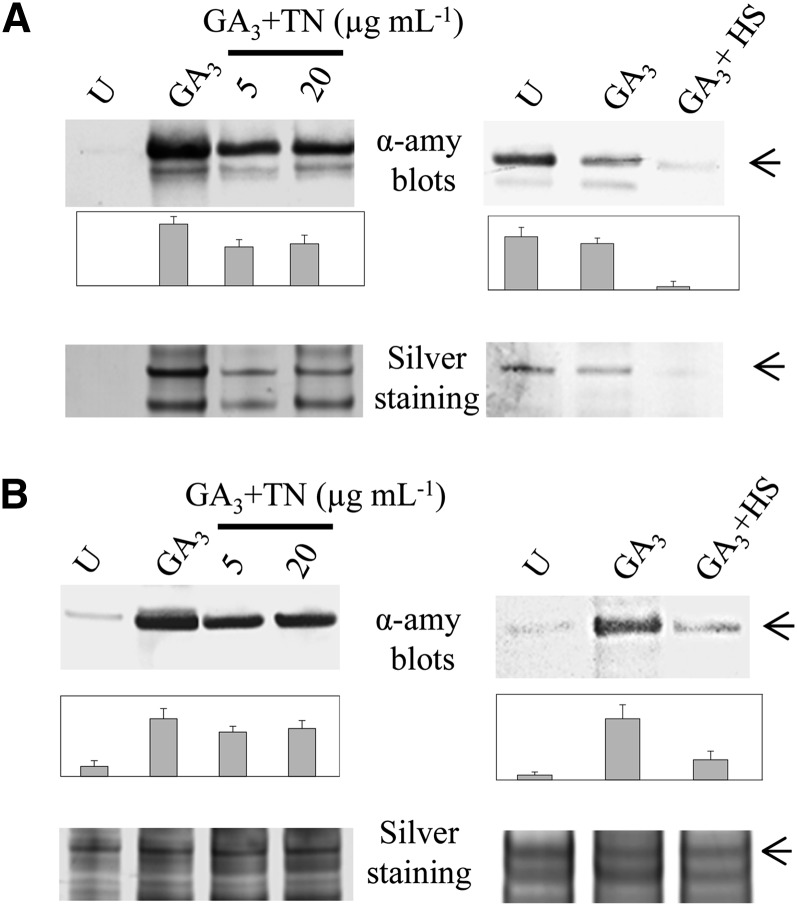
Figure 1.
Figure 1.
Western blots probing α-amylase in the extracellular (A) and intracellular (B) water-soluble protein fractions of in vitro-incubated aleurone layers. Equal volumes of extracellular protein fraction (A) and equal amounts of total protein (B) were applied to SDS-PAGE. For each blot, a parallel protein gel was stained with silver nitrate. Bands corresponding to the α-amylase (45 kD) are indicated by arrowheads. Densitometric quantification of western-blot signals was performed using ImageJ software (National Institutes of Health) and is expressed as the average of three biological replicates plus se (bar charts). HS, 4-h HS; U, untreated.
Figure 2.
Figure 2.
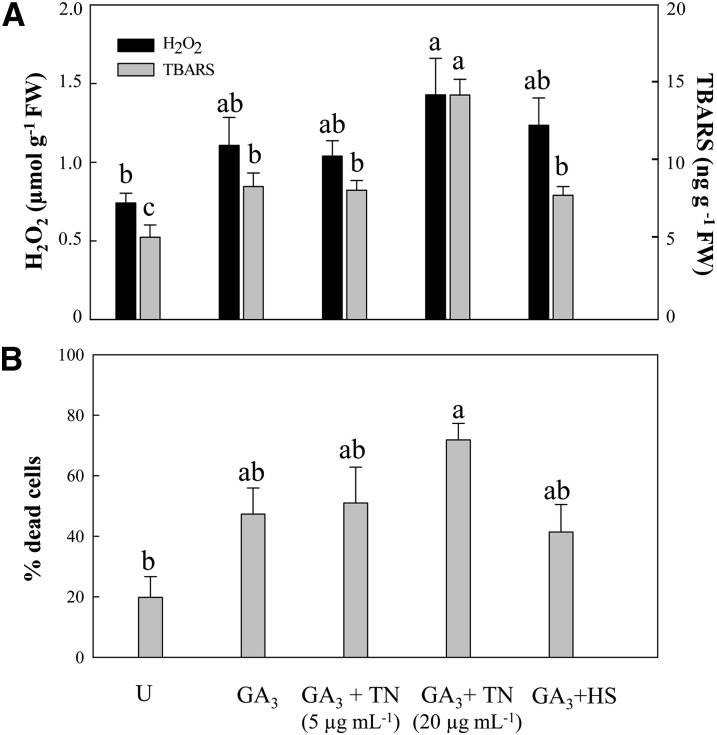
Enhanced cell death in GA3-induced aleurone layers correlates with higher endogenous H2O2 and lipid peroxidation contents. A, H2O2 and TBARS were measured in aleurone layer extracts. B, Vital staining was performed in intact aleurone layers, and randomly selected fields were counted to determine the percentage of dead cells. Different letters indicate statistical significance according to Tukey’s test (P < 0.05). FW, Fresh weight; U, untreated.
Figure 3.
Figure 3.
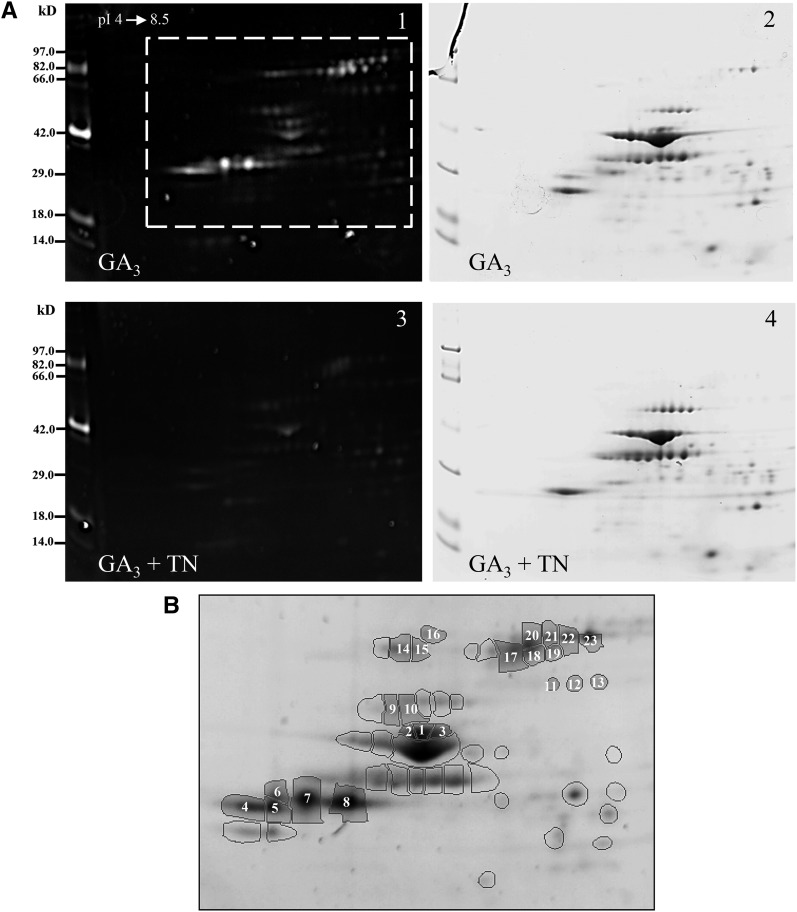
Fluorescent glycoprotein staining of extracellular proteins. A, One representative glycoprotein-stained gel (gels 1 and 3) and a corresponding colloidal Coomassie blue-stained gel (gels 2 and 4) covering the pH range 4 to 8.5 are shown for GA3-induced (gels 1 and 2) and GA3 + 5 µg mL−1 TN-treated (gels 3 and 4) aleurone layers. Molecular size markers are indicated at left. B, View of the GA3 reference gel framed in A showing 53 intense fluorescent spots present in all GA3 replicates. Twenty-three of them (numbered spots) correspond to spots absent in GA3 + TN aleurone layers, of which 14 were identified by mass spectrometry. (For details about protein identifications, see Supplemental Table S1).
Figure 4.
Figure 4.
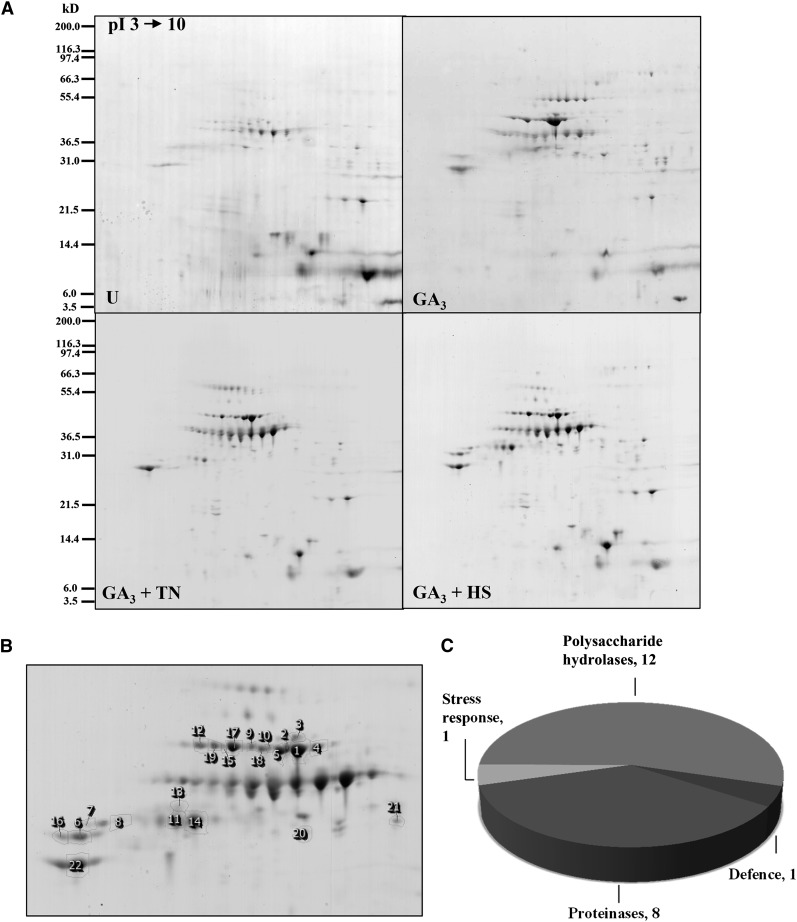
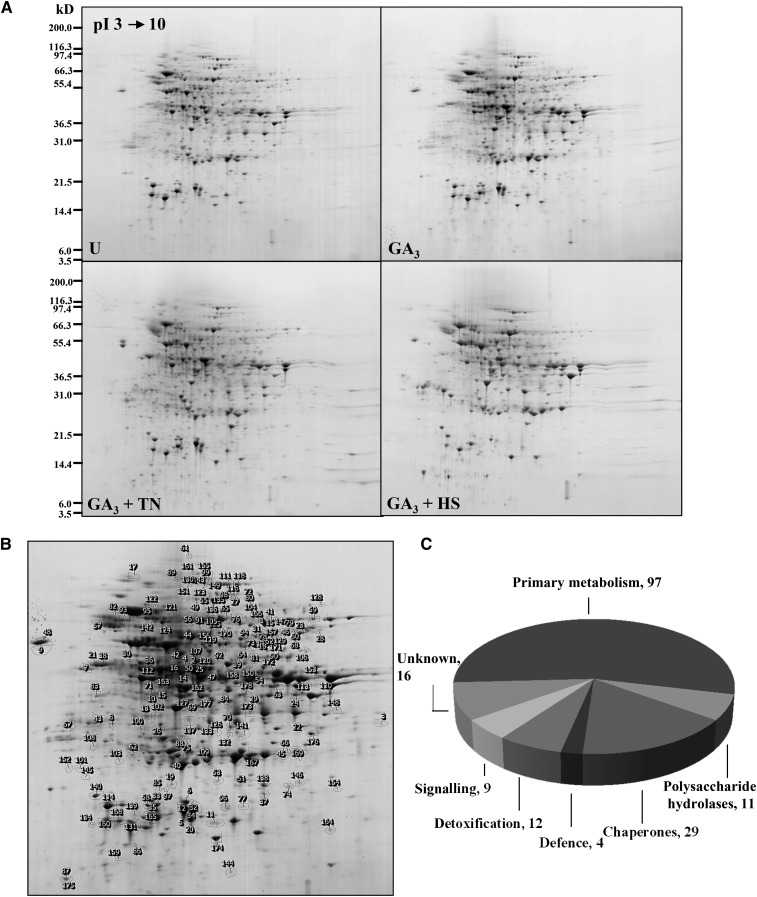
Extracellular protein profiles of barley aleurone layer extracts. A, One representative colloidal Coomassie blue-stained gel covering the pH range 3 to 10 is shown for each treatment. Molecular size markers are indicated at left. U, Untreated. B, Closeup view of the reference gel showing 22 identified spots. C, Functional categories of the plant proteins identified. (For details about protein identifications, see Supplemental Table S2).
Figure 5.
Figure 5.
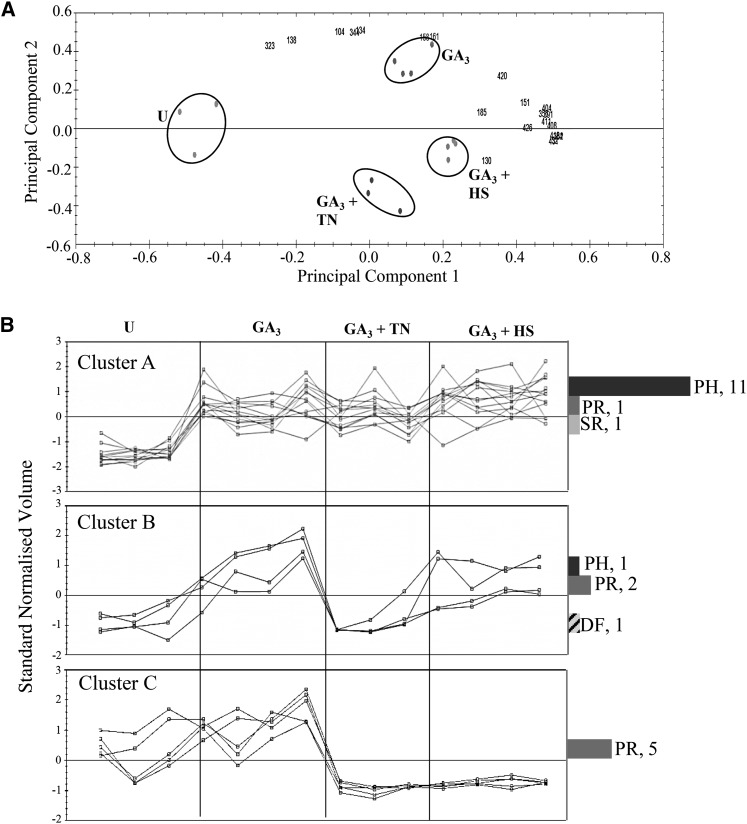
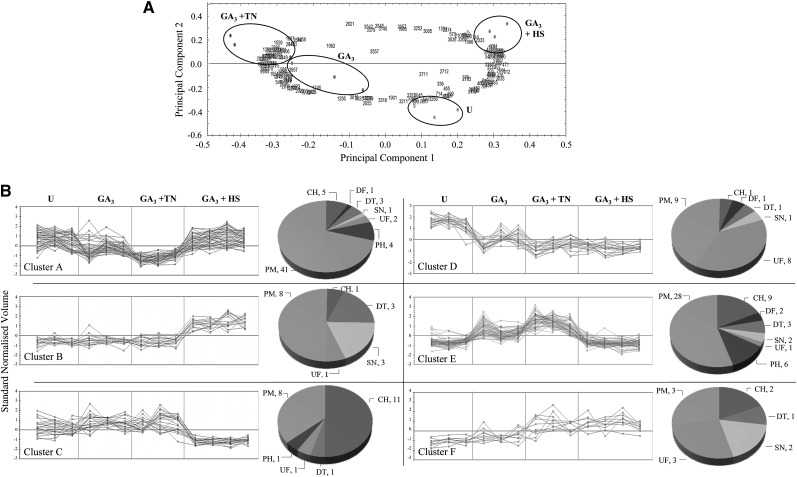
PCA and clustering of extracellular protein spots. A, PCA was performed on the 22 identified spots. Biological replicates are grouped by circles, and spots are indicated by numbers. B, Expression profiles of protein spots from PCA analysis were grouped in three clusters. The normalized volume for each spot is expressed relative to a reference gel (GA3), in which all spot volumes are by default set to 1. Corresponding functional classifications are indicated: DF, defense; PH, polysaccharide hydrolase; PR, protease; SR, stress response. U, Untreated. (For details about protein identifications, see Supplemental Table S2).
Figure 6.
Figure 6.
Intracellular water-soluble protein profiles of barley aleurone layer extracts. A, One representative colloidal Coomassie blue-stained gel covering the pH range 3 to 10 is shown for each treatment. Molecular size markers are indicated at left. U, Untreated. B, Closeup view of the reference gel showing 178 identified spots. C, Functional categories of the plant proteins identified. (For details about protein identifications, see Supplemental Table S3).
Figure 7.
Figure 7.
PCA and clustering of intracellular water-soluble protein spots. A, PCA was performed on the 178 identified spots. Biological replicates are grouped by circles, and spots are indicated by numbers. B, Expression profiles of protein spots from PCA analysis were grouped in six clusters. The normalized volume for each spot is expressed relative to a reference gel (GA3), in which all spot volumes are by default set to 1. Corresponding functional classifications are indicated: CH, Chaperone; DF, defense; DT, detoxification enzymes; PH, polysaccharide hydrolase; PM, primary metabolism; SN, signaling; UF, unknown function. U, Untreated. (For details about protein identifications, see Supplemental Table S3).
Figure 8.
Figure 8.
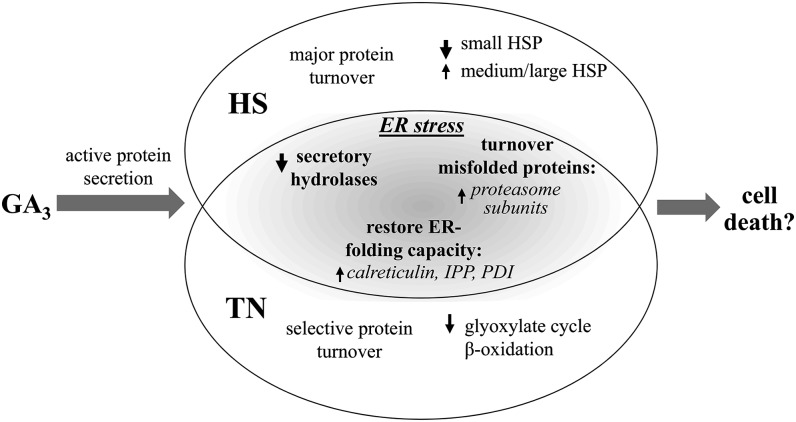
Summary of distinct and overlapping responses of GA3-induced aleurone layers to HS and TN treatments. GA3-induced aleurone layers may display early symptoms of ER stress due to the pressure on the protein secretion system and reflected by the enhanced expression of proteins induced by ER stress. IPP, Isopentenyl diphosphate isomerase.

References

    1. Agrawal GK, Jwa NS, Lebrun MH, Job D, Rakwal R. (2010) Plant secretome: unlocking secrets of the secreted proteins. Proteomics 10: 799–827 - PubMed
    1. Alexandersson E, Ali A, Resjö S, Andreasson E. (2013) Plant secretome proteomics. Front Plant Sci 4: 9. - PMC - PubMed
    1. Apweiler R, Hermjakob H, Sharon N. (1999) On the frequency of protein glycosylation, as deduced from analysis of the SWISS-PROT database. Biochim Biophys Acta 1473: 4–8 - PubMed
    1. Bailly C. (2004) Active oxygen species and antioxidants in seed biology. Seed Sci Res 14: 93–107
    1. Bailly C, El-Maarouf-Bouteau H, Corbineau F. (2008) From intracellular signaling networks to cell death: the dual role of reactive oxygen species in seed physiology. C R Biol 331: 806–814 - PubMed

Publication types

MeSH terms

LinkOut - more resources