Synergy against PML-RARa: targeting transcription, proteolysis, differentiation, and self-renewal in acute promyelocytic leukemia
- PMID: 24344243
- PMCID: PMC3865469
- DOI: 10.1084/jem.20131121
Synergy against PML-RARa: targeting transcription, proteolysis, differentiation, and self-renewal in acute promyelocytic leukemia
Abstract
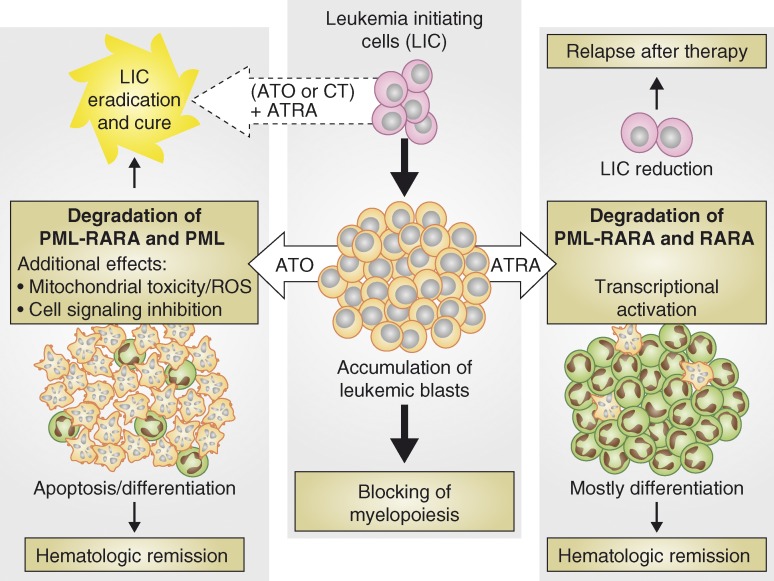
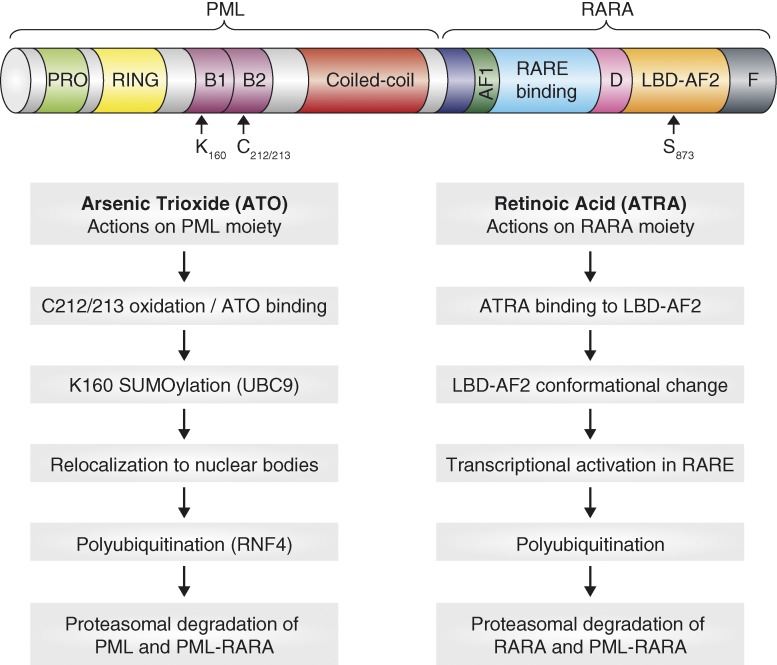
Acute promyelocytic leukemia (APL) is a hematological malignancy driven by a chimeric oncoprotein containing the C terminus of the retinoic acid receptor-a (RARa) fused to an N-terminal partner, most commonly promyelocytic leukemia protein (PML). Mechanistically, PML-RARa acts as a transcriptional repressor of RARa and non-RARa target genes and antagonizes the formation and function of PML nuclear bodies that regulate numerous signaling pathways. The empirical discoveries that PML-RARa-associated APL is sensitive to both all-trans-retinoic acid (ATRA) and arsenic trioxide (ATO), and the subsequent understanding of the mechanisms of action of these drugs, have led to efforts to understand the contribution of molecular events to APL cell differentiation, leukemia-initiating cell (LIC) clearance, and disease eradication in vitro and in vivo. Critically, the mechanistic insights gleaned from these studies have resulted not only in a better understanding of APL itself, but also carry valuable lessons for other malignancies.
Figures
References
-
- Ablain J., Nasr R., Bazarbachi A., de Thé H. 2011. The drug-induced degradation of oncoproteins: an unexpected Achilles’ heel of cancer cells? Cancer Discov. 1:117–127 10.1158/2159-8290.CD-11-0087 - DOI - PubMed
-
- Alcalay M., Zangrilli D., Pandolfi P.P., Longo L., Mencarelli A., Giacomucci A., Rocchi M., Biondi A., Rambaldi A., Lo-Coco F., et al. 1991. Translocation breakpoint of acute promyelocytic leukemia lies within the retinoic acid receptor alpha locus. Proc. Natl. Acad. Sci. USA. 88:1977–1981 10.1073/pnas.88.5.1977 - DOI - PMC - PubMed
-
- Au W.Y., Chim C.S., Lie A.K., Liang R., Kwong Y.L. 2002. Combined arsenic trioxide and all-trans retinoic acid treatment for acute promyelocytic leukaemia recurring from previous relapses successfully treated using arsenic trioxide. Br. J. Haematol. 117:130–132 10.1046/j.1365-2141.2002.03409.x - DOI - PubMed
Publication types
MeSH terms
Substances
Grants and funding
LinkOut - more resources
Full Text Sources
Other Literature Sources
Medical