


Innovative drugs to treat depression: did animal models fail to be predictive or did clinical trials fail to detect effects?
- PMID: 24345817
- PMCID: PMC3957126
- DOI: 10.1038/npp.2013.342
Innovative drugs to treat depression: did animal models fail to be predictive or did clinical trials fail to detect effects?
Abstract
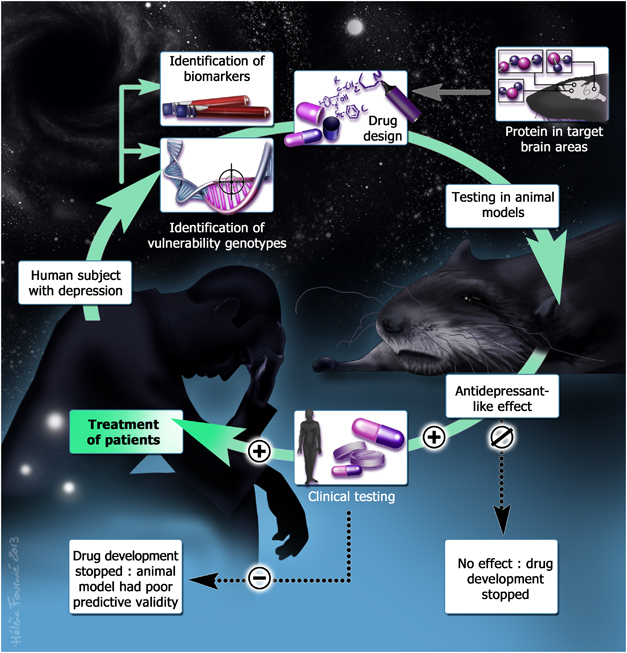
Over recent decades, encouraging preclinical evidence using rodent models pointed to innovative pharmacological targets to treat major depressive disorder. However, subsequent clinical trials have failed to show convincing results. Two explanations for these rather disappointing results can be put forward, either animal models of psychiatric disorders have failed to predict the clinical effectiveness of treatments or clinical trials have failed to detect the effects of these new drugs. A careful analysis of the literature reveals that both statements are true. Indeed, in some cases, clinical efficacy has been predicted on the basis of inappropriate animal models, although the contrary is also true, as some clinical trials have not targeted the appropriate dose or clinical population. On the one hand, refinement of animal models requires using species that have better homological validity, designing models that rely on experimental manipulations inducing pathological features, and trying to model subtypes of depression. On the other hand, clinical research should consider carefully the results from preclinical studies, in order to study these compounds at the correct dose, in the appropriate psychiatric nosological entity or symptomatology, in relevant subpopulations of patients characterized by specific biomarkers. To achieve these goals, translational research has to strengthen the dialogue between basic and clinical science.
Figures
References
-
- Abramson LY, Seligman MEP.1977Modeling psychopathology in the laboratory: history and rationaleIn: Maser JD, Seligman MEP, (eds).Psychopathology: Experimental Models WH Freeman: San Francisco; 1–26.
-
- Anisman H, Ravindran AV, Griffiths J, Merali Z. Endocrine and cytokine correlates of major depression and dysthymia with typical or atypical features. Mol Psychiatry. 1999;4:182–188. - PubMed
-
- Barbee JG, Thompson TR, Jamhour NJ, Stewart JW, Conrad EJ, Reimherr FW, et al. A double-blind placebo-controlled trial of lamotrigine as an antidepressant augmentation agent in treatment-refractory unipolar depression. J Clin Psychiatry. 2011;72:1405–1012. - PubMed
-
- Beck JA, Lloyd S, Hafezparast M, Lennon-Pierce M, Eppig JT, Festing MF, et al. Genealogies of mouse inbred strains. Nat Genet. 2000;24:23–25. - PubMed
Publication types
MeSH terms
Substances
LinkOut - more resources
Full Text Sources
Other Literature Sources
Medical
