. 2013 Dec;4(12):2271-87.
doi: 10.18632/oncotarget.1403.

A tumor-promoting mechanism mediated by retrotransposon-encoded reverse transcriptase is active in human transformed cell lines

Affiliations

A tumor-promoting mechanism mediated by retrotransposon-encoded reverse transcriptase is active in human transformed cell lines

Ilaria Sciamanna et al. Oncotarget. 2013 Dec.

Abstract

LINE-1 elements make up the most abundant retrotransposon family in the human genome. Full-length LINE-1 elements encode a reverse transcriptase (RT) activity required for their own retrotranpsosition as well as that of non-autonomous Alu elements. LINE-1 are poorly expressed in normal cells and abundantly in cancer cells. Decreasing RT activity in cancer cells, by either LINE-1-specific RNA interference, or by RT inhibitory drugs, was previously found to reduce proliferation and promote differentiation and to antagonize tumor growth in animal models. Here we have investigated how RT exerts these global regulatory functions. We report that the RT inhibitor efavirenz (EFV) selectively downregulates proliferation of transformed cell lines, while exerting only mild effects on non-transformed cells; this differential sensitivity matches a differential RT abundance, which is high in the former and undetectable in the latter. Using CsCl density gradients, we selectively identify Alu and LINE-1 containing DNA:RNA hybrid molecules in cancer but not in normal cells. Remarkably, hybrid molecules fail to form in tumor cells treated with EFV under the same conditions that repress proliferation and induce the reprogramming of expression profiles of coding genes, microRNAs (miRNAs) and ultraconserved regions (UCRs). The RT-sensitive miRNAs and UCRs are significantly associated with Alu sequences. The results suggest that LINE-1-encoded RT governs the balance between single-stranded and double-stranded RNA production. In cancer cells the abundant RT reverse-transcribes retroelement-derived mRNAs forming RNA:DNA hybrids. We propose that this impairs the formation of double-stranded RNAs and the ensuing production of small regulatory RNAs, with a direct impact on gene expression. RT inhibition restores the 'normal' small RNA profile and the regulatory networks that depend on them. Thus, the retrotransposon-encoded RT drives a previously unrecognized mechanism crucial to the transformed state in tumor cells.


Figures
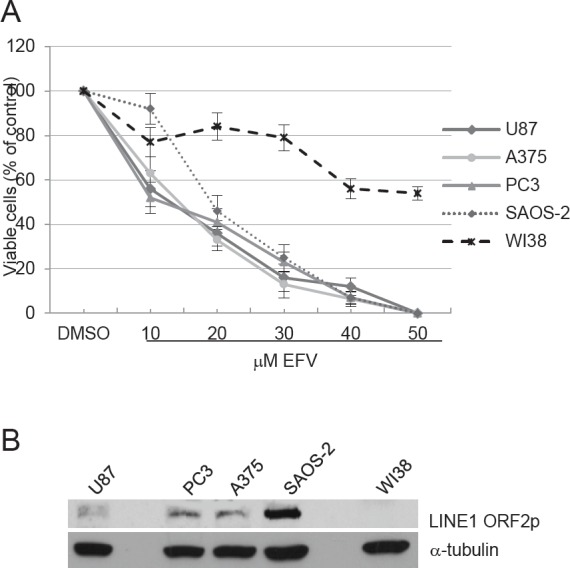
Figure 1
Figure 1. A) EFZ inhibits proliferation in human transformed cell lines
Cells were cultured in the presence of increasing EFV concentrations for four days. The proliferation rate is expressed as the percentage of counted cells relative to the initial number of seeded cells, taken as 100. Histograms represent the mean value and bars the s.d. from at least three independent assays for all cell types. B) Western analysis of LINE-1 ORF2 protein (upper panel) and b-tubulin (lower panel) in whole cell extract (WCE) from the indicated cell lines.
Figure 2
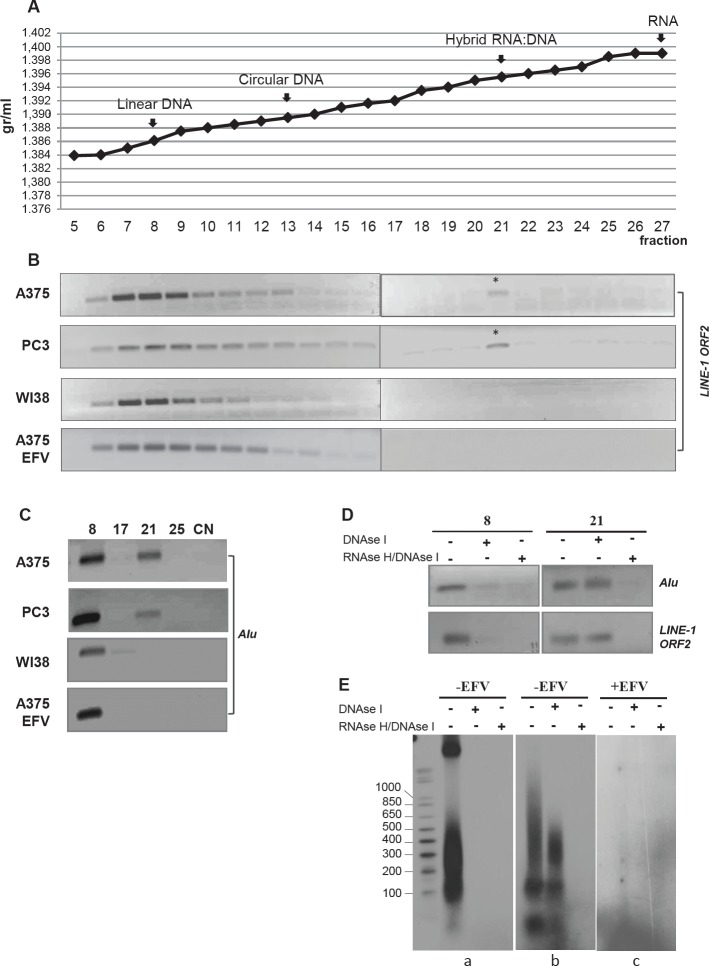
Figure 2. Identification of RNA:DNA hybrid structures through EtBr/CsCl density gradient centrifugation
A) Buoyant densitiy of linear DNA, circular DNA, RNA:DNA hybrid and RNA used as density markers. Density values are indicated on the y axis and gradient fractions on the x axis. B) PCR amplification of LINE-1 sequences throughout the gradient fractions from untreated A-375, PC3 and WI38 cell lines and EFV-treated A-375 cultures. The asterisk marks LINE-1-specific amplification products in fraction 21. C) PCR amplification of Alu sequences throughout the gradient fractions as in B; only relevant fractions are shown. Numbers indicate the gradient fractions. NC, negative control. D) Alu and LINE-1 PCR amplification of aliquots withdrawn from fractions 8 and 21 of the A-375 DNA-containing gradient, treated with either DNase I alone or sequentially with DNase I + RNase H. E) Samples were labeled by random priming and analyzed through a 1.5% agarose gel. Panel (a) shows fraction 8 and (b) fraction 21 from untreated A-375 cell samples; panel c shows gradient fraction 21 from EFV-treated A-375 sample.
Figure 3
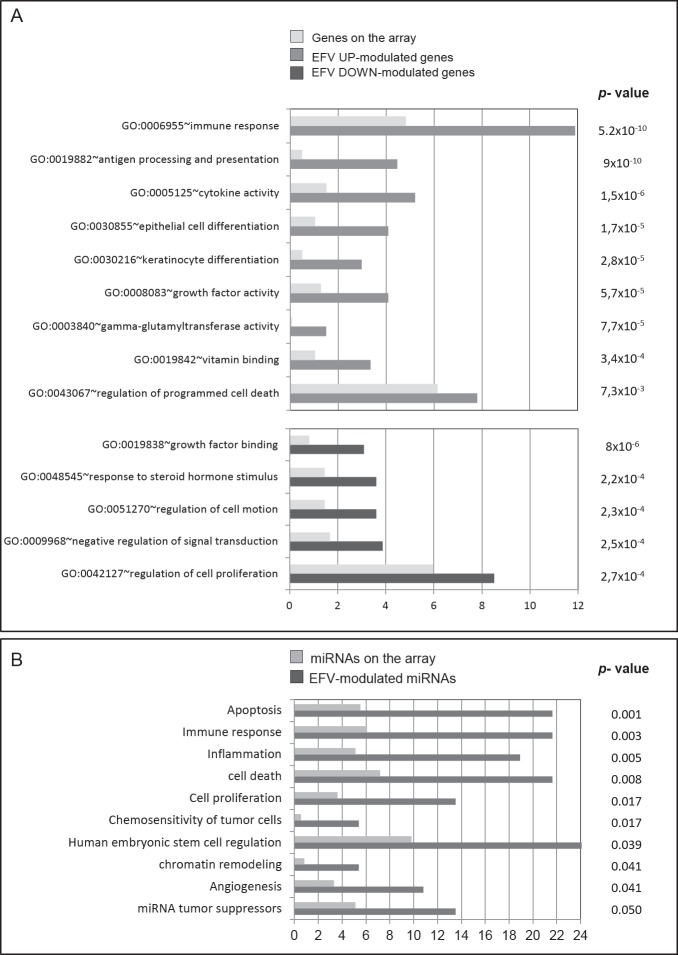
Figure 3. Gene ontology classification of EFV-modulated genes and miRNAs
A) Gene Ontology classification of up- (gray histograms) and downregulated (dark histograms) genes in EFV-exposed A-375 cell cultures (at least 2.0-fold change, unpaired T-test P-value<0.05), using the David software. Biological process and Molecular function classes in which the genes fall are ranked according to the percentage of genes fitting each class relative to their expected frequency by chance (light gray histograms), calculated on the basis of the global array composition. The P value from the modified Fisher test classes enrichment (p < 0.05) is shown. B) Gene Ontology classification of differentially expressed miRNAs in EFV-exposed A-375 cell cultures (2.0-fold change, unpaired T-test P-value<0.05), using the Tool for annotations of human miRNAs (TAM, http://cmbi.bjmu.edu.cn/tam). The fold-enrichment values shows the overrepresentation of biological functions involving EFV-sensitive miRNAs (including up- and downregulated miRNAs), expressed as the pecentage of miRNAs fitting each class (gray histograms) relative to their expected frequency by chance, calculated on the basis of the global composition of the array (light gray histograms).
Figure 4
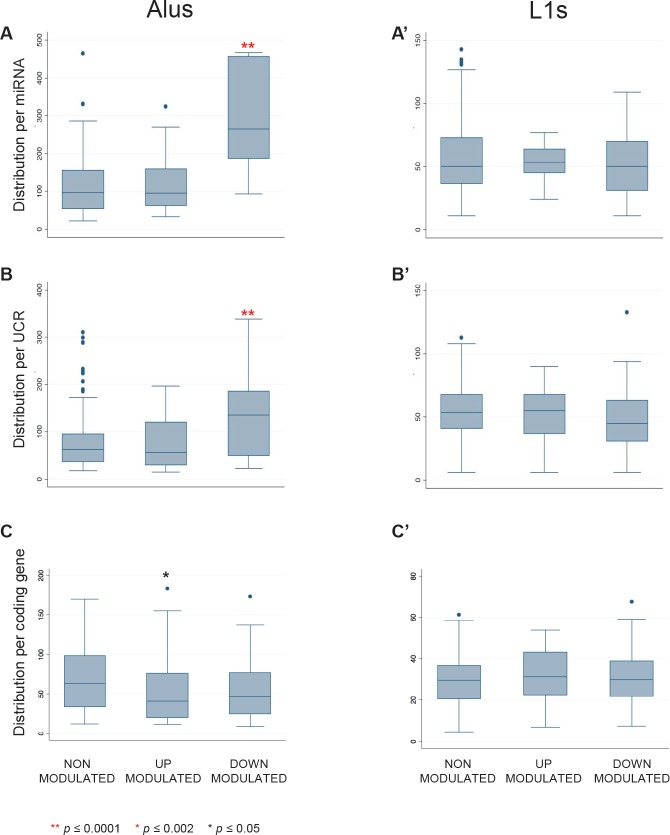
Figure 4. Alu and LINE-1 content around miRNAs, UCRs and coding genes
The box and whisker plots represent the distribution of numbers of repeated Alu (left panels) and LINE-1 (right panels) elements flanking (+/− 100 Kbp) the indicated sequence classes, i.e. miRNAs (A and A'), UCRs (B and B') and protein-coding genes (C and C'). EFV-downregulated miRNAs (A) and UCRs (B) are highly significantly enriched (**, P≤0.0001) in Alu elements.
Figure 5
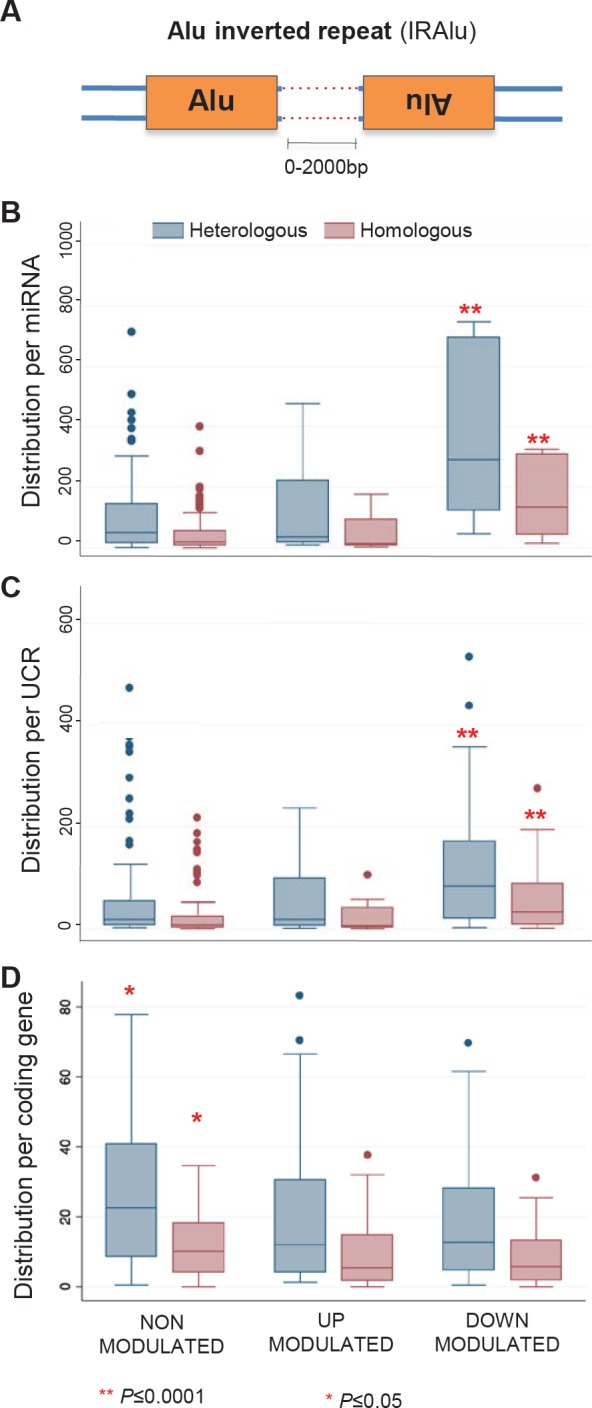
Figure 5. Inverted Alu repeats (IRAlus) distribution around miRNAs, UCRs and coding genes
IRAlus in which inverted repeats are spaced by less than 2.000 bp are considered (A). The box and whisker plots represent the distribution of numbers of IRAlus flanking (+/− 100 Kbp) the indicated sequence classes. IRAlus are highly significantly more abundant (**, P≤0.0001) among EFV-downregulated miRNAs (B) and UCRs (C), but not among EFV-modulated coding genes (D). Blue box plots represent heterologous IRAlus (i.e., Alu inverted repeats from two distinct subfamilies), red box plots represent homologous IRAlus (i.e., both Alu repeats from the same subfamily).
Figure 6
Figure 6. Model for RT-mediated control of the transcriptome in cancer cells
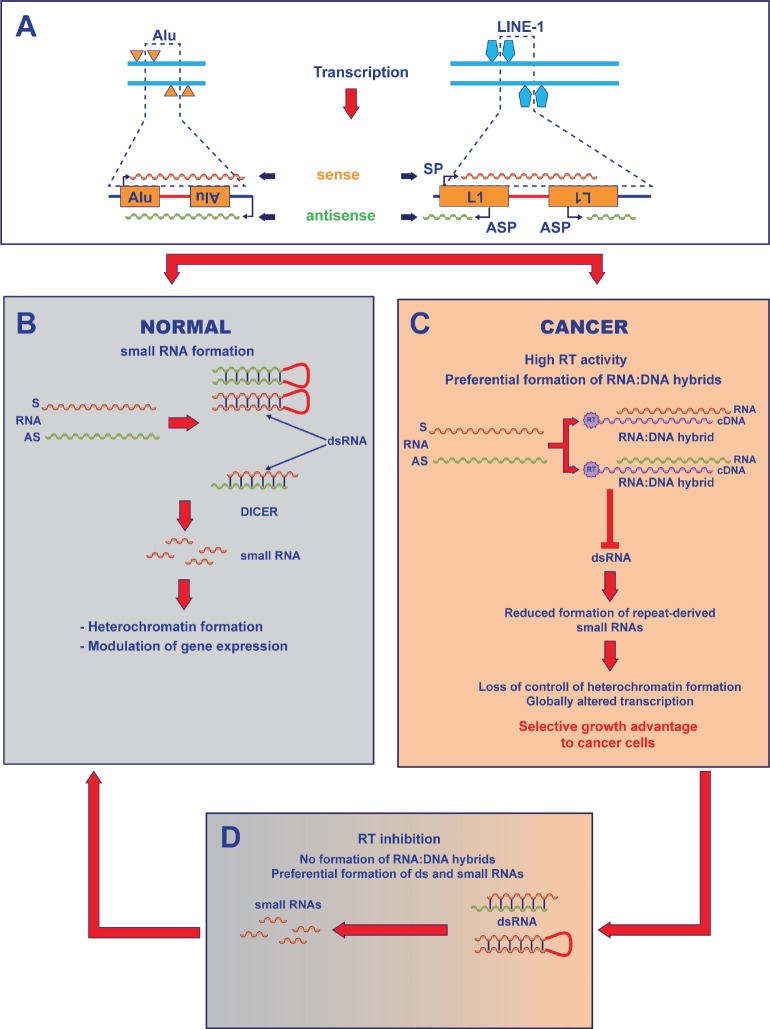
A) Retroelements are distributed in the genome in tandem and inverted repeats (i.e. closely spaced elements with opposite orientation). The top left panel depicts four Alu elements in opposite orientation on complementary DNA strands. Below, RNA transcripts (sense, red; antisense, green) containing two Alu retroelements in opposite orientation can be generated either by the internal Alu promoters, or from one Alu promoter and a nearby gene promoter in antisense orientation (external black arrows) provided by the host genome. LINE-1 elements (right) are endowed with sense (SP) and antisense (ASP) promoters, supporting LINE-1 sense and antisense transcription. B) In normal cells, double-stranded RNA (dsRNA) forms either via intramolecular base paring of an RNA containing two oppositely orientated retroelements, or via base pairing between sense (S) RNA and antisense (AS) RNAs. dsRNAs are processed by Dicer into small regulatory RNAs. C) In cancer cells, the RT encoded by highly active LINE-1 elements reverse-transcribes the available RNA populations: RNA:cDNA hybrid molecules form efficiently (Figure 3B) to the detriment of dsRNA. D) EFV treatment of cancer cells inhibits the RT activity, reduces the formation of RNA:cDNA hybrid and restores the control of regulatory small RNAs, causing the epigenetic conversion to a normal phenotype.

References

    1. The ENCODE Project Consortium An integrated encyclopedia of DNA elements in the human genome. Nature. 2012;489:57–74. - PMC - PubMed
    1. Djebali S, Davis CA, Merkel A, Dobin A, Lassmann T, Mortazavi A, Tanzer A, Lagarde J, Lin W, Schlesinger F, Xue C, Marinov GK, Khatun J, et al. Landscape of transcription in human cells. Nature. 2012;489:101–108. - PMC - PubMed
    1. INTERNATIONAL HUMAN GENOME CONSORTIUM Initial sequencing and analysis of the human genome. Nature. 2001;409:860–921. - PubMed
    1. Faulkner GJ, Kimura Y, Daub CO, Wani S, Plessy C, Irvine KM, Schroder K, Cloonan N, Steptoe AL, Lassmann T, Waki K, Hornig N, Arakawa T, et al. The regulated retrotransposon transcriptome of mammalian cells. Nat Genet. 2009;41:563–571. - PubMed
    1. Ivics Z. Genomic parasites and genome evolution. Genome Biol. 2009;10:R 306. - PMC - PubMed

Publication types

MeSH terms