. 2014 Feb 4;110(3):695-705.
doi: 10.1038/bjc.2013.770. Epub 2013 Dec 17.

Akt/Ezrin Tyr353/NF-κB pathway regulates EGF-induced EMT and metastasis in tongue squamous cell carcinoma

Affiliations

Akt/Ezrin Tyr353/NF-κB pathway regulates EGF-induced EMT and metastasis in tongue squamous cell carcinoma

Y Wang et al. Br J Cancer. .

Abstract

Background: Epithelial-mesenchymal transition (EMT) is a crucial programme in cancer metastasis. Epidermal growth factor (EGF) is a key inducer of EMT, and Ezrin has an important role in this process. However, how Ezrin is activated and whether it mediates EGF-induced EMT in tongue squamous cell carcinomas (TSCCs) through activating NF-κB remains obscure.

Methods: We used two TSCC cell lines as a cell model to study invasion and EMT in vitro, and used nude mice xenografts model to evaluate metastasis of TSCC cells. Finally, we evaluated the level of pEzrin Tyr353, nuclear p65 and EMT markers in TSCC clinical samples.

Results: Ezrin Tyr353 was phosphorylated through Akt (but not ERK1/2, ROCK1) pathway, and lead to the activation of NF-κB in EGF-treated TSCC cells. Akt and NF-κB inhibitors blocked EGF-induced EMT, and suppressed invasion and migration of TSCC cells. In vivo, silencing Ezrin significantly suppressed EGF-enhanced metastasis of TSCC xenografts. Finally, high levels of expression of pEzrin Tyr353, nuclear p65, vimentin and low level of expression of E-cadherin were correlated with cancer metastasis and poor patient prognosis.

Conclusion: Our data suggest that Akt/Ezrin Tyr353/NF-κB pathway regulates EGF-induced EMT and metastasis inTSCC, and Ezrin may serve as a therapeutic target to reverse EMT in tongue cancers and prevent TSCC progression.


Figures
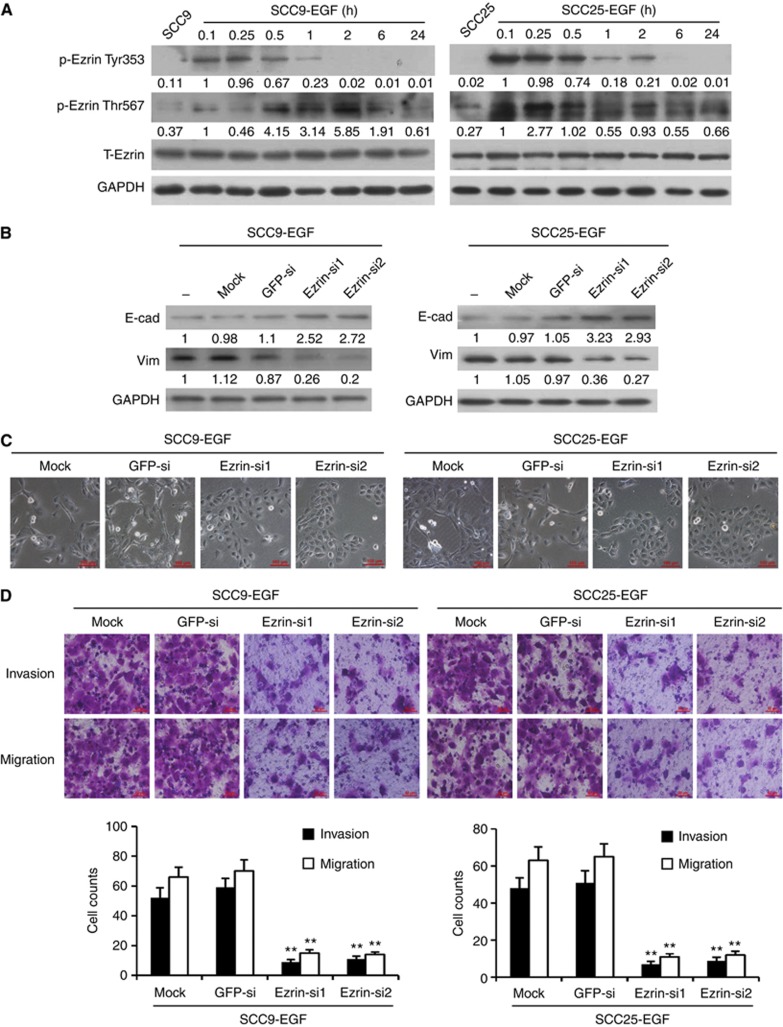
Figure 1
Figure 1
Ezrin is phosphorylated by EGF, and reduction of Ezrin inhibits EGF-induced EMT of SCC9 and SCC25 cells. (A) Western blotting showed that Ezrin Tyr 353 and Thr 567 were phosphorylated in EGF-treated SCC9 and SCC25 cells. Glyceraldehyde 3-phosphate dehydrogenase (GAPDH) was used as an internal control. The ratios of phosphorylated target to its total protein values were calculated. (B) Western blotting showed that transfection with Ezrin siRNA enhanced expression of E-cadherin (E-cad) and inhibited expression of vimentin (Vim) in EGF-treated SCC9 and SCC25 cells. The band intensity values of E-cadherin and vimentin were normalised to those of GAPDH. (C) Transfection with Ezrin siRNA inhibited mesenchymal morphology in EGF-treated SCC9 and SCC25 cells. Scale bar: 100 μm. (D) Modified Boyden chamber assays demonstrated transfection with Ezrin siRNA inhibited invasion and migration of EGF-treated SCC9 and SCC25 cells. Scale bar: 50 μm. **P<0.01 vs mock.
Figure 2
Figure 2
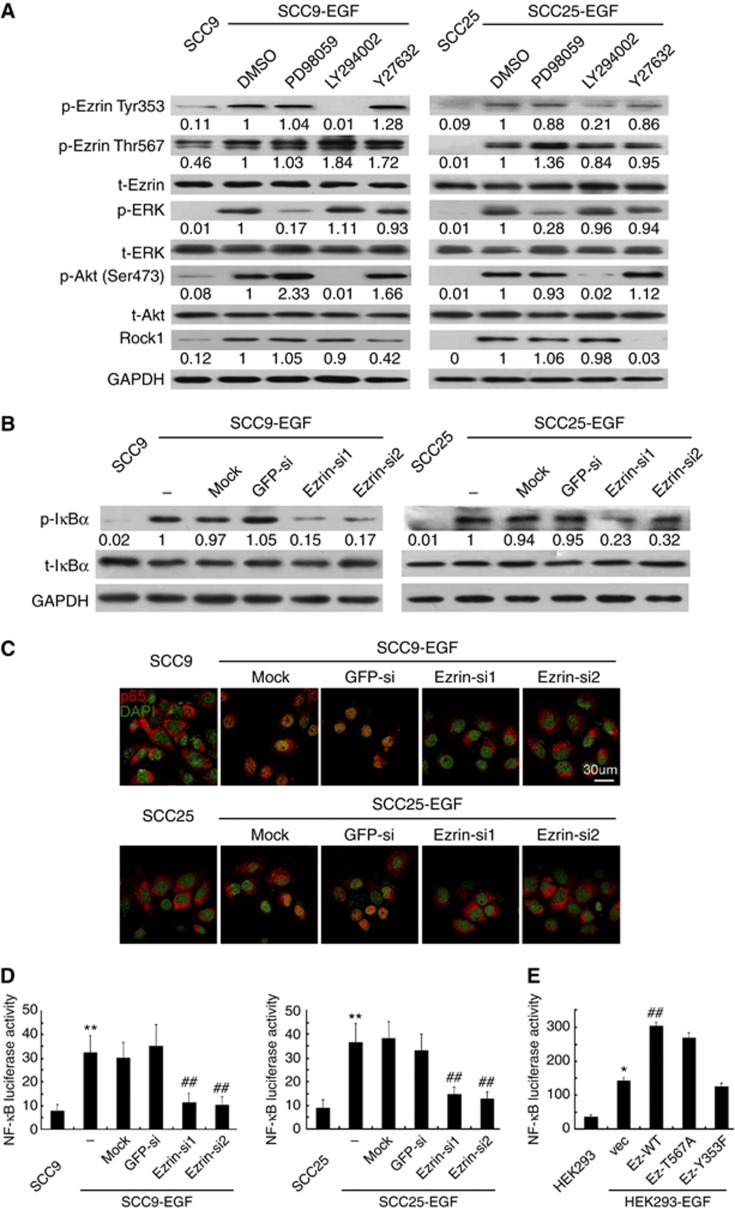
Phosphorylation of Akt and Ezrin Tyr353 is responsible for activation of NF-κB in EGF-treated SCC9 and SCC25 cells. (A) Western blotting showed that phosphorylation of Ezrin Tyr353 was inhibited by Akt inhibitor (LY294002, 20 μM) but not EKR1/2 (PD98059, 20 μM) and ROCK1 (Y27632, 20 μM) inhibitors, and these three inhibitors had no effect on phosphorylation of Ezrin Thr567 in EGF-treated SCC9 and SCC25 cells. (B) Western blotting showed that transfection with Ezrin siRNA inhibited phosphorylation of IκBα in EGF-treated SCC9 and SCC25 cells. The band intensity value of ROCK1 was normalised to those of GAPDH. The ratios of phosphorylated target to its total protein values were also calculated. (C) Immunofluorescence staining demonstrated that Ezrin siRNA inhibited p65 nuclear translocation in EGF-treated cells. Scale bar: 30 μm. p65: red; nuclear: green; merged: yellow. (D) Luciferase reporter assay showed that Ezrin siRNA inhibited NF-κB activity in EGF-treated cells. **P<0.01 vs SCC9 or SCC25 cells. ##P<0.01 vs mock. (E) Luciferase reporter assay showed that Ezrin Tyr353 was responsible for activation of NF-κB in EGF-treated HER-293 cells. vec: pcDNA3.1; Ez-WT: wild-type Ezrin; Ez-T567A: Ezrin with Thr567 mutated to Ala; Ez-Y353F: Ezrin with Tyr567 mutated to Phe. *P<0.05 vs SCC9 or SCC25 cell; ##P<0.01 vs vec.
Figure 3
Figure 3
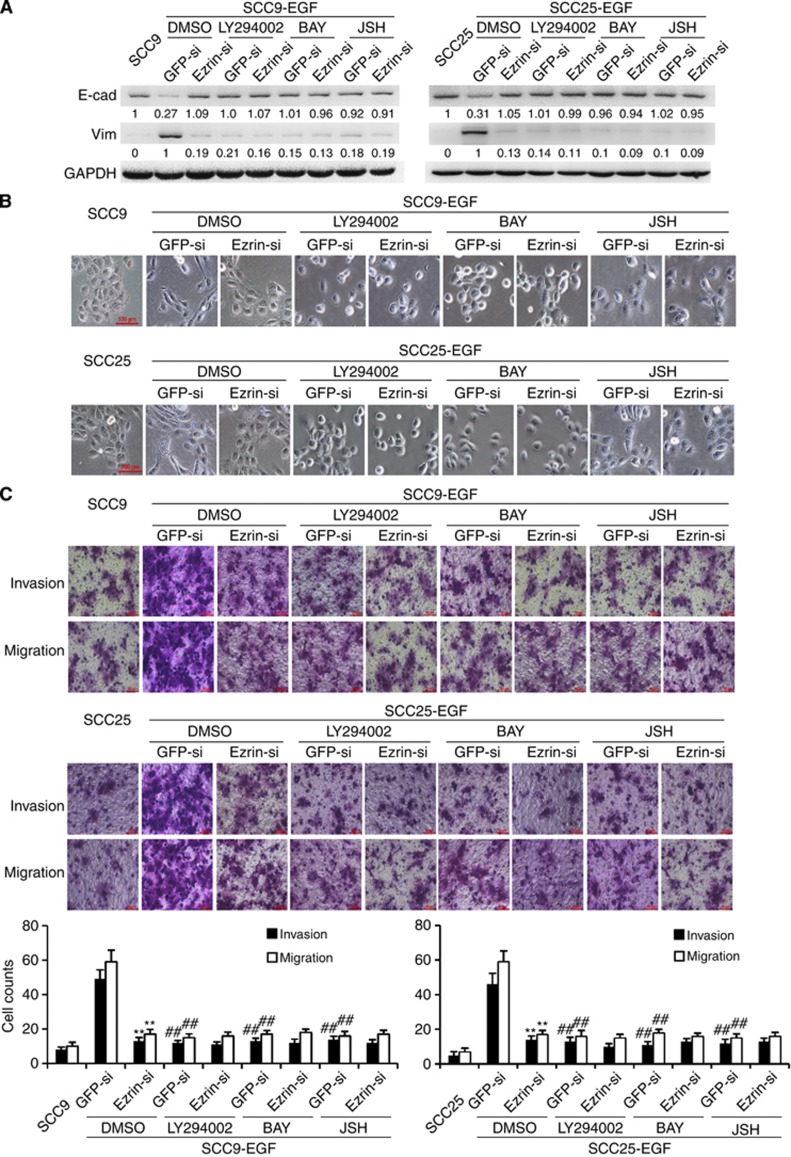
Epidermal growth factor induces EMT through Akt/Ezrin/NF-κB pathway in SCC9 and SCC25 cells. (A) Western blotting showed that transfection with Ezrin siRNA and pre-treating Akt inhibitor (LY294002), NF-κB inhibitor (Bay 11-7082, 10 μM and JSH-23, 20 μM) enhanced the expression of E-cadherin (E-cad) and inhibited expression of vimentin (Vim) in EGF-treated SCC9 and SCC25 cells. GAPDH was used as an internal control. (B) Transfection with Ezrin siRNA and pre-treating Akt inhibitor, NF-κB inhibitor reversed mesenchymal morphology of EGF-treated SCC9 and SCC25 cells. Scale bar: 100 μm. (C) Modified chamber assay showed that transfection with Ezrin siRNA and pre-treating Akt inhibitor, NF-κB inhibitor inhibited invasion and migration in EGF-treated SCC9 and SCC25 cells. Scale bar: 50 μm. **P<0.01 vs GFP-si; ##P<0.01 vs DMSO.
Figure 4
Figure 4
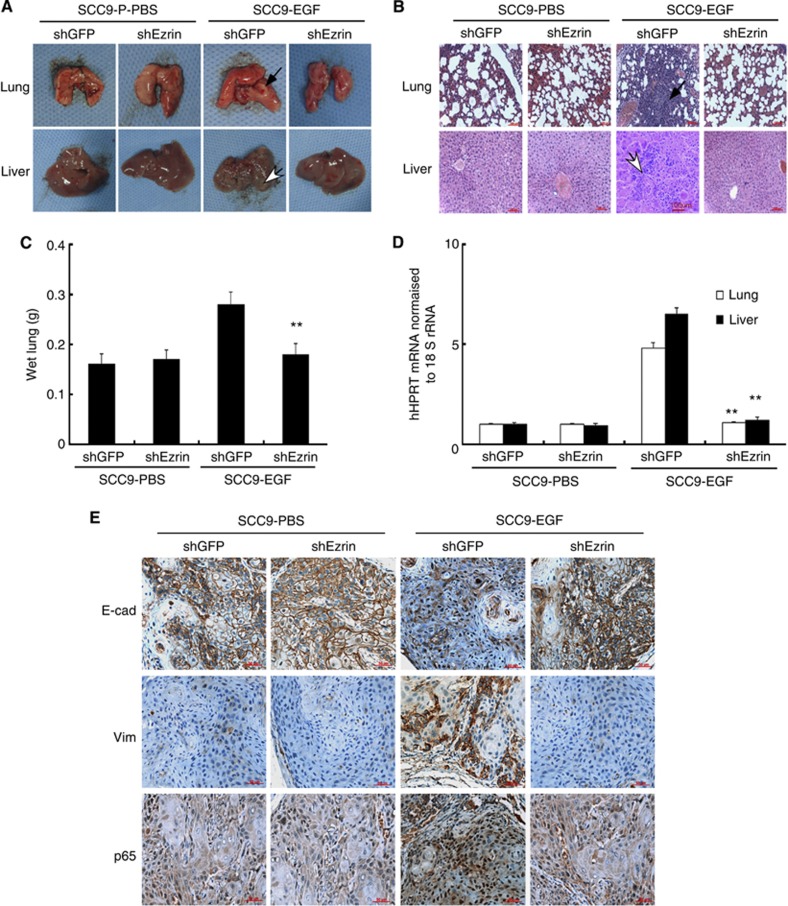
Reduction of Ezrin inhibits metastasis of EGF-injected SCC9 xenografts of BALB/c-nu mice. (A) Tissue images and (B) haematoxylin and eosin staining of paraffin sections for the lungs (upper) and livers (lower) of the tumour-bearing mice. Arrows: tumour; scale bar: 100 μm. (C) Mean±s.d. wet lung weight of tumour-bearing mice (n=8 per group). (D) Expression of human HPRT mRNA relative to mouse 18 S rRNA, in the lungs and livers of the tumour-bearing mice, was determined by qRT–PCR. **P<0.01 vs shGFP. (E) Immunohistochemical staining illustrated that reduction of Ezrin enhanced E-cadherin expression, inhibited vimentin expression and p65 nuclear expression of EGF-injected SCC9 xenografts. Scale bar: 50 μm. shEzrin, Ezrin shRNA.
Figure 5
Figure 5
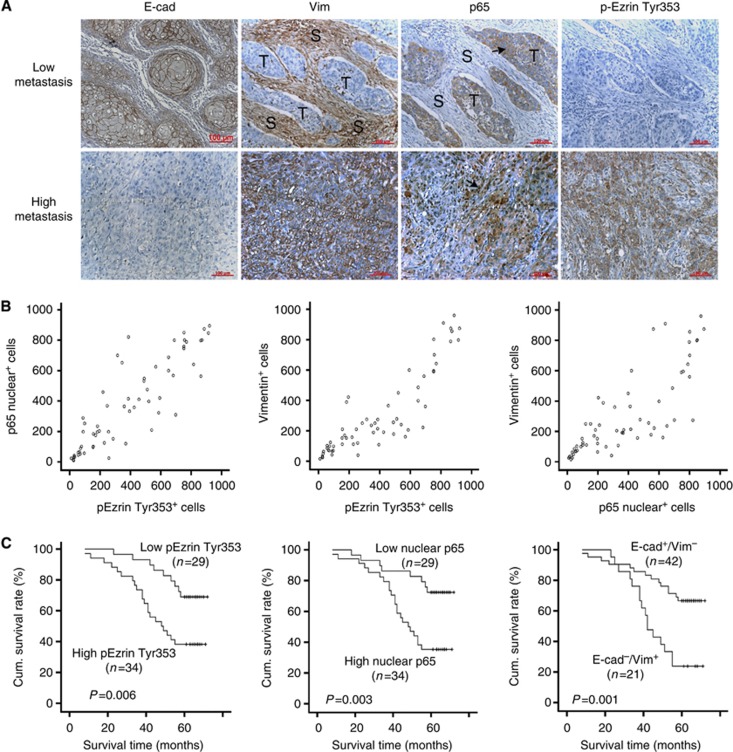
Activation of Ezrin and NF-κB correlates with metastasis and poor patient survival in TSCCs. (A) Immunohistochemical staining for E-cadherin (E-cad), vimentin (Vim), pEzrin Tyr353 and NF-κB p65 were demonstrated in TSCCs. Scale bar: 100 μm. T, tumour; S, stroma. Arrows indicate p65 staining. P65 was expressed in the cytoplasm in low metastatic TSCCs and translocated to cell nuclear in high metastatic TSCCs. (B) Associations between nuclear p65 (left), Vim (middle) expression and pEzrin Tyr353 expression, and between Vim (Baumgartner et al, 2006) and nuclear p65 in TSCCs were analysed with Spearman's order correlation. (C) Kaplan–Meier survival curves for TSCC patients plotted on pEzrin Tyr353 (left), nuclear p65 (middle) and E-cad/Vim (Baumgartner et al, 2006) expression, and survival difference was analysed by log-rank test. High expression: positive cells >30% low expression: positive cells <30%.

References

    1. Al Moustafa AE, Achkhar A, Yasmeen A. EGF-receptor signaling and epithelial–mesenchymal transition in human carcinomas. Front Biosci (School Ed) 2012;4:671–684. - PubMed
    1. Arpin M, Chirivino D, Naba A, Zwaenepoel I. Emerging role for ERM proteins in cell adhesion and migration. Cell Adhes Migr. 2011;5:199–206. - PMC - PubMed
    1. Baumgartner M, Sillman A, Blackwood E, Srivastava JMN, Schilling JW, Wright JH, Barber DL. The Nck-interacting kinase phosphorylates ERM proteins for formation of lamellipodium by growth factors. Proc Natl Acad Sci USA. 2006;103:13391–13396. - PMC - PubMed
    1. Chai KX, Cheng J-C, Auersperg N, Leung PCK. EGF-induced EMT and invasiveness in serous borderline ovarian tumor cells: a possible step in the transition to low-grade serous carcinoma cells. PLoS One. 2012;7:e34071. - PMC - PubMed
    1. Chaudhury A, Hussey GS, Ray PS, Jin G, Fox PL, Howe PH. TGF-β-mediated phosphorylation of hnRNP E1 induces EMT via transcript-selective translational induction of Dab2 and ILEI. Nat Cell Biol. 2010;12:286–293. - PMC - PubMed

Publication types

MeSH terms

LinkOut - more resources