. 2014 Jan 7;111(1):415-20.
doi: 10.1073/pnas.1319000111. Epub 2013 Dec 17.

Dual-modality gene reporter for in vivo imaging

Affiliations

Dual-modality gene reporter for in vivo imaging

P Stephen Patrick et al. Proc Natl Acad Sci U S A. .

Abstract

The ability to track cells and their patterns of gene expression in living organisms can increase our understanding of tissue development and disease. Gene reporters for bioluminescence, fluorescence, radionuclide, and magnetic resonance imaging (MRI) have been described but these suffer variously from limited depth penetration, spatial resolution, and sensitivity. We describe here a gene reporter, based on the organic anion transporting protein Oatp1a1, which mediates uptake of a clinically approved, Gd(3+)-based, hepatotrophic contrast agent (gadolinium-ethoxybenzyl-diethylenetriamine pentaacetic acid). Cells expressing the reporter showed readily reversible, intense, and positive contrast (up to 7.8-fold signal enhancement) in T1-weighted magnetic resonance images acquired in vivo. The maximum signal enhancement obtained so far is more than double that produced by MRI gene reporters described previously. Exchanging the Gd(3+) ion for the radionuclide, (111)In, also allowed detection by single-photon emission computed tomography, thus combining the spatial resolution of MRI with the sensitivity of radionuclide imaging.

Keywords: Oatp; SPECT.


Conflict of interest statement

The authors declare no conflict of interest.

Figures
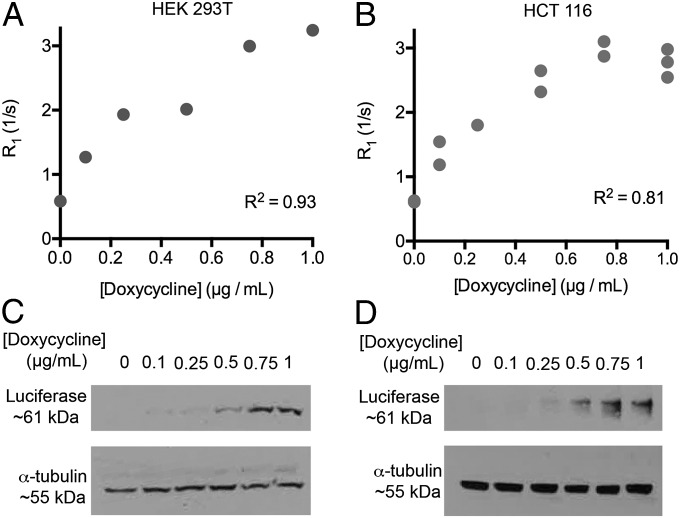
Fig. 1.
Fig. 1.
Relaxation enhancement rate (R1) correlates with Oatp1 expression. (A) Clonal HEK 293T and (B) HCT 116 cells transfected with the inducible pTRE3G-LO plasmid were induced for 24 h with doxycycline. Cells were then incubated with 0.5 mM (HEK 293T) or 0.25 mM (HCT 116) Gd-EOB-DTPA, washed, pelleted, and imaged with T1 imaging and mapping sequences. Western blots of luciferase in protein extracts from (C) HEK 293T and (D) HCT 116 cells shown in A and B, showing that induction of transgene expression correlated with doxycycline concentration and R1 enhancement.
Fig. 2.
Fig. 2.
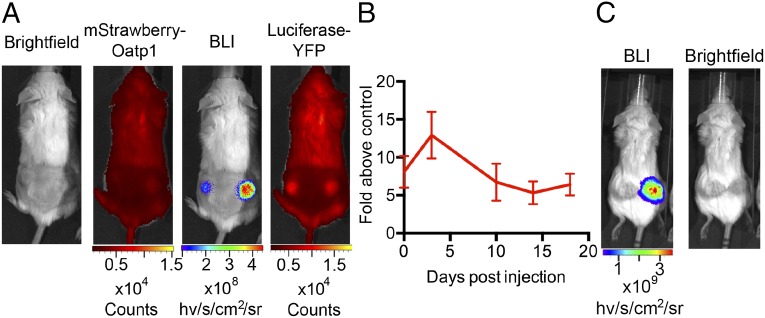
Bioluminescence measurements demonstrate expression of Oatp1 in vivo. (A) Light output was greater in the bioluminescence image (BLI) from the Oatp1-expressing HEK 293T xenograft (right flank), whereas luciferase–YFP fluorescence was the same in both xenografts. Red fluorescence confirmed expression of the mStrawberry–Oatp1 transgenes. (B) Mean increase in light output from Oatp1-expressing xenografts compared with controls expressing luciferase–YFP alone (n = 5). Points represent the average light output over 20 min following i.p. injection of luciferin. Error bars show SEM. (C) Light output was increased from a representative HCT 116 tumor expressing an inducible luciferase–E2A–Oatp1 construct, 3 d postinduction with doxycycline (10 mg/mL in drinking water), compared with the control tumor (left flank), which was not transfected with the construct.
Fig. 3.
Fig. 3.
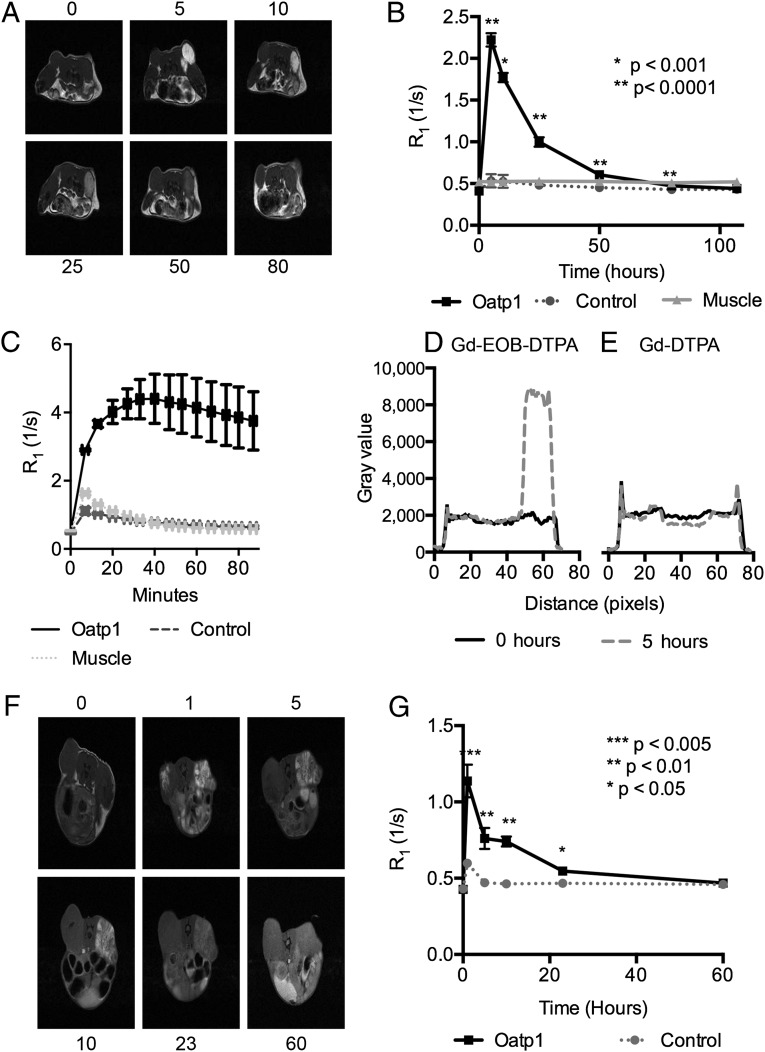
MRI of Oatp1 expression in vivo. (A) T1-weighted images before (0 h) and 5, 10, 25, 50, and 80 h after i.v. injection of Gd-EOB-DTPA, from a representative animal bearing an HEK 293T xenograft (as shown in Fig. 2). Control xenografts (left flank) expressed luciferase–YFP and the xenografts on the right flank also expressed Oatp1. (B) Xenograft relaxation rates (R1) before (0 h) and following i.v. injection of Gd-EOB-DTPA (0.664 mmoles/kg) were significantly greater compared with controls [*P < 0.001, **P < 0.0001, n = 5 (n = 4 at 107 h)]. (C) R1 increased in control and Oatp1-expressing xenografts after repeat i.v. injection with Gd-EOB-DTPA (0.664 mmoles/kg), following washout of the original dose in B and injection and washout of Gd-DTPA (E) (n = 2). Error bars show SEM. (D) Pixel intensities along a line bisecting the control and Oatp1-expressing xenografts shown in A, obtained before (0 h) and 5 h after Gd-EOB-DTPA injection. (E) The same as in D, but before (0 h) and 5 h after injection of Gd-DTPA. (F) T1-weighted images before (0 h) and 1, 5, 10, 23, and 60 h after i.v. injection of Gd-EOB-DTPA (0.664 mmoles/kg) from a representative mouse bearing a control HCT 116 xenograft (left flank) and a xenograft expressing the pTRE3G-LO construct (right flank). Animals were induced with 10 mg/mL doxycycline in the drinking water for 3 d before imaging. (G) Relaxation rates (R1) before (0 h) and following i.v. injection of Gd-EOB-DTPA. R1 was significantly greater in xenografts expressing Oatp1 compared with controls (one-tailed paired t test, *P < 0.05, **P < 0.01, ***P < 0.005, n = 4 at 0–24 h, n = 3 at 60 h). Error bars show the SEM. Some error bars are obscured by the data points.
Fig. 4.
Fig. 4.
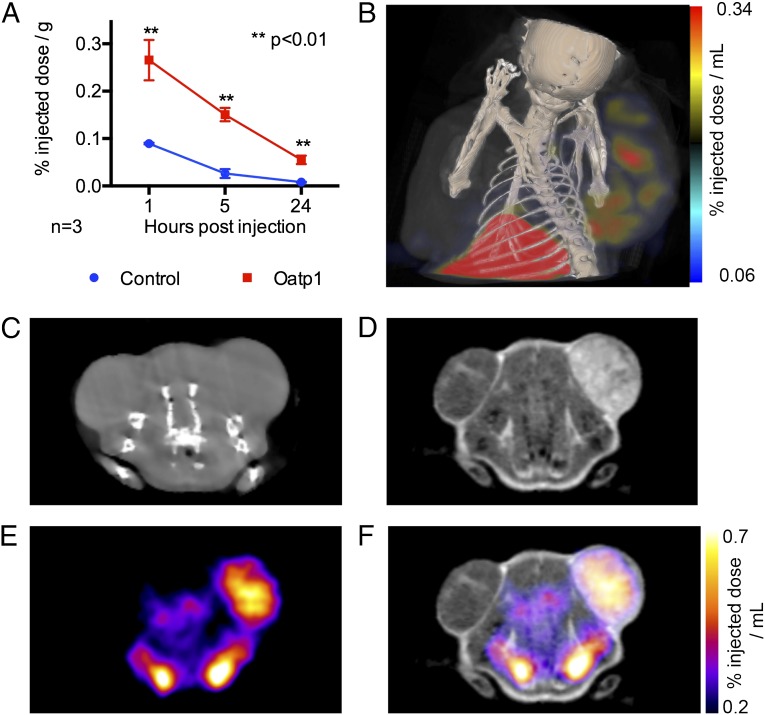
Oatp1 expression was detectable in HEK 293T xenografts using MRI and SPECT after sequential injections of Gd-EOB-DTPA and 111In-EOB-DTPA, respectively. (A) Measurements on extracted tissue showed that 111In-EOB-DTPA was taken up by Oatp1-expressing xenografts (n = 3, two-tailed t test, **P < 0.01). (B) SPECT-CT image obtained 5 h after injection of 111In-EOB-DTPA. The xenograft on the left flank was a control and the xenograft on the right flank expressed Oatp1. (C) CT image showing control (left flank) and Oatp1-expressing (right flank) xenografts. (D) T1-weighted MR image of the section shown in C, 1 h postinjection of Gd-EOB-DTPA. (E) SPECT image of the cross section shown in C, 1 h postinjection of 111In-EOB-DTPA. (F) MRI and SPECT images shown in D and E combined.

References

    1. Brader P, Serganova I, Blasberg RG. Noninvasive molecular imaging using reporter genes. J Nucl Med. 2013;54(2):167–172. - PubMed
    1. Lyons SK, Patrick PS, Brindle KM. 2013. Imaging mouse cancer models in vivo using reporter transgenes. Cold Spring Harb Protoc 2013(8):685–699.
    1. Contag CH, Bachmann MH. Advances in in vivo bioluminescence imaging of gene expression. Annu Rev Biomed Eng. 2002;4:235–260. - PubMed
    1. Shaner NC, et al. Improved monomeric red, orange and yellow fluorescent proteins derived from Discosoma sp. red fluorescent protein. Nat Biotechnol. 2004;22(12):1567–1572. - PubMed
    1. James ML, Gambhir SS. A molecular imaging primer: Modalities, imaging agents, and applications. Physiol Rev. 2012;92(2):897–965. - PubMed

Publication types

MeSH terms

LinkOut - more resources