


Genetic screen of African Americans with Fuchs endothelial corneal dystrophy
- PMID: 24348007
- PMCID: PMC3859630
Genetic screen of African Americans with Fuchs endothelial corneal dystrophy
Abstract
Purpose: Fuchs endothelial corneal dystrophy (FECD) is a genetically heterogeneous disorder that has been primarily studied in patients of European or Asian ancestry. Given the sparse literature on African Americans with FECD, we sought to characterize the genetic variation in three known FECD candidate genes in African American patients with FECD.
Methods: Over an 8-year period, we enrolled 47 African American probands with FECD. All participants were clinically examined with slit-lamp biomicroscopy, and when corneal tissue specimens were available, histopathologic confirmation of the clinical diagnosis was obtained. The coding regions of known FECD susceptibility genes collagen, type VIII, alpha 2 (COL8A2); solute carrier family 4, sodium borate transporter, member 11 (SLC4A11); and zinc finger E-box binding homeobox 1 (ZEB1 [also known as TCF8]) were Sanger sequenced in the 47 probands using DNA isolated from blood samples.
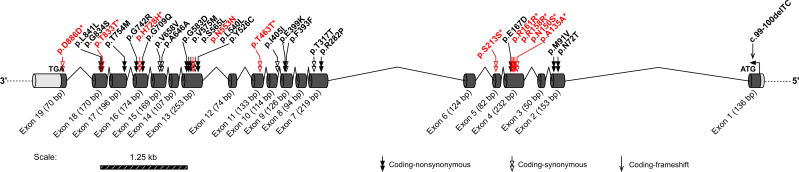
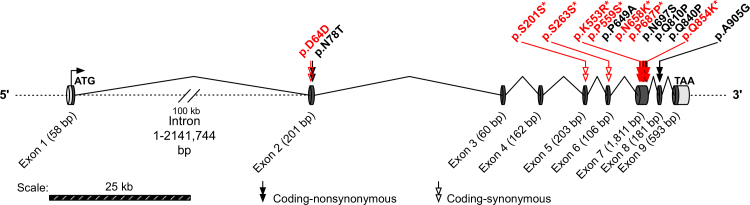
Results: Twenty-two coding variants were detected across the COL8A2, SLC4A11, and ZEB1 genes; six were nonsynonymous variants. Three novel coding variants were detected: a synonymous variant each in COL8A2 and SLC4A11 and one nonsynonymous variant in ZEB1 (p.P559S), which is predicted to be benign and tolerated, thus making its physiologic consequence uncertain.
Conclusions: Variation in the COL8A2, SLC4A11, and ZEB1 genes is present in only a small fraction of our African American cases and as such does not appear to significantly contribute to the genetic risk of FECD in African Americans. This observation is on par with findings from previous sequencing studies involving European or Asian ancestry patients with FECD.
Figures

References
-
- Afshari NA, Pittard AB, Siddiqui A, Klintworth GK. Clinical study of Fuchs corneal endothelial dystrophy leading to penetrating keratoplasty: a 30-year experience. Arch Ophthalmol. 2006;124:777–80. - PubMed
-
- Krachmer JH, Purcell JJ, Jr, Young CW, Bucher KD. Corneal endothelial dystrophy. A study of 64 families. Arch Ophthalmol. 1978;96:2036–9. - PubMed
-
- Rosenblum P, Stark WJ, Maumenee IH, Hirst LW, Maumenee AE. Hereditary Fuchs' Dystrophy. Am J Ophthalmol. 1980;90:455–62. - PubMed
-
- Louttit MD, Kopplin LJ, Igo RP, Jr, Fondran JR, Tagliaferri A, Bardenstein D, Aldave AJ, Croasdale CR, Price MO, Rosenwasser GO, Lass JH, Iyengar SK. A multicenter study to map genes for Fuchs endothelial corneal dystrophy: baseline characteristics and heritability. Cornea. 2012;31:26–35. - PMC - PubMed
Publication types
MeSH terms
Substances
Grants and funding
LinkOut - more resources
Full Text Sources
Research Materials