


Chronic khat (Catha edulis) and alcohol marginally alter complete blood counts, clinical chemistry, and testosterone in male rats
- PMID: 24348075
- PMCID: PMC3858587
- DOI: 10.2147/JEP.S46635
Chronic khat (Catha edulis) and alcohol marginally alter complete blood counts, clinical chemistry, and testosterone in male rats
Abstract
Introduction: Khat (Catha edulis) is a recreational psychoactive drug with psychostimulant properties. While the use of this drug is widespread in eastern Africa, including the Horn of Africa, surveys and anecdotal data show that its use has become cosmopolitan, with users now living in Europe and North America as well. Recent data in Uganda suggest an increasing pattern of simultaneous khat and ethanol use particularly among young adults. However, the effects of this pattern of use remain largely unknown, even though long-term use of either drug alone is known to be harmful. The aim of this study was to examine the toxic effects of simultaneous chronic administration of khat and ethanol on hematological parameters, clinical chemistry, and testosterone in a rat model.
Methods: Adult male Sprague-Dawley rats were randomly assigned to one of six dose groups: 2 g/kg khat; 4 g/kg khat; 4 g/kg ethanol; combined khat and ethanol (4 g/kg each); control; and an untreated group. Treatments were given by gavage twice daily for 28 days, followed by determination of hematological parameters, blood clinical chemistry, and testosterone.
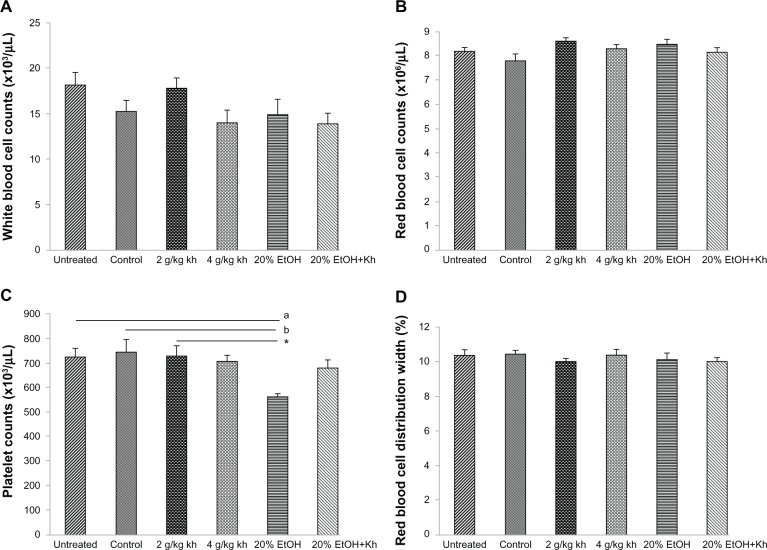
Results: Ethanol alone significantly reduced platelet counts compared to control-, untreated and low-dose khat-treated rats; conversely low-dose khat significantly increased both the hemoglobin and hematocrit values, while ethanol alone also significantly increased the hemoglobin value compared to controls. Simultaneous khat and ethanol administration per se did not produce more toxic consequences in chronic use than either drug alone.
Conclusion: Chronic short-term khat use and ethanol dependence individually produce note-worthy effects on the blood, but not on clinical chemistry or testosterone. Chronic short-term combined khat and ethanol use does not produce more toxic effects compared to use of either drug alone. This provides an opportunity for appropriate clinical interventions to avert the chronic long-term effects that result from use of these drugs of abuse.
Keywords: chemistry; chronic; ethanol; hematology; khat; testosterone.
Figures



References
-
- Al-Samarraie M, Z Khiabani H, Opdal MS. Khat – a new drug of abuse in Norway. Tidsskr Nor Laegeforen. 2007;127(5):574–576. Norwegian. - PubMed
-
- Nencini P, Ahmed AM. Khat consumption: a pharmacological review. Drug Alcohol Depend. 1989;23(1):19–29. - PubMed
-
- Ihunwo AO, Kayanja FIB, Amadi-Ihunwo UB. Use and perception of the psychostimulant, khat (catha edulis) among three occupational groups in south western Uganda. East Afr Med J. 2004;81(9):468–473. - PubMed
-
- Anderson D, Beckerleg S, Hailu D, Klein A. The Khat Controversy: Stimulating the Debate on Drugs. Oxford: Berg Publishers; 2007.
Grants and funding
LinkOut - more resources
Full Text Sources
Other Literature Sources
