. 2013 Nov;56(11):482-9.
doi: 10.3345/kjp.2013.56.11.482. Epub 2013 Nov 27.

The effect of rhinovirus on airway inflammation in a murine asthma model

Affiliations

The effect of rhinovirus on airway inflammation in a murine asthma model

Eugene Kim et al. Korean J Pediatr. 2013 Nov.

Abstract

Purpose: The aim of the present study was to investigate the differences in lower airway inflammatory immune responses, including cellular responses and responses in terms of inflammatory mediators in bronchoalveolar lavage fluid (BALF) and the airway, to rhinovirus (RV) infection on asthma exacerbation by comparing a control and a murine asthma model, with or without RV infection.

Methods: BALB/c mice were intraperitoneally injected with a crude extract of Dermatophagoides farinae (Df) or phosphate buffered saline (PBS) and were subsequently intranasally treated with a crude extract of Df or PBS. Airway responsiveness and cell infiltration, differential cell counts in BALF, and cytokine and chemokine concentrations in BALF were measured 24 hours after intranasal RV1B infection.

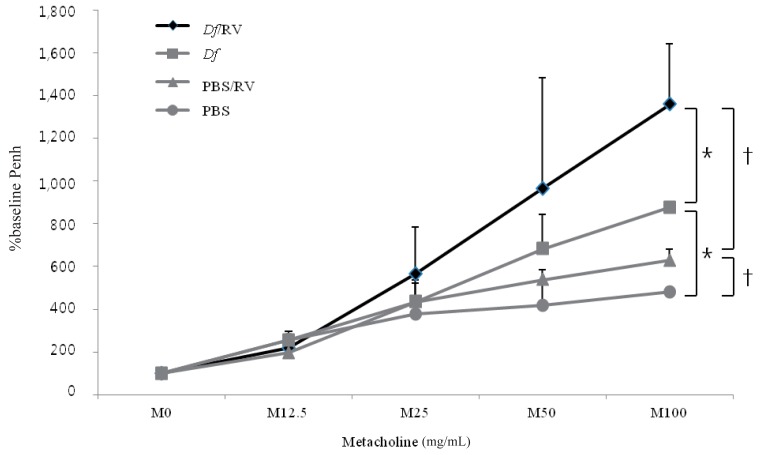
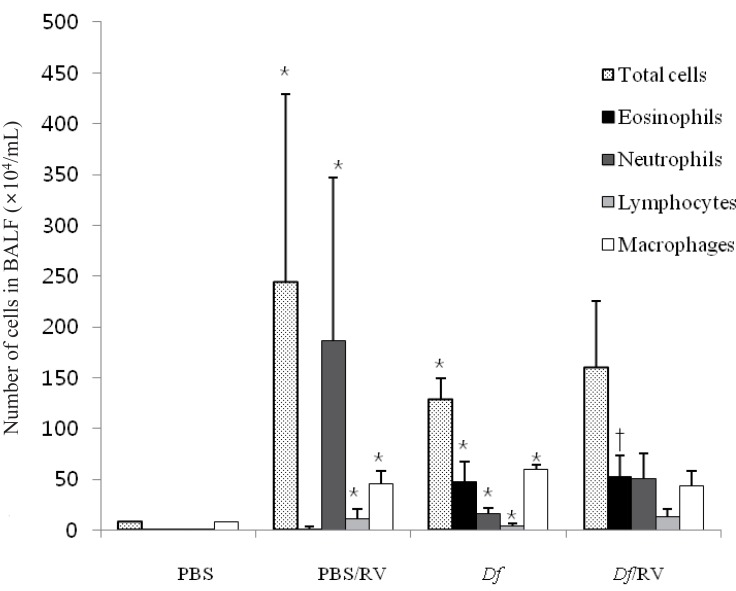
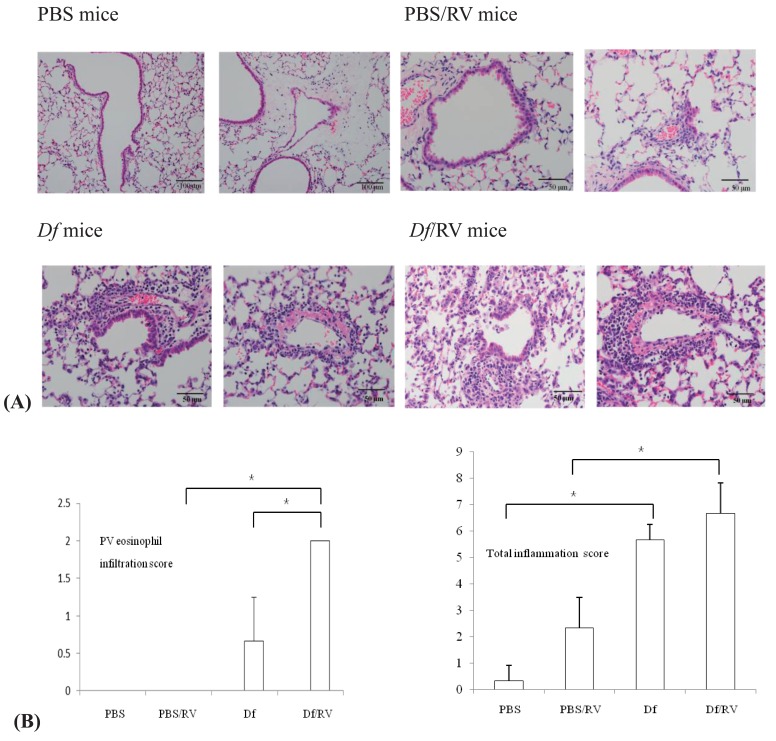
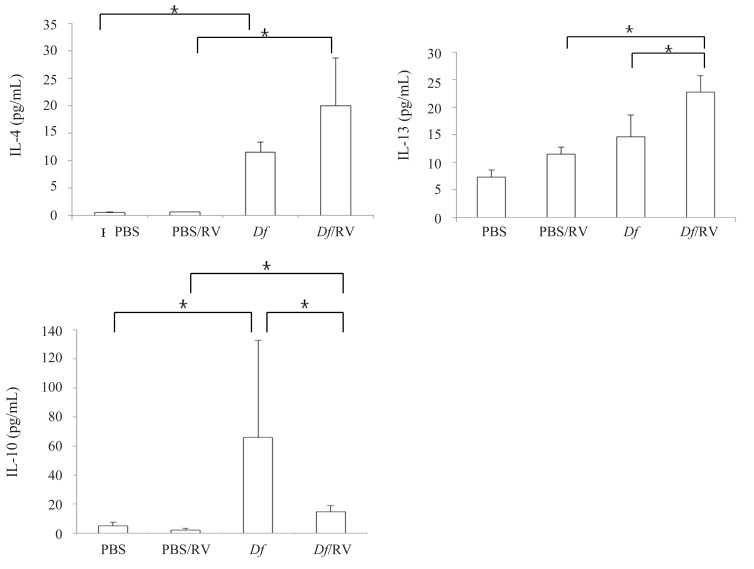
Results: RV infection increased the enhanced pause (Penh) in both the Df sensitized and challenged mice (Df mice) and PBS-treated mice (PBS mice) (P<0.05). Airway eosinophil infiltration increased in Df mice after RV infection (P<0.05). The levels of interleukin (IL) 13, tumor necrosis factor alpha, and regulated on activation, normal T cells expressed and secreted (RANTES) increased in response to RV infection in Df mice, but not in PBS mice (P<0.05). The level of IL-10 significantly decreased following RV infection in Df mice (P<0.05).

Conclusion: Our findings suggest that the augmented induction of proinflammatory cytokines, Th2 cytokines, and chemokines that mediate an eosinophil response and the decreased induction of regulatory cytokines after RV infection may be important manifestations leading to airway inflammation with eosinophil infiltration and changes in airway responsiveness in the asthma model.

Keywords: Asthma; Exacerbation; Immune response; Rhinovirus.


Conflict of interest statement

No potential conflict of interest relevant to this article was reported.

Figures
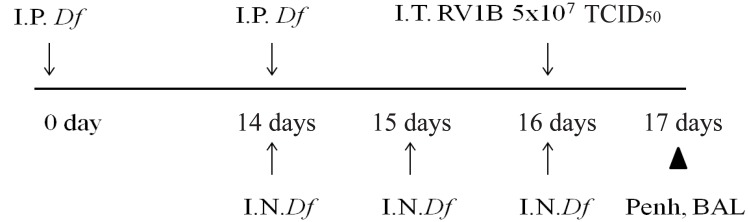
Fig. 1
Fig. 1
Protocol for exacerbation of allergic reactions induced by rhinovirus administration in BALB/c mice. I.P., intraperitoneal; I.T., intratracheal; I.N., intranasal; Df, Dermatophagoides farinae; BAL, bronchoalveolar lavage; TCID50, 50% tissue culture infective dose.
Fig. 2
Fig. 2
Airway hyperresponsiveness as determined by the measurement of the enhanced pause (n=3 mice per group). PBS mice, phosphate buffered saline-treated mice; Df mice, Dermatophagoides farinae sensitized and challenged mice; RV, rhinovirus. *P<0.05 vs. Df mice. P<0.05 vs. PBS/RV.
Fig. 3
Fig. 3
Total and differential cell counts in bronchoalveolar lavage fluid (BALF) (n=3 mice per group). PBS mice, phosphate buffered saline-treated mice; Df mice, Dermatophagoides farinae sensitized and challenged mice; RV, rhinovirus. *P<0.05 vs. PBS. P<0.05, PBS/RV vs. Df/RV.
Fig. 4
Fig. 4
(A) Hematoxylin and eosin-stained lung sections (n=3 mice per group). Rhinovirus (RV) infection induced focal loss of bronchial epithelial cells (left) and an increase in perivascular inflammatory cell infiltration (right) in Dermatophagoides farinae (Df) sensitized and challenged mice (Df mice). Perivascular eosinophil infiltration was observed in Df mice and in Df mice with RV infection (Df/RV mice) (×100, scale bars indicate 100 µm for phosphate buffered saline-treated mice [PBS mice]; ×200, scale bars indicate 50 µm for the other 3 groups). (B) Perivascular (PV) eosinophil infiltration and total inflammation score (n=3 mice per group). PBS mice, phosphate buffered saline-treated mice; Df mice, Dermatophagoides farinae sensitized and challenged mice; RV, rhinovirus. *P<0.05.
Fig. 5
Fig. 5
Concentrations of Th2 cytokines (interleukin [IL] 4 and IL-13) and IL-10 in bronchoalveolar lavage fluid (n=5 mice per group). PBS mice, phosphate buffered saline-treated mice; Df mice, Dermatophagoides farinae sensitized and challenged mice; RV, rhinovirus. *P<0.05.
Fig. 6
Fig. 6
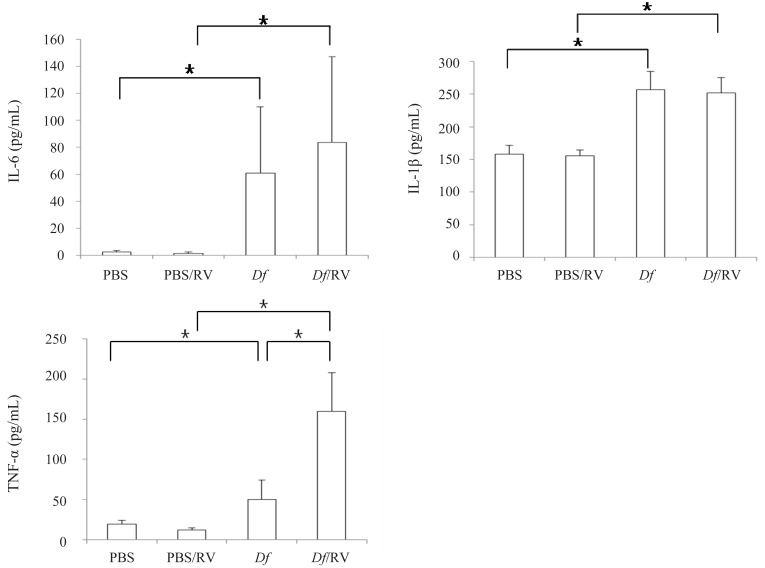
Concentrations of proinflammatory cytokines (interleukin [IL] 6, IL-1β, and tumor necrosis factor [TNF-α]) in bronchoalveolar lavage fluid (n=5 mice per group). PBS mice, phosphate buffered saline-treated mice; Df mice, Dermatophagoides farinae sensitized and challenged mice; RV, rhinovirus. *P<0.05.
Fig. 7
Fig. 7
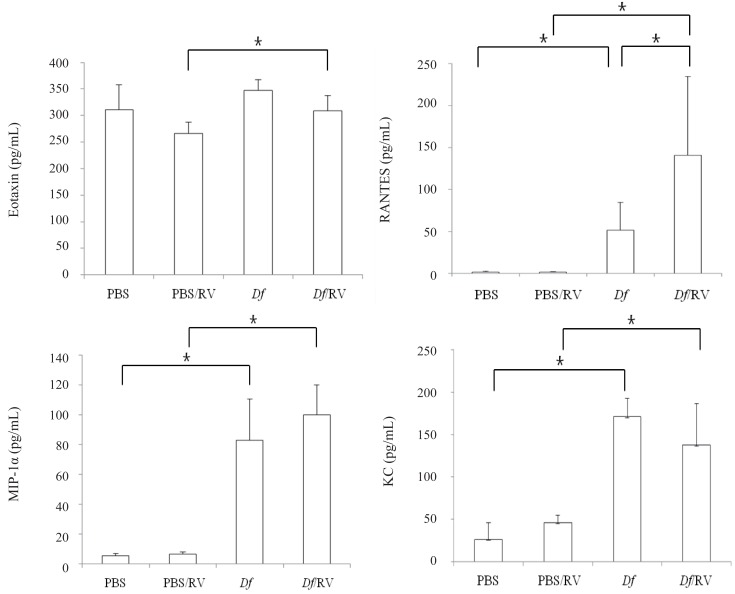
Concentrations of chemokines (regulated on activation, normal T cells expressed and secreted [RANTES], eotaxin, macrophage inflammatory protein-1-alpha [MIP-1α], and keratinocyte-derived chemokines [KC]) in bronchoalveolar lavage fluid (n=5 mice per group). PBS mice, phosphate buffered saline-treated mice; Df mice, Dermatophagoides farinae sensitized and challenged mice; RV, rhinovirus. *P<0.05.

References

    1. Johnston SL, Pattemore PK, Sanderson G, Smith S, Lampe F, Josephs L, et al. Community study of role of viral infections in exacerbations of asthma in 9-11 year old children. BMJ. 1995;310:1225–1229. - PMC - PubMed
    1. Kim WK. Human rhinoviruses and asthma in children. Korean J Pediatr. 2010;53:129–135.
    1. Kelly JT, Busse WW. Host immune responses to rhinovirus: mechanisms in asthma. J Allergy Clin Immunol. 2008;122:671–682. - PMC - PubMed
    1. Spahn JD. Asthma biomarkers in sputum. Immunol Allergy Clin North Am. 2012;32:387–399. - PubMed
    1. Silkoff PE, Trudeau JB, Gibbs R, Wenzel S. The relationship of induced-sputum inflammatory cells to BAL and biopsy. Chest. 2003;123(3 Suppl):371S–372S. - PubMed

LinkOut - more resources