


Renal function can improve at any stage of chronic kidney disease
- PMID: 24349134
- PMCID: PMC3862566
- DOI: 10.1371/journal.pone.0081835
Renal function can improve at any stage of chronic kidney disease
Abstract
Introduction: Even though renal function decline is considered relentless in chronic kidney disease (CKD), improvement has been shown in patients with hypertensive nephropathy. Whether this can occur in any type of nephropathy and at any stage is unknown as are the features of patients who improve.
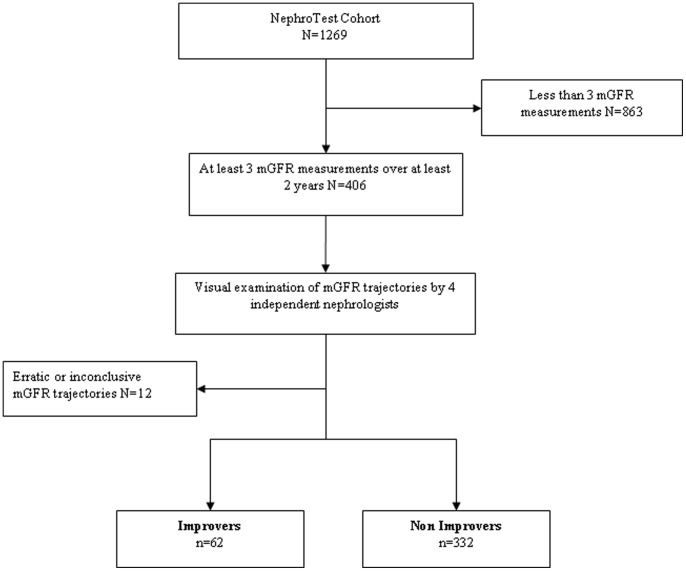
Methods: We identified 406 patients in the NephroTest cohort with glomerular filtration rates (mGFR) measured by (51)Cr-EDTA clearance at least 3 times during at least 2 years of follow-up. Individual examination of mGFR trajectories by 4 independent nephrologists classified patients as improvers, defined as those showing a sustained mGFR increase, or nonimprovers. Twelve patients with erratic trajectories were excluded. Baseline data were compared between improvers and nonimprovers, as was the number of recommended therapeutic targets achieved over time (specifically, for systolic and diastolic blood pressure, proteinuria, and use of renin angiotensin system blockers).
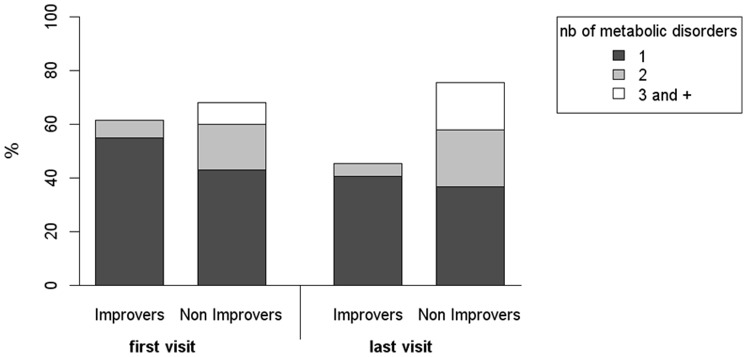
Results: Measured GFR improved over time in 62 patients (15.3%). Their median mGFR slope was +1.88[IQR 1.38, 3.55] ml/min/year; it was -2.23[-3.9, -0.91] for the 332 nonimprovers. Improvers had various nephropathies, but not diabetic glomerulopathy or polycystic kidney disease. They did not differ from nonimprovers for age, sex, cardiovascular history, or CKD stage, but their urinary albumin excretion rate was lower. Improvers achieved significantly more recommended therapeutic targets (2.74±0.87) than nonimprovers (2.44±0.80, p<0.01). They also had fewer CKD-related metabolic complications and a lower prevalence of 25OH-vitamin-D deficiency.
Conclusion: GFR improvement is possible in CKD patients at any CKD stage through stage 4-5. It is noteworthy that this GFR improvement is associated with a decrease in the number of metabolic complications over time.
Conflict of interest statement
Figures
References
-
- Klahr S, Levey AS, Beck GJ, Caggiula AW, Hunsicker L, et al. (1994) The effects of dietary protein restriction and blood-pressure control on the progression of chronic renal disease. Modification of Diet in Renal Disease Study Group. N Engl J Med 330: 877–84. - PubMed
-
- Hunsicker LG, Adler S, Caggiula A, England BK, Greene T, et al. (1997) Predictors of the progression of renal disease in the Modification of Diet in Renal Disease Study. Kidney Int 51: 1908–19. - PubMed
-
- Eriksen BO, Ingebretsen OC (2006) The progression of chronic kidney disease: a 10-year population-based study of the effects of gender and age. Kidney Int 69: 375–82. - PubMed
-
- Hemmelgarn BR, Zhang J, Manns BJ, Tonelli M, Larsen E, et al. (2006) Progression of kidney dysfunction in the community-dwelling elderly. Kidney Int 69: 2155–61. - PubMed
MeSH terms
Substances
Supplementary concepts
LinkOut - more resources
Full Text Sources
Other Literature Sources
Medical
