Randomized Controlled Trial
. 2013 Dec 12;8(12):e83309.
doi: 10.1371/journal.pone.0083309. eCollection 2013.

Effects of textured insoles on balance in people with Parkinson's disease

Affiliations
Randomized Controlled Trial

Effects of textured insoles on balance in people with Parkinson's disease

Feng Qiu et al. PLoS One. .

Abstract

Background: Degradation of the somatosensory system has been implicated in postural instability and increased falls risk for older people and Parkinson's disease (PD) patients. Here we demonstrate that textured insoles provide a passive intervention that is an inexpensive and accessible means to enhance the somatosensory input from the plantar surface of the feet.

Methods: 20 healthy older adults (controls) and 20 participants with PD were recruited for the study. We evaluated effects of manipulating somatosensory information from the plantar surface of the feet using textured insoles. Participants performed standing tests, on two different surfaces (firm and foam), under three footwear conditions: 1) barefoot; 2) smooth insoles; and 3) textured insoles. Standing balance was evaluated using a force plate yielding data on the range of anterior-posterior and medial-lateral sway, as well as standard deviations for anterior-posterior and medial-lateral sway.

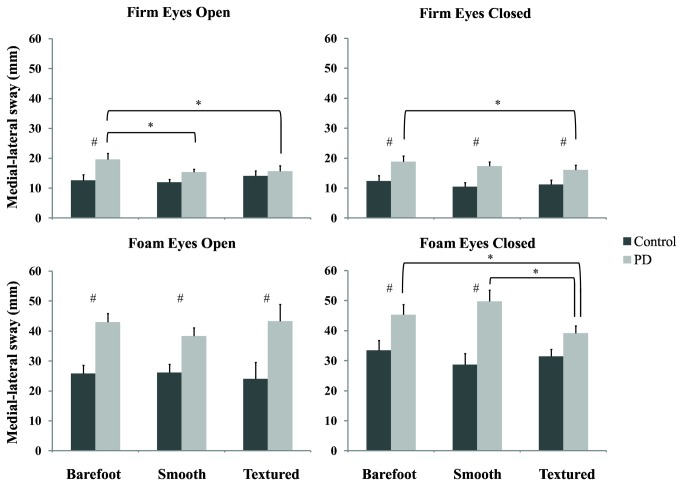
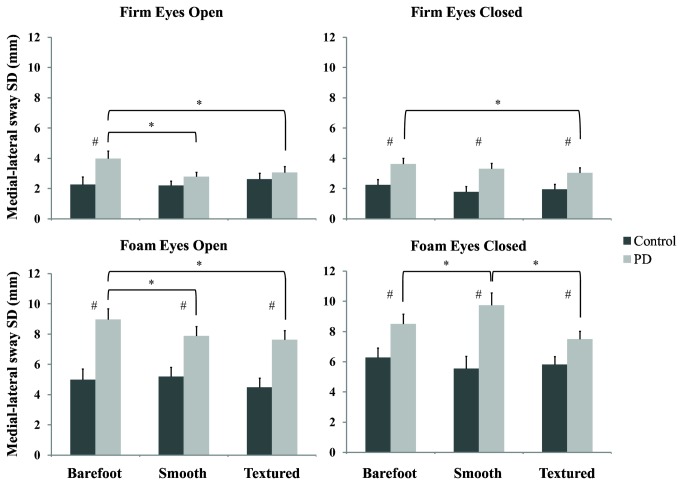
Results: On the firm surface with eyes open both the smooth and textured insoles reduced medial-lateral sway in the PD group to a similar level as the controls. Only the textured insole decreased medial-lateral sway and medial-lateral sway standard deviation in the PD group on both surfaces, with and without visual input. Greatest benefits were observed in the PD group while wearing the textured insoles, and when standing on the foam surface with eyes closed.

Conclusions: Data suggested that textured insoles may provide a low-cost means of improving postural stability in high falls-risk groups, such as people with PD.


Conflict of interest statement

Competing Interests: Please note that there is no formal affiliation with the International Children’s Orthotic Laboratory which is owned by Dr Heather Netscher, who is a co-author on the paper. Dr Netscher’s company is primarily focused on podiatric problems in children and not with people with Parkinson’s disease. Her company contributed to the manufacture of the textured insoles without any expectation of immediate or future financial benefit. There is no patent associated with the insole and the authors have elected to publish details as an open-source paper so that it is freely available. This does not alter our adherence to all the PLOS ONE policies on sharing data and materials.

Figures

Figure 1
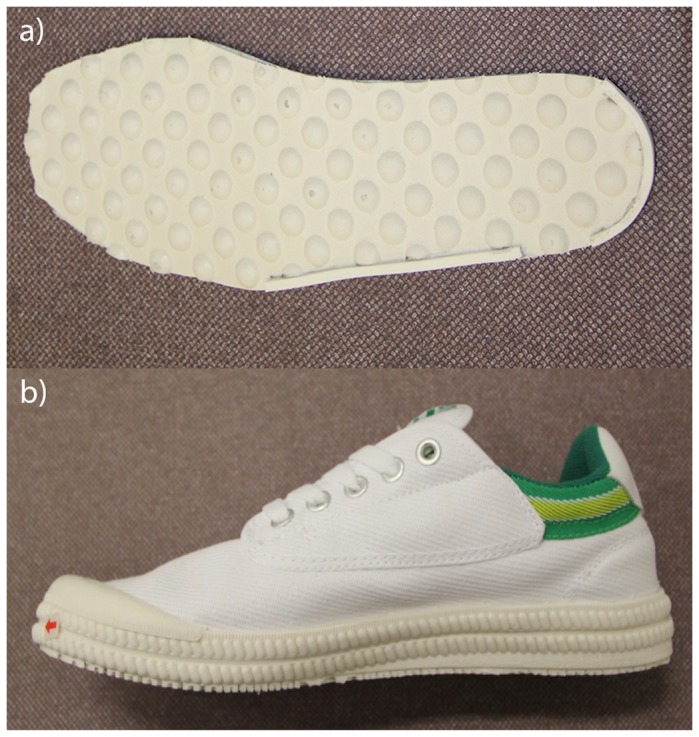
Figure 1. The characteristics of the textured insole (a) and the basic construct rubber-soled shankless shoe (b) used in this research.
Figure 2
Figure 2. Mean (+1 SD) medial-lateral sway for the control (black) and PD (grey) participants under the four standing conditions.
Note: # denotes a significant difference between the PD and control groups; * denotes a significant difference between the footwear conditions for the PD participants.
Figure 3
Figure 3. Mean (+1 SD) medial-lateral sway standard deviation for the control (black) and PD (grey) participants during the four standing conditions.
Note: # denotes a significant difference between the PD and control groups; * denotes a significant difference between the footwear conditions for the PD participants.

References

    1. Lord SR, Sherrington C, Menz H (2001) Falls in older people: Risk factors and strategies for prevention. Cambridge: Cambridge University Press.
    1. Carpenter MG, Bloem BR (2011) Postural control in Parkinson patients: A proprioceptive problem? Exp Neurol 227(1): 26-30. PubMed: 21087607. - PubMed
    1. Nolano M, Provitera V, Estraneo A, Selim MM, Caporaso G et al. (2008) Sensory deficit in Parkinson's disease: Evidence of a cutaneous denervation. Brain 131(7): 1903-1911. doi: 10.1093/brain/awn102. PubMed: 18515869. - DOI - PubMed
    1. Kerr GK, Worringham CJ, Cole MH, Lacherez PF, Wood JM et al. (2010) Predictors of future falls in Parkinson disease. Neurology 75(2): 116-124. doi: 10.1212/WNL.0b013e3181e7b688. PubMed: 20574039. - DOI - PubMed
    1. Latt MD, Lord SR, Morris JG, Fung VS (2009) Clinical and physiological assessments for elucidating falls risk in Parkinson's disease. Mov Disord 24: 1280-1289. doi: 10.1002/mds.22561. PubMed: 19425059. - DOI - PubMed

Publication types