


Calling by domestic piglets during simulated crushing and isolation: a signal of need?
- PMID: 24349527
- PMCID: PMC3862757
- DOI: 10.1371/journal.pone.0083529
Calling by domestic piglets during simulated crushing and isolation: a signal of need?
Abstract
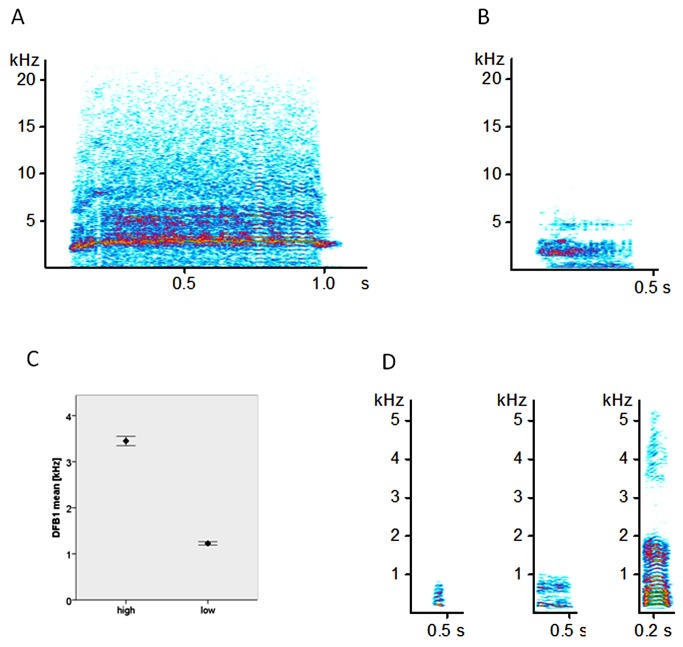
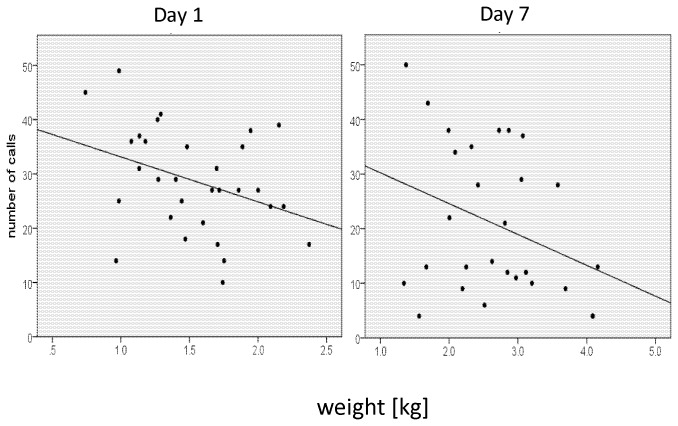
This study examined whether piglet distress vocalizations vary with age, body weight and health status, according to the predictions of the honest signalling of need evolutionary model. Vocalizations were recorded during manual squeezing (a simulation of being crushed by mother sow) and during isolation on Days 1 and 7 after birth in piglets from 15 litters. We predicted that during squeezing, younger, lighter and sick piglets would call more intensely because they are in higher risk of dying during crushing and therefore they benefit more from the sow's reaction to intensive vocalization. For isolation, we predicted that lighter and younger piglets would call more because they are more vulnerable to adverse effects of the separation. Calls were analyzed in their time and frequency domain. The rate of calling, call duration, proportion of high-pitched calls and eight acoustic parameters characterizing frequency distribution and tonality were used as indicators of acoustic signalling intensity. Piglets that experienced "squeezing" on Day 1 produced more intense acoustic distress signalling than on Day 7. Lighter piglets called more during squeezing than heavier piglets. Health status did not significantly affect any of the indicators of intensity of vocalization during squeezing. In isolation, none of the parameters of vocalization intensity were affected either by the age or by the weight of the piglets. In summary, the model of honest signalling of need was confirmed in the squeezed situation, but not in the isolation situation.
Conflict of interest statement
Figures
References
-
- Evans RM (1994) Cold-induced calling and shivering in young american white pelicans: honest signalling of offspring need for warmth in a functionally integrated thermoregulatory system. Behaviour 129: 13-34. doi: 10.1163/156853994X00334. - DOI
-
- Laiolo P, Serrano D, Tella JL, Carrete M, Lopez G et al. (2007) Distress Calls Reflect Poxvirus Infection in Lesser Short-Toed Lark Calandrella Rufescens. Behav Ecol 18: 507-512. doi: 10.1093/beheco/arm008. - DOI
-
- Magrath RD, Haff TM, Horn AG, Leonard ML (2010) Calling in the Face of Danger: Predation Risk and Acoustic Communication by Parent Birds and Their Offspring. In: Brockmann HJ, Roper TJ, Naguib M, WynneEdwards KE, Mitani JC. Advances in the Study of Behavior, Vol 41 San Diego: Elsevier Academic Press Inc. pp. 187-253.
Publication types
MeSH terms
LinkOut - more resources
Full Text Sources
Other Literature Sources
Medical
Miscellaneous
