Review
. 2013 Sep;4(9-10):342-59.
doi: 10.1177/1947601913507951.

Role of p38 MAP Kinase Signal Transduction in Solid Tumors

Affiliations
Review

Role of p38 MAP Kinase Signal Transduction in Solid Tumors

Hari K Koul et al. Genes Cancer. 2013 Sep.

Abstract

Mitogen-activated protein kinases (MAPKs) mediate a wide variety of cellular behaviors in response to extracellular stimuli. One of the main subgroups, the p38 MAP kinases, has been implicated in a wide range of complex biologic processes, such as cell proliferation, cell differentiation, cell death, cell migration, and invasion. Dysregulation of p38 MAPK levels in patients are associated with advanced stages and short survival in cancer patients (e.g., prostate, breast, bladder, liver, and lung cancer). p38 MAPK plays a dual role as a regulator of cell death, and it can either mediate cell survival or cell death depending not only on the type of stimulus but also in a cell type specific manner. In addition to modulating cell survival, an essential role of p38 MAPK in modulation of cell migration and invasion offers a distinct opportunity to target this pathway with respect to tumor metastasis. The specific function of p38 MAPK appears to depend not only on the cell type but also on the stimuli and/or the isoform that is activated. p38 MAPK signaling pathway is activated in response to diverse stimuli and mediates its function by components downstream of p38. Extrapolation of the knowledge gained from laboratory findings is essential to address the clinical significance of p38 MAPK signaling pathways. The goal of this review is to provide an overview on recent progress made in defining the functions of p38 MAPK pathways with respect to solid tumor biology and generate testable hypothesis with respect to the role of p38 MAPK as an attractive target for intervention of solid tumors.

Keywords: mitogen-activated protein kinase (MAPK); p38 signaling pathway; solid tumors.


Conflict of interest statement

Declaration of Conflicting Interests: The author(s) declared no potential conflicts of interest with respect to the research, authorship, and/or publication of this article.

Figures

Figure 1.
Figure 1.
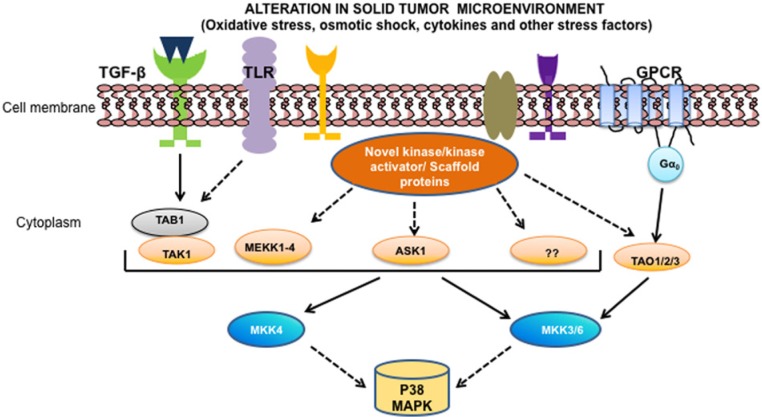
Schematic representation of the activation of p38 MAPK. Numerous physical and chemical stresses, including oxidative stress and osmotic shock, cytokines, and growth factors such as TGF-β (transforming growth factor-β) activate p38 MAPKs through complex kinase cascades signaling pathways. The mechanism of p38 MAPK activation is mediated by dual phosphorylation (at Thr-Pro-Tyr motif) by MAPK kinase 4 (MKK4) and MKK3/6. Upstream of the MKKs are their MAPKKKs, which include MEKKs 1-4, a member of the mixed-lineage kinases (MLK3) and ASK-1. In turn, these are activated by cellular intermediates, like GTPases, kinase activator, or receptor adapter proteins, among others, which transmit the stimulus to the kinase cascades. TGF-β also activates Smad-independent signaling pathways, including TAK1, which in turn triggers the activation of downstream p38 MAPK signaling cascades. GPCR (G protein-coupled receptor) stimulation results in the activation of heterotrimeric G protein that transmits the signal to TAOs (thousand-and-one amino acid), which then activate p38 MAPK cascades. Once activated, the different p38MAPKs either phosphorylate cytoplasmic targets or translocate into the nucleus leading to the regulation of transcription factors involved in cellular responses.
Figure 2.
Figure 2.
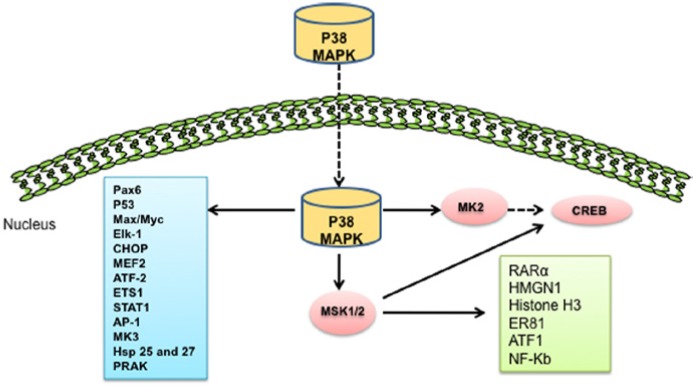
Schematic diagram of the downstream targets of p38 MAPK. Activated p38 MAPK regulates downstream targets including several kinases and transcription factors. These kinases include PRAK (p38-related/activated protein kinase), MSK1/2 (mitogen- and stress-activated protein kinase-1/2), and MK2 (MAPK-activated protein kinase 2). Some important transcription factors phosphorylated by p38 MAPK include tumor suppressor protein p53, CHOP (C/EBP-homologous protein), STAT1 (signal transducers and activators of transcription-1), CREB (cAMP response element-binding protein), NF-κB, Max/Myc complexes, and so on. Other substrates of the p38 signaling pathway include Pax6, Elk-1, MEF2, ATF-2, Hsp 25 and 27, ETS1, MK3, RARα, HMGN1, Histone H3, ER81, Activator Protein 1 (AP-1), and ATF1 for regulation of gene expression, affecting cell motility, transcription, and chromatin remodeling.

References

    1. Kim TW, Michniewicz M, Bergmann DC, Wang ZY. Brassinosteroid regulates stomatal development by GSK3-mediated inhibition of a MAPK pathway. Nature. 2012;482(7385):419-22 - PMC - PubMed
    1. Sayama K, Hanakawa Y, Nagai H, et al. Transforming growth factor-beta-activated kinase 1 is essential for differentiation and the prevention of apoptosis in epidermis. J Biol Chem. 2006;281(31):22013-20 - PubMed
    1. Fang WB, Jokar I, Zou A, Lambert D, Dendukuri P, Cheng N. CCL2/CCR2 chemokine signaling coordinates survival and motility of breast cancer cells through Smad3 protein- and p42/44 mitogen-activated protein kinase (MAPK)-dependent mechanisms. J Biol Chem. 2012;287(43):36593-608 - PMC - PubMed
    1. Sayama K, Yamasaki K, Hanakawa Y, Shirakata Y, Tokumaru S, Ijuin T, Takenawa T, Hashimoto K. Phosphatidylinositol 3-kinase is a key regulator of early phase differentiation in keratinocytes. J Biol Chem 2002;277(43):40390-6 - PubMed
    1. Lawson SK, Dobrikova EY, Shveygert M, Gromeier M. p38alpha mitogen-activated protein kinase depletion and repression of signal transduction to translation machinery by miR-124 and -128 in neurons. Mol Cell Biol. 2013;33(1):127-35 - PMC - PubMed