Post-traumatic stress in Crohn's disease and its association with disease activity
- PMID: 24349679
- PMCID: PMC3854716
- DOI: 10.1136/fg.2010.002733
Post-traumatic stress in Crohn's disease and its association with disease activity
Abstract
Objective: Violence, accidents and natural disasters are known to cause post-traumatic stress, which is typically accompanied by fear, suffering and impaired quality of life. Similar to chronic diseases, such events preoccupy the patient over longer periods. We hypothesised that post-traumatic stress could also be caused by Crohn's disease (CD), and that CD specific post-traumatic stress could be associated with an increased risk of disease exacerbation.
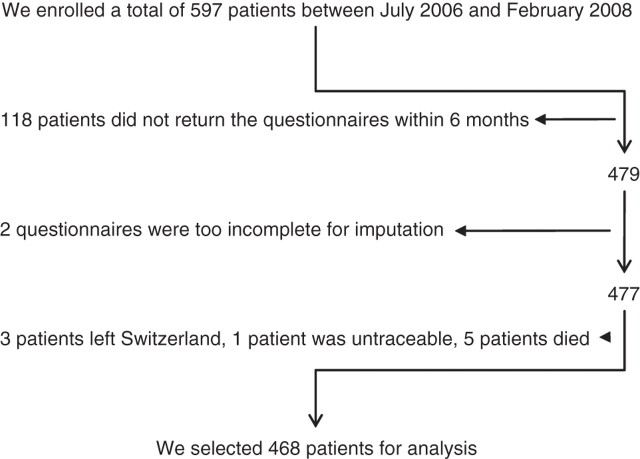
Methods: A cohort of CD patients was observed over 18 months in various types of locations providing gastroenterological treatment in Switzerland. The cohort included 597 consecutively recruited adults. At inclusion, CD specific post-traumatic stress was assessed using the Post-traumatic Diagnostic Scale (range 0-51 points). During follow-up, clinical aggravation was assessed by combining important outcome measures. Patients with post-traumatic stress levels suggestive of a post-traumatic stress disorder (≥ 15 points) were compared with patients with lower post-traumatic stress levels as well as with patients without post-traumatic stress. Also, the continuous relation between post-traumatic stress severity and risk of disease exacerbation was assessed.
Results: The 88 (19.1%) patients scoring ≥15 points had 4.3 times higher odds of exacerbation (95% CI 2.6 to 7.2) than the 372 (80.9%) patients scoring <15 points, and 13.0 times higher odds (95% CI 3.6 to 46.2) than the 45 (9.8%) patients scoring 0 points. The odds of exacerbation increased by 2.2 (95% CI 1.6 to 2.8) per standard deviation of post-traumatic stress.
Conclusions: CD specific post-traumatic stress is frequent and seems to be associated with exacerbation of CD. Thus gastroenterologists may want to ask about symptoms of post-traumatic stress and, where relevant, offer appropriate management according to current knowledge.
Conflict of interest statement
Figures
References
-
- Loftus EV., Jr Clinical epidemiology of inflammatory bowel disease: Incidence, prevalence, and environmental influences. Gastroenterology 2004;126:1504–17. - PubMed
-
- Casati J, Toner BB, de Rooy EC, et al. Concerns of patients with inflammatory bowel disease: a review of emerging themes. Dig Dis Sci 2000;45:26–31. - PubMed
-
- Schnurr PP, Lunney CA, Bovin MJ, et al. Posttraumatic stress disorder and quality of life: extension of findings to veterans of the wars in Iraq and Afghanistan. Clin Psychol Rev 2009;29:727–35. - PubMed
-
- Diagnostic and Statistical Manual of Mental Disorders, 4th Edn Arlington, VA: American Psychiatric Association; 2004.
-
- Gurevich M, Devins GM, Rodin GM. Stress response syndromes and cancer: conceptual and assessment issues. Psychosomatics 2002;43:259–81. - PubMed
LinkOut - more resources
Full Text Sources