


DiAs web monitoring: a real-time remote monitoring system designed for artificial pancreas outpatient trials
- PMID: 24351169
- PMCID: PMC3876321
- DOI: 10.1177/193229681300700603
DiAs web monitoring: a real-time remote monitoring system designed for artificial pancreas outpatient trials
Abstract
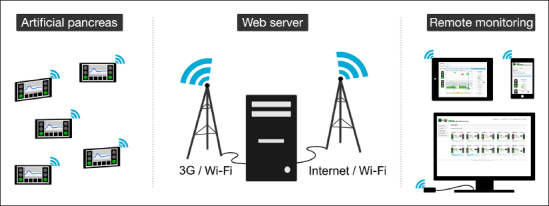
Background: Developments in an artificial pancreas (AP) for patients with type 1 diabetes have allowed a move toward performing outpatient clinical trials. "Home-like" environment implies specific protocol and system adaptations among which the introduction of remote monitoring is meaningful. We present a novel tool allowing multiple patients to monitor AP use in home-like settings.
Methods: We investigated existing systems, performed interviews of experienced clinical teams, listed required features, and drew several mockups of the user interface. The resulting application was tested on the bench before it was used in three outpatient studies representing 3480 h of remote monitoring.
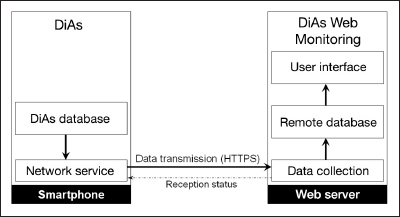
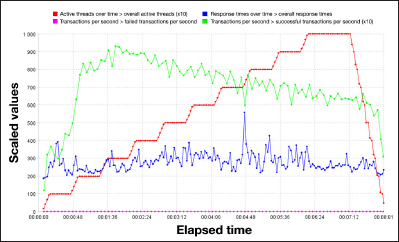
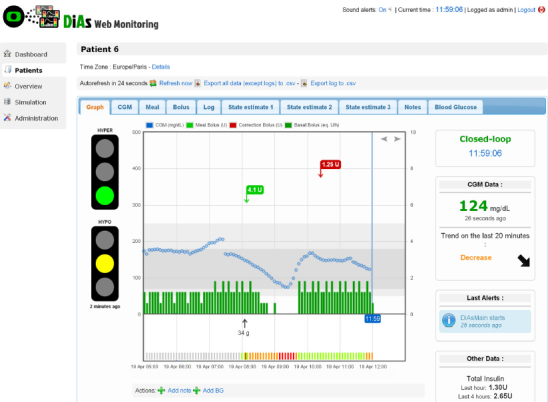
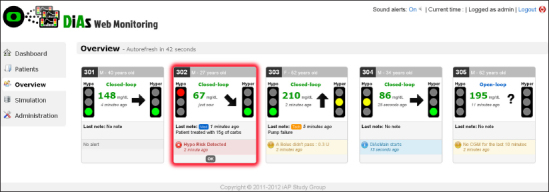
Results: Our tool, called DiAs Web Monitoring (DWM), is a web-based application that ensures reception, storage, and display of data sent by AP systems. Continuous glucose monitoring (CGM) and insulin delivery data are presented in a colored chart to facilitate reading and interpretation. Several subjects can be monitored simultaneously on the same screen, and alerts are triggered to help detect events such as hypoglycemia or CGM failures. In the third trial, DWM received approximately 460 data per subject per hour: 77% for log messages, 5% for CGM data. More than 97% of transmissions were achieved in less than 5 min.
Conclusions: Transition from a hospital setting to home-like conditions requires specific AP supervision to which remote monitoring systems can contribute valuably. DiAs Web Monitoring worked properly when tested in our outpatient studies. It could facilitate subject monitoring and even accelerate medical and technical assessment of the AP. It should now be adapted for long-term studies with an enhanced notification feature.
© 2013 Diabetes Technology Society.
Figures
References
-
- Klonof DC. Continuous glucose monitoring: roadmap for 21st century diabetes therapy. Diabetes Care. 2005;28(5):1231–1239. - PubMed
-
- Zisser H, Jovanovic L. OmniPod Insulin Management System: patient perceptions, preference, and glycemic control. Diabetes Care. 2006;29(9):2175. - PubMed
-
- Hovorka R, Canonico V, Chassin LJ, Haueter U, Massi-Benedetti M, Orsini Federici M, Pieber TR, Schaller HC, Schaupp L, Vering T, Wilinska ME. Nonlinear model predictive control of glucose concentration in subjects with type 1 diabetes. Physiol Meas. 2004;25(4):905–920. - PubMed
-
- Bruttomesso D, Farret A, Costa S, Marescotti MC, Vettore M, Avogaro A, Tiengo A, Dalla Man C, Place J, Facchinetti A, Guerra S, Magni L, De Nicolao G, Cobelli C, Renard E, Maran A. Closed-loop artifcial pancreas using subcutaneous glucose sensing and insulin delivery and a model predictive control algorithm: preliminary studies in Padova and Montpellier. J Diabetes Sci Technol. 2009;3(5):1014–1021. - PMC - PubMed
Publication types
MeSH terms
Substances
LinkOut - more resources
Full Text Sources
Other Literature Sources
Medical
