


Economic analysis of revision amputation and replantation treatment of finger amputation injuries
- PMID: 24352209
- PMCID: PMC4154255
- DOI: 10.1097/PRS.0000000000000019
Economic analysis of revision amputation and replantation treatment of finger amputation injuries
Abstract
Background: The purpose of this study was to perform a cost-utility analysis to compare revision amputation and replantation treatment of finger amputation injuries across a spectrum of injury scenarios.
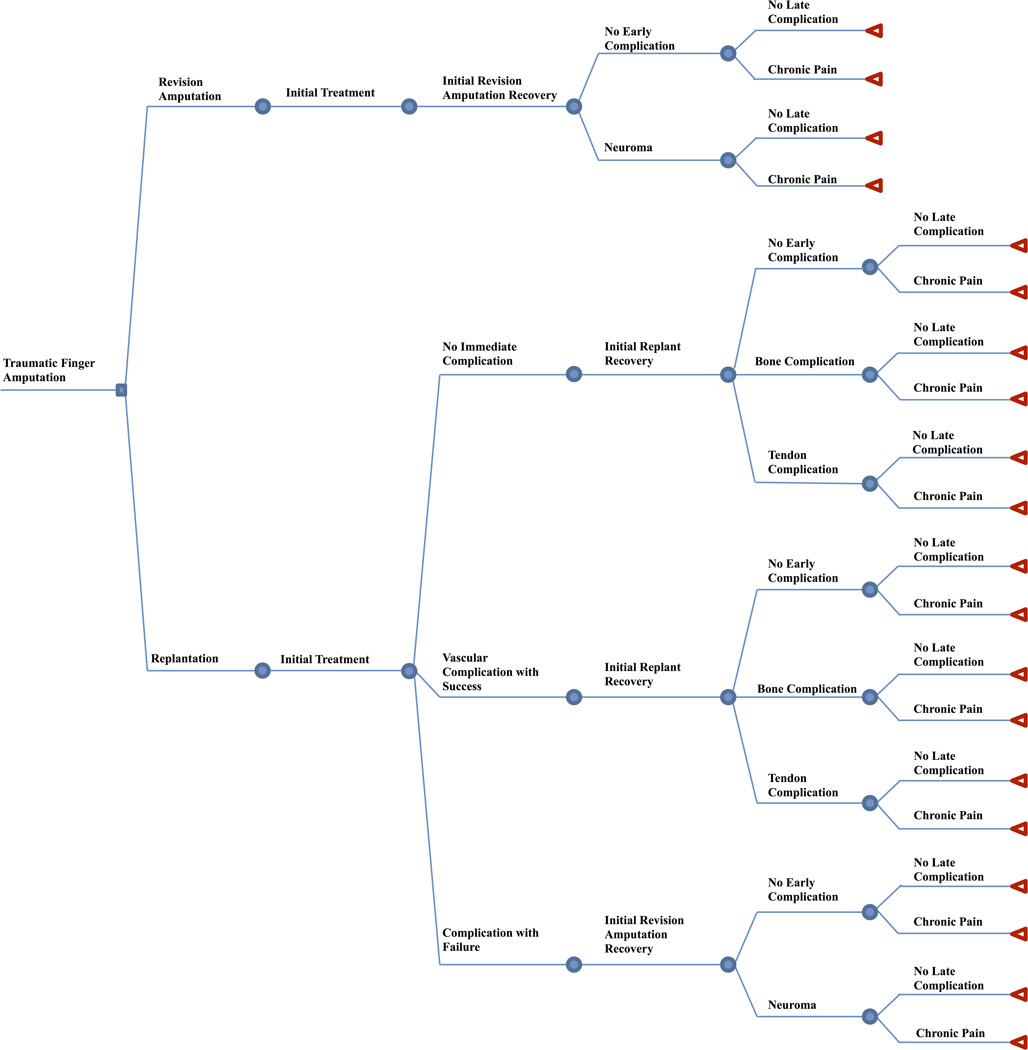
Methods: The study was conducted from the societal perspective. Decision tree models were created for the reference case (two-finger amputation injury) and seven additional injury scenarios for comparison. Inputs included cost, quality of life, and probability of each health state. A Web-based time trade-off survey was created to determine quality-adjusted life-years for health states; 685 nationally representative adult community members were invited to participate in the survey. Overall cost and quality-adjusted life-years for revision amputation and replantation were calculated for each decision tree. An incremental cost-effectiveness ratio was calculated if a treatment was more costly but more effective.
Results: The authors had a 64 percent response rate (n = 437). Replantation treatment had greater costs and quality-adjusted life-years compared with revision amputation in all injury scenarios. Replantation of single-digit injuries had the highest incremental cost-effectiveness ratio ($136,400 per quality-adjusted life-year gained). Replantation of three- and four-digit amputation injuries had relatively low cost-to-benefit ratios ($27,100 and $23,800 per quality-adjusted life-year, respectively). Replantation for distal thumb amputation had a relatively low incremental cost-effectiveness ratio ($26,300 per quality-adjusted life-year) compared with replantation of nonthumb distal amputations ($60,200 per quality-adjusted life-year).
Conclusions: The relative cost per quality-adjusted life-year gained with replantation treatment varied greatly among the injury scenarios. Situations in which indications for replantation are debated had higher cost per quality-adjusted life-year gained. This study highlights variability in value for replantation among different injury scenarios.
Figures

References
-
- Buntic RF, Brooks D, Buncke GM. Index finger salvage with replantation and revascularization: revisiting conventional wisdom. Microsurgery. 2008;28:612–616. - PubMed
-
- Hattori Y, Doi K, Ikeda K, et al. A retrospective study of functional outcomes after successful replantation versus amputation closure for single fingertip amputations. J Hand Surg Am. 2006;31:811–818. - PubMed
-
- Hattori Y, Doi K, Sakamoto S, et al. Fingertip replantation. J Hand Surg Am. 2007;32:548–555. - PubMed
-
- Li J, Guo Z, Zhu Q, et al. Fingertip replantation: determinants of survival. Plast Reconstr Surg. 2008;122:833–839. - PubMed
-
- Matsuzaki H, Yoshizu T, Maki Y, et al. Functional and cosmetic results of fingertip replantation: anastomosing only the digital artery. Ann Plast Surg. 2004;53:353–359. - PubMed
Publication types
MeSH terms
Grants and funding
LinkOut - more resources
Full Text Sources
Other Literature Sources
Medical
