Review
. 2013 Dec 18;11(92):20130901.
doi: 10.1098/rsif.2013.0901. Print 2014 Mar 6.

Photosynthetic light harvesting: excitons and coherence

Affiliations
Review

Photosynthetic light harvesting: excitons and coherence

Francesca Fassioli et al. J R Soc Interface. .

Abstract

Photosynthesis begins with light harvesting, where specialized pigment-protein complexes transform sunlight into electronic excitations delivered to reaction centres to initiate charge separation. There is evidence that quantum coherence between electronic excited states plays a role in energy transfer. In this review, we discuss how quantum coherence manifests in photosynthetic light harvesting and its implications. We begin by examining the concept of an exciton, an excited electronic state delocalized over several spatially separated molecules, which is the most widely available signature of quantum coherence in light harvesting. We then discuss recent results concerning the possibility that quantum coherence between electronically excited states of donors and acceptors may give rise to a quantum coherent evolution of excitations, modifying the traditional incoherent picture of energy transfer. Key to this (partially) coherent energy transfer appears to be the structure of the environment, in particular the participation of non-equilibrium vibrational modes. We discuss the open questions and controversies regarding quantum coherent energy transfer and how these can be addressed using new experimental techniques.

Keywords: coherence; energy transfer; exciton; light harvesting.


Figures
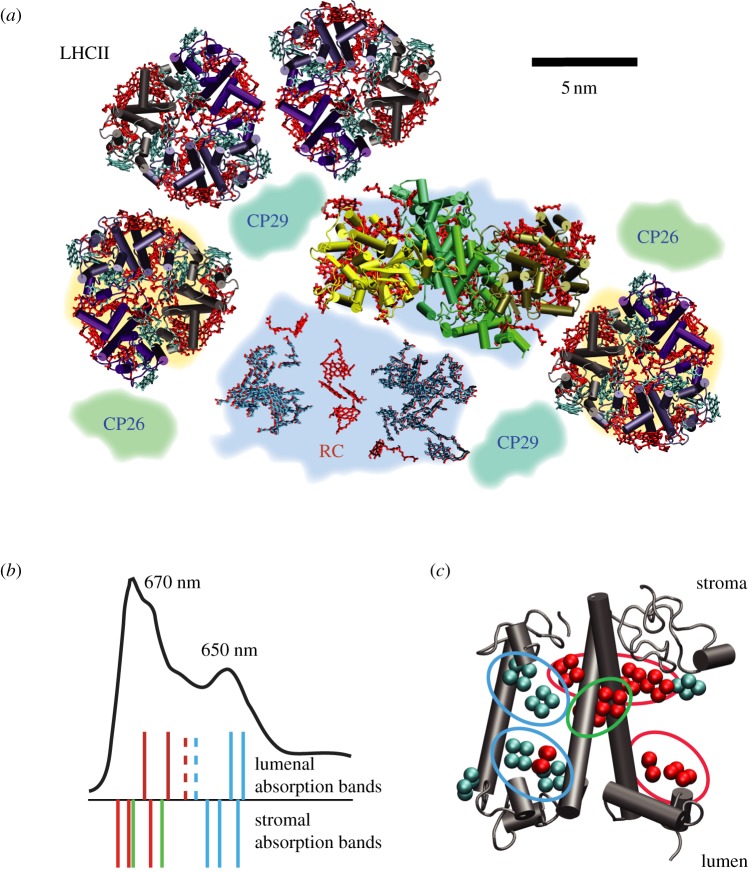
Figure 1.
Figure 1.
(a) Structural organization of light-harvesting complexes and reaction centres in higher plants and green algae. The layout of the photosystem II (PSII) supercomplex [14] is templated on the three-dimensional electron density map reported by Barber and co-workers (shaded regions) [15]. To illustrate what the proteins resemble, atomic resolution structural models of the peripheral light-harvesting complex LHCII [16] and the core of PSII (cyanobacterium [17]) are drawn. Excitation energy captured by the LHCII and the minor peripheral light-harvesting complexes is transferred, via core light-harvesting complexes CP43 and CP47, to the reaction centre where charge separation is initiated. (b) Absorption spectrum of the LHCII trimer (77K) with assignments of the positions of electronic absorption bands drawn as sticks according to the model proposed by Schlau-Cohen et al. [18]. Solid lines denote exciton states. Localized absorption bands are drawn as dashed lines. (c) The LHCII monomer with chlorophyll b molecules indicated in blue and chlorophyll a in red. Shared excitation is indicated by the groups of chromophores circled. The chlorophyll a chromophore circled in green shares excitation with the adjacent monomer in the trimer. (Adapted from Scholes et al. [11].)
Figure 2.
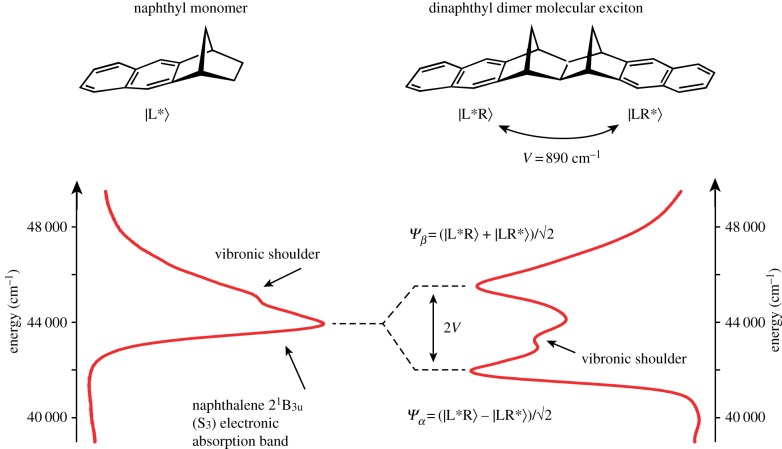
Figure 2.
Exciton splitting in a naphthalene dimer. See text for details. Data are from the report published in [82]. (Online version in colour.)
Figure 3.
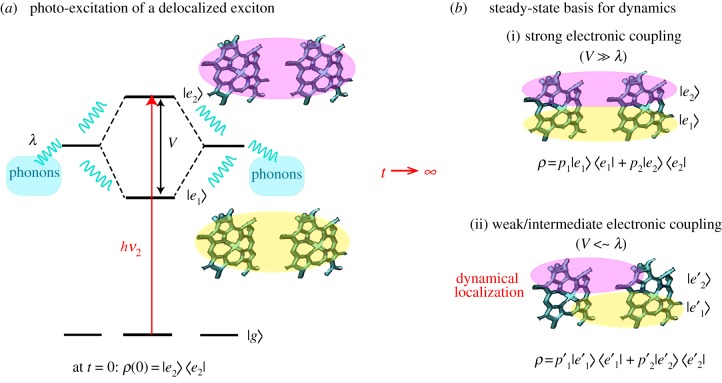
Figure 3.
Dynamical localization in an electronic dimer. (a) At t = 0 light excites a fully delocalized electronic state. (b) The interaction with the phonon modes induces relaxation and dephasing, and the steady state of the system corresponds to a statistical mixture of electronic states. In the strong electronic coupling regime (i) the system is in a mixture of the fully delocalized excited states that diagonalize the electronic Hamiltonian (equation (2.1)). Otherwise (ii), the environment induces dynamical localization such that the excited states that diagonalize the density matrix in the steady state are more localized than the electronic eigenstates.
Figure 4.
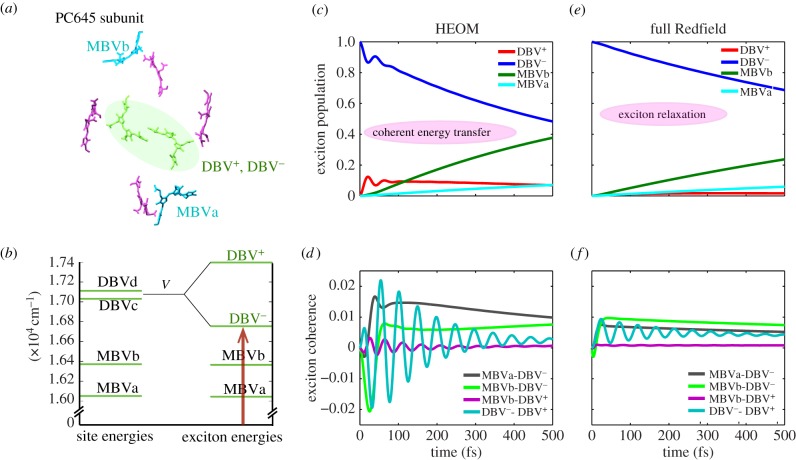
Figure 4.
(a) Chromophores in PC645 light-harvesting protein found in cryptophyte algae. (b) Energy landscape of a subunit of PC645 consisting of the four highest energy molecules: two DBV, MBVa and MBVb. (c,d) Time evolution of populations and coherences in the electronic eigenbasis after excitation of the delocalized DBV exciton state, using the HEOM method. (e,f) As in c,d, using the full-Redfield equation to simulate dynamics.
Figure 5.
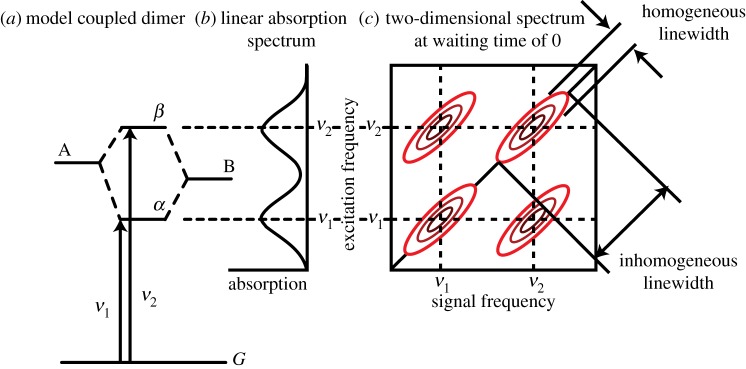
Figure 5.
(a) Energy level scheme for model dimer system formed between two different chromophores A and B with different transition energies. (b) Corresponding linear absorption spectrum for model dimer. (c) Two-dimensional spectrum of dimer system at 0 waiting time between the pump and probe pulses. The inhomogeneous and homogeneous linewidths are indicated by the diagonal and antidiagonal linewidths, respectively. Cross peaks appear because the states share a common ground state. (Online version in colour.)
Figure 6.
Figure 6.
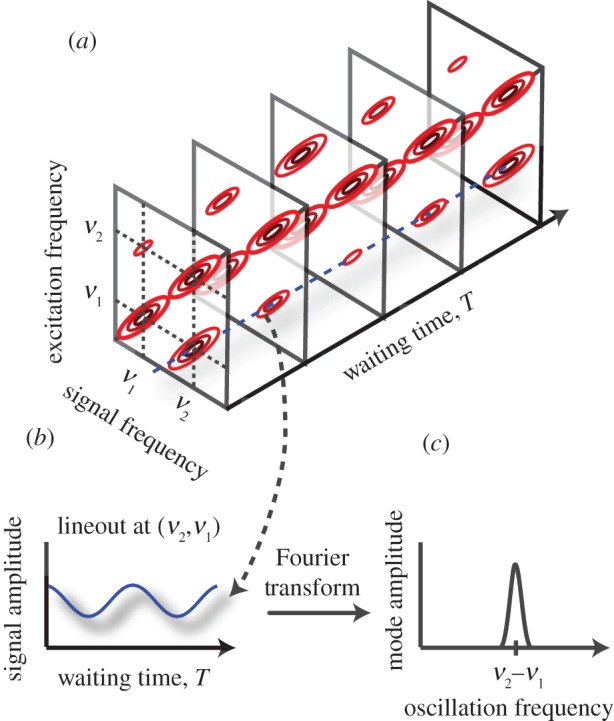
(a) Evolution of the two-dimensional spectrum of the idealized dimer system of figure 5 with the waiting time, T. The amplitudes of the cross peaks oscillate at the difference frequency of the two states. (b) When analysing real data, lineouts are typically taken, plotting the signal amplitude as a function of waiting time at different positions in the two-dimensional spectrum. In this simple system, an oscillation of the cross-peak amplitude is observed at the difference frequency between the two states. (c) A Fourier transform of the signal amplitude gives a peak at the measured oscillation frequency. In general, this type of analysis helps to identify different contributions to the overall signal that is complicated by the presence of many states and vibrational modes typically accessible in 2DES measurements. (Online version in colour.)
Figure 7.
Figure 7.
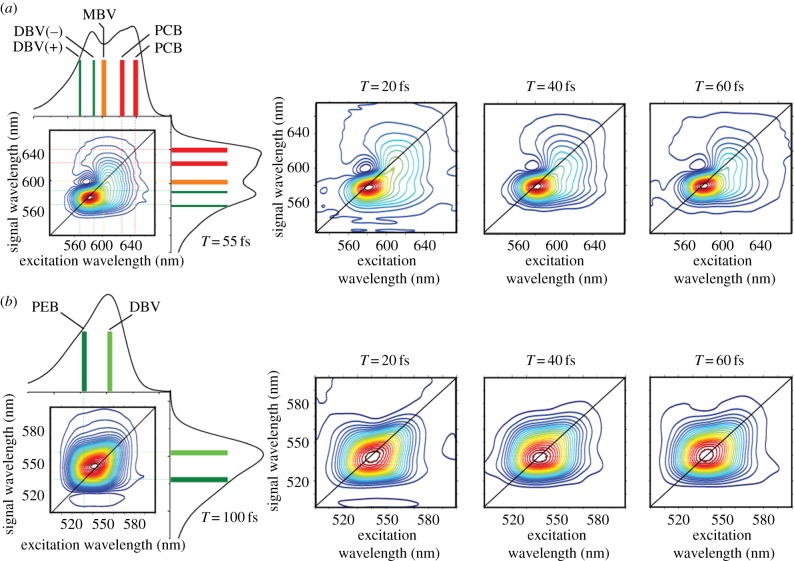
Representative two-dimensional spectra of PC645 and PE555 plotted at various waiting times with corresponding linear absorption spectra shown alongside the T = 55 fs spectrum of PC645 and the T = 100 fs spectrum of PE555. The two-dimensional spectra are the real part of the total signal, plotted with 33 evenly spaced contours. The coloured bars in the linear spectra indicate locations of the estimated peak transition energies of individual components. (Adapted from Harrop et al. [145].)
Figure 8.
Figure 8.
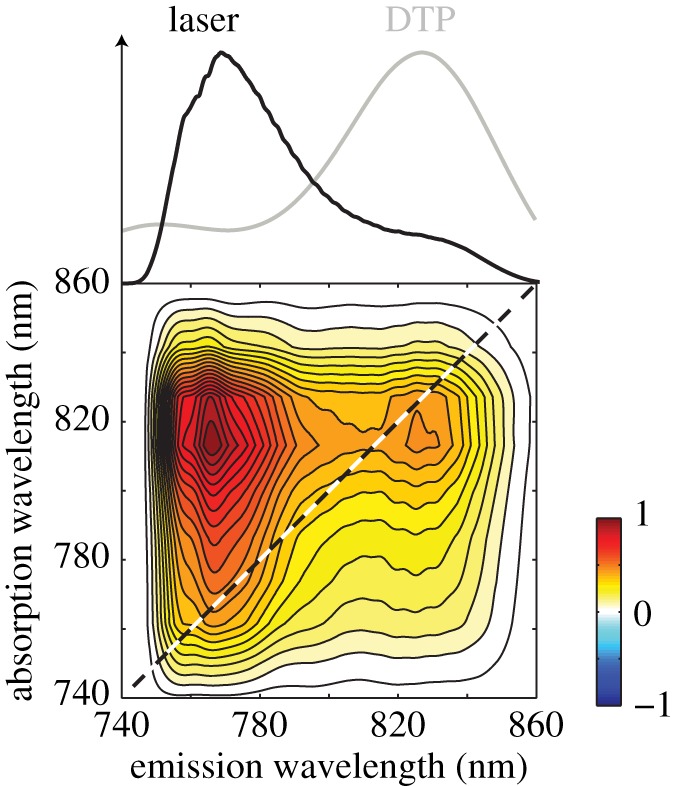
Real part of the total two-dimensional spectrum of the carbocyanine dye 1,1′-diethyl-2,2′-tricarbocyanine perchlorate (DTP) in butanol measured with incoherent light at a waiting time of 100 fs. These measurements were made with the ASE of an unseeded laser amplifier, a light source with temporal properties more closely resembling sunlight than a femtosecond laser. Still, the two-dimensional spectrum looks qualitatively similar to those measured with femtosecond light sources, including a distinct cross peak between two transitions in a vibronic progression. The laser spectrum (black) and DTP absorption (grey) are plotted above. (Adapted from Turner et al. [170].)

References

    1. Connolly JS, Janzen AF, Samuel EB. 1982. Fluorescence lifetimes of chlorophyll a: solvent, concentration and oxygen dependence. Photochem. Photobiol. 36, 559–563. ( 10.1111/j.1751-1097.1982.tb04416.x) - DOI
    1. Mullineaux CW, Pascal AA, Horton P, Holzwarth AR. 1993. Excitation-energy quenching in aggregates of the LHC II chlorophyll–protein complex: a time-resolved fluorescence study. Biochim. Biophys. Acta - Bioenerg. 1141, 23–28. ( 10.1016/0005-2728(93)90184-H) - DOI
    1. Bowers PG, Porter G. 1967. Quantum yields of triplet formation in solutions of chlorophyll. Proc. R. Soc. A Math. Phys. Eng. Sci. 296, 435–441. ( 10.1098/rspa.1967.0036) - DOI
    1. Peterman EJ, Dukker FM, van Grondelle R, van Amerongen H. 1995. Chlorophyll a and carotenoid triplet states in light-harvesting complex II of higher plants. Biophys. J. 69, 2670–2678. ( 10.1016/S0006-3495(95)80138-4) - DOI - PMC - PubMed
    1. Blankenship RE. 2002. Molecular mechanisms of photosynthesis. Oxford, UK: Blackwell Science Ltd.

Publication types

MeSH terms

Substances