


Is brief advice in primary care a cost-effective way to promote physical activity?
- PMID: 24352807
- PMCID: PMC3913207
- DOI: 10.1136/bjsports-2013-092897
Is brief advice in primary care a cost-effective way to promote physical activity?
Abstract
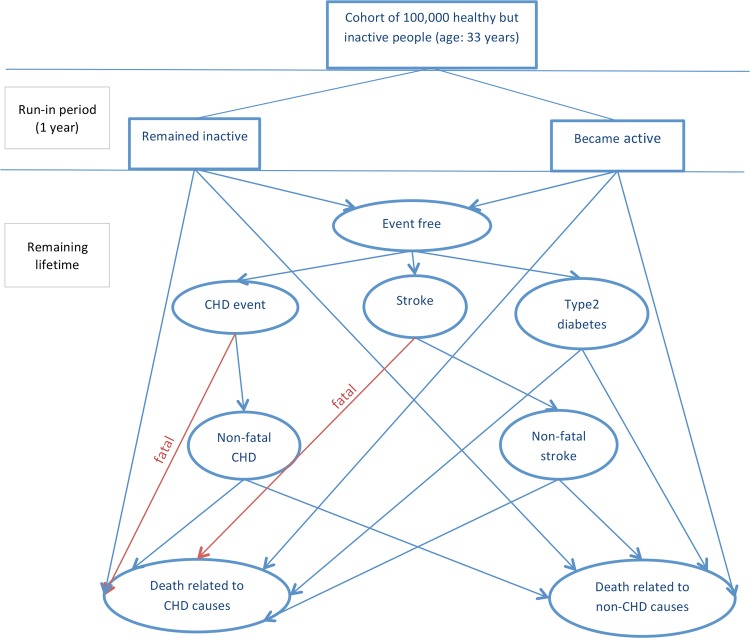
Aim: This study models the cost-effectiveness of brief advice (BA) in primary care for physical activity (PA) addressing the limitations in the current limited economic literature through the use of a time-based modelling approach.
Methods: A Markov model was used to compare the lifetime costs and outcomes of a cohort of 100 000 people exposed to BA versus usual care. Health outcomes were expressed in terms of quality-adjusted life years (QALYs). Costs were assessed from a health provider perspective (£2010/11 prices). Data to populate the model were derived from systematic literature reviews and the literature searches of economic evaluations that were conducted for national guidelines. Deterministic and probability sensitivity analyses explored the uncertainty in parameter estimates including short-term mental health gains associated with PA.
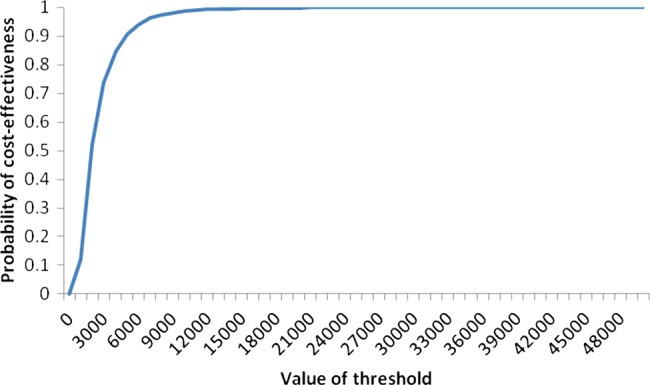
Results: Compared with usual care, BA is more expensive, incurring additional costs of £806 809 but it is more effective leading to 466 QALYs gained in the total cohort, a QALY gain of 0.0047/person. The incremental cost per QALY of BA is £1730 (including mental health gains) and thus can be considered cost-effective at a threshold of £20 000/QALY. Most changes in assumptions resulted in the incremental cost-effectiveness ratio (ICER) falling at or below £12 000/QALY gained. However, when short-term mental health gains were excluded the ICER was £27 000/QALY gained. The probabilistic sensitivity analysis showed that, at a threshold of £20 000/QALY, there was a 99.9% chance that BA would be cost-effective.
Conclusions: BA is a cost-effective way to improve PA among adults, provided short-term mental health gains are considered. Further research is required to provide more accurate evidence on factors contributing to the cost-effectiveness of BA.
Keywords: Health promotion through physical activity.
Figures
References
-
- Department of Health Healthy lives, healthy people: our strategy for public health in England. London: Department of Health, 2010
-
- Department of Health Start active, stay active: a report on physical activity from the four home counties’ chief medical officers. London: Department of Health, 2011
-
- Craig R, Mindell J, Hirani V. Health Survey for England 2008. Volume 1: physical activity and fitness. London: National Health Service Information Centre, 2009
-
- Matrix Rapid review of the economic evidence of physical activity interventions. London: Matrix Knowledge, 2006.
-
- Matrix Modelling the cost-effectiveness of physical activity interventions. London: Matrix Knowledge, 2006
Publication types
MeSH terms
LinkOut - more resources
Full Text Sources
Other Literature Sources
Medical
