. 2009 May;351(7-8):10.1002/adsc.200800776.
doi: 10.1002/adsc.200800776.

The Enantioselective Addition of Alkyne Nucleophiles to Carbonyl Groups

Affiliations

The Enantioselective Addition of Alkyne Nucleophiles to Carbonyl Groups

Barry M Trost et al. Adv Synth Catal. 2009 May.

Abstract

Over the past decade, large strides have been achieved in the invention of methods for the direct enantioselective addition of alkynes and metal alkynylide nucleophiles into prochiral aldehydes, ketones, and imines. This review highlights and compares the available methods for these transformations.

Keywords: alkynylation; catalytic asymmetric; propargylic alcohol; propargylic amine.


Figures

Figure 1
Figure 1
Propargyl alcohols as synthetic intermediates.
Figure 2
Figure 2
Ligands for the alkynylation of aldehydes.
Figure 3
Figure 3
γ-Hydroxy-α,β-acetylenic ester transformations.
Scheme 1
Scheme 1
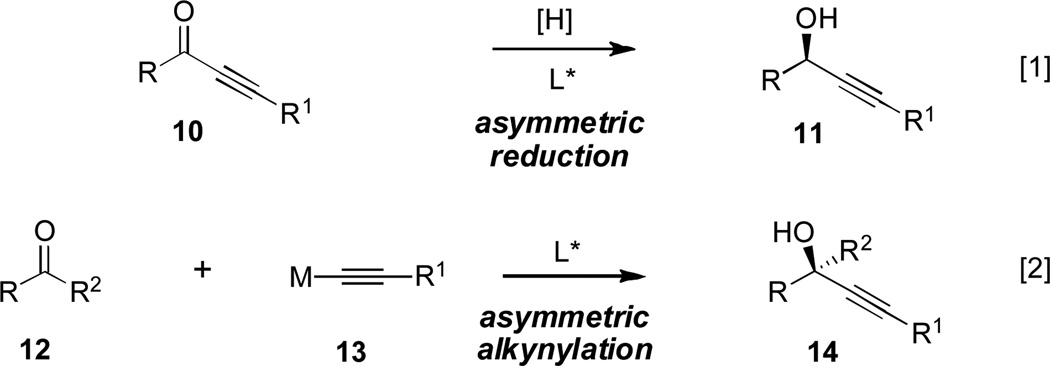
Common methods for the synthesis of propargylic alcohols.
Scheme 2
Scheme 2
First example of an enantioselective alkynylation of an aldehyde.
Scheme 3
Scheme 3
Catalytic asymmetric zinc alkynylation of aldehydes.
Scheme 4
Scheme 4
Rationale for enantioselectivity of alkyne or alkyl (R) addition to an aldehyde.
Scheme 5
Scheme 5
(+)-NME-mediated enantioselective addition of zinc alkynylides.
Scheme 6
Scheme 6
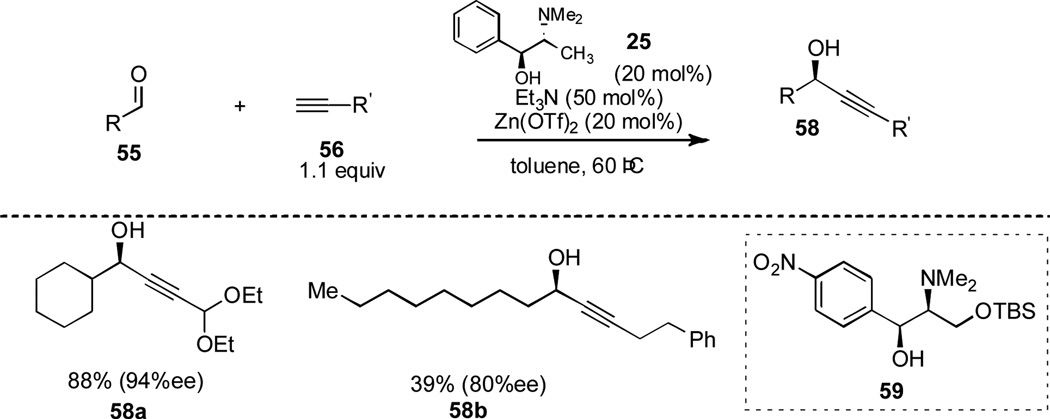
Alternative conditions employing catalytic amino alcohol ligands.
Scheme 7
Scheme 7
Wang’s bifunctional catalyst for the asymmetric alkynylation of aldehydes.
Scheme 8
Scheme 8
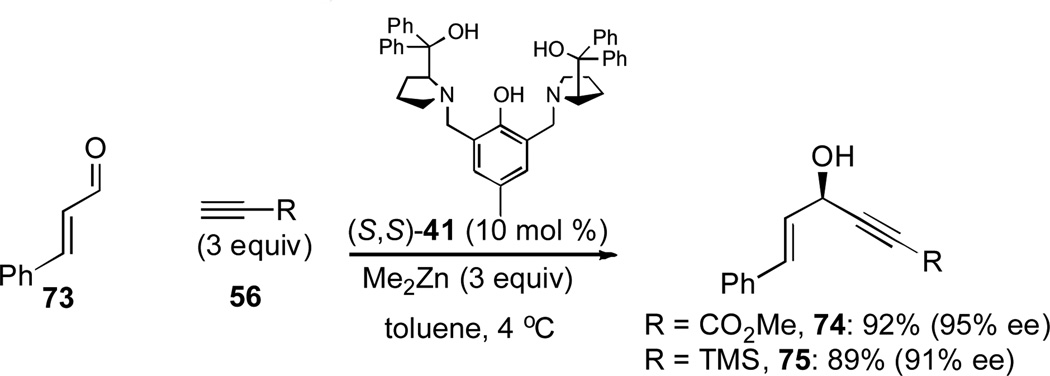
Trost’s bifunctional ProPhenol catalyst for the enantioselective alkynylation of unsaturated aldehydes.
Scheme 9
Scheme 9
Enantioselective titanium-catalyzed addition of zinc alkynylides to aldehydes.
Scheme 10
Scheme 10
Metal salt-mediated alkynylation of aldehydes.
Scheme 11
Scheme 11
Stoichiometric N-methylephedrine-mediated alkynylation methodology.
Scheme 12
Scheme 12
Catalytic N-methylephedrine-mediated alkynylation methodology.
Scheme 13
Scheme 13
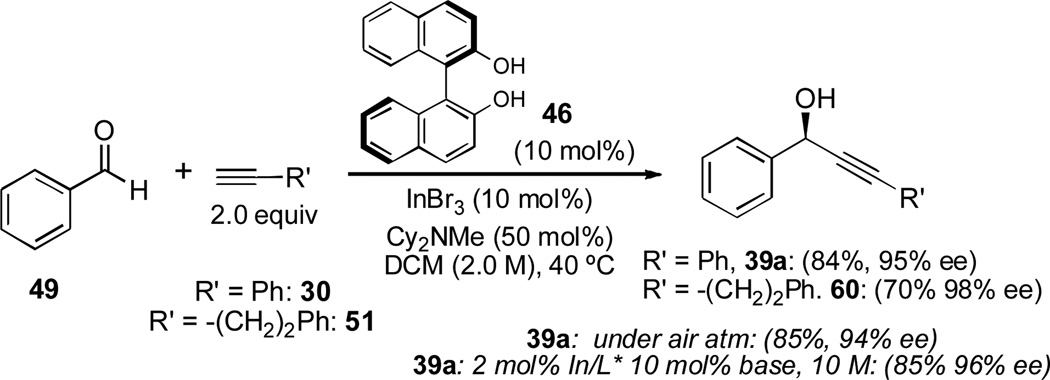
Shibasaki’s In(III)/BINOL-catalyzed alkynylation.
Scheme 14
Scheme 14
Attempted propiolate addition with Carriera’s conditions.
Scheme 15
Scheme 15
ProPhenol-catalyzed enantioselective propiolate addition.
Scheme 16
Scheme 16
Pu’s titanium-BINOL-HMPA catalyst for the zinc propiolate addition to aldehydes.
Scheme 17
Scheme 17
Chan and Wang’s alternative propiolate addition.
Scheme 18
Scheme 18
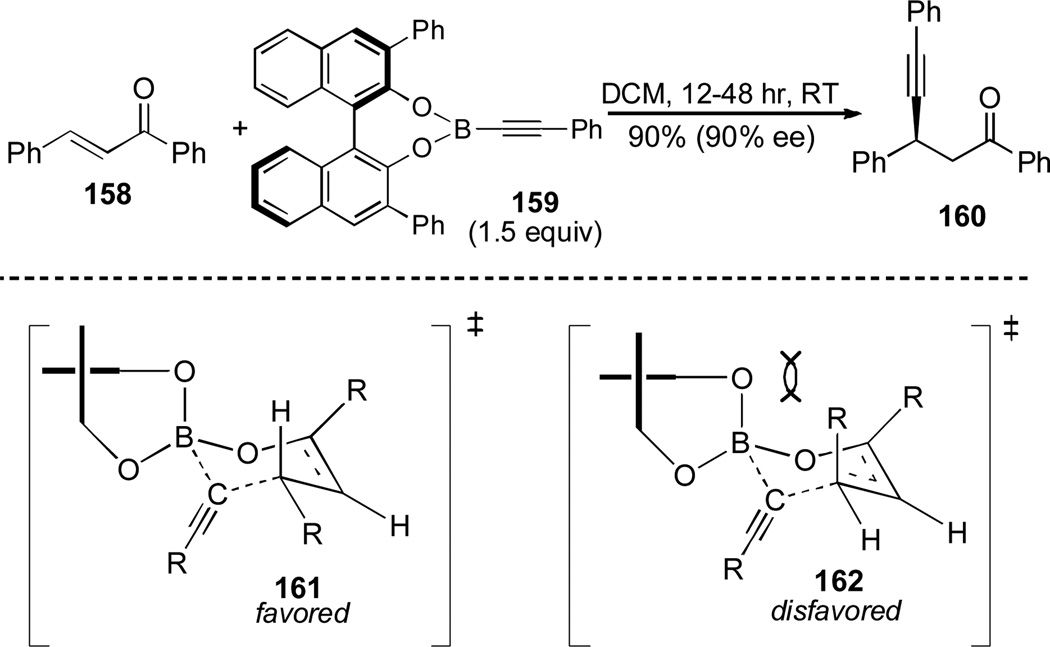
Corey's enantioselective boron alkynylide addition to aldehydes.
Scheme 19
Scheme 19
Enantioselective MPV alkyne addition to activated aldehydes.
Scheme 20
Scheme 20
First example of enantioselective alkynylide addition to a ketone.
Scheme 21
Scheme 21
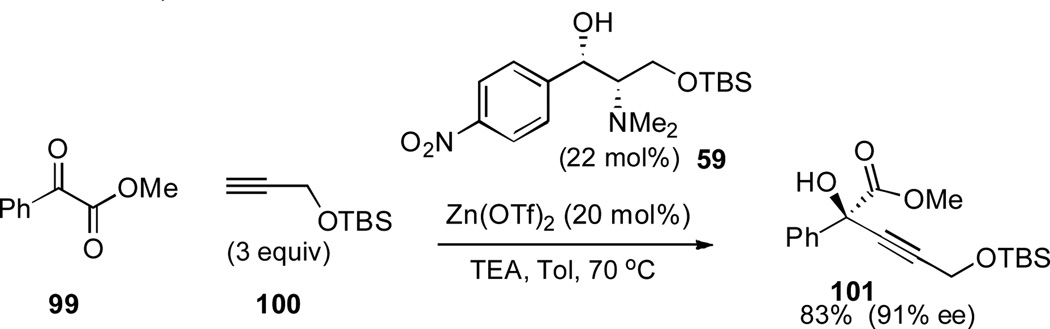
Enantioselective alkynylation of activated ketones with catalytic zinc.
Scheme 22
Scheme 22
Cozzi’s salen-catalyzed alkynylation of ketones.
Scheme 23
Scheme 23
Enantioselective copper-catalyzed zinc alkynylide addition to ketones.
Scheme 24
Scheme 24
Titanium(IV)-BINOL catalyzed alkynylations of ketones.
Scheme 25
Scheme 25
Wang’s enantioselective addition of zinc alkynylides to unactivated ketones.
Scheme 26
Scheme 26
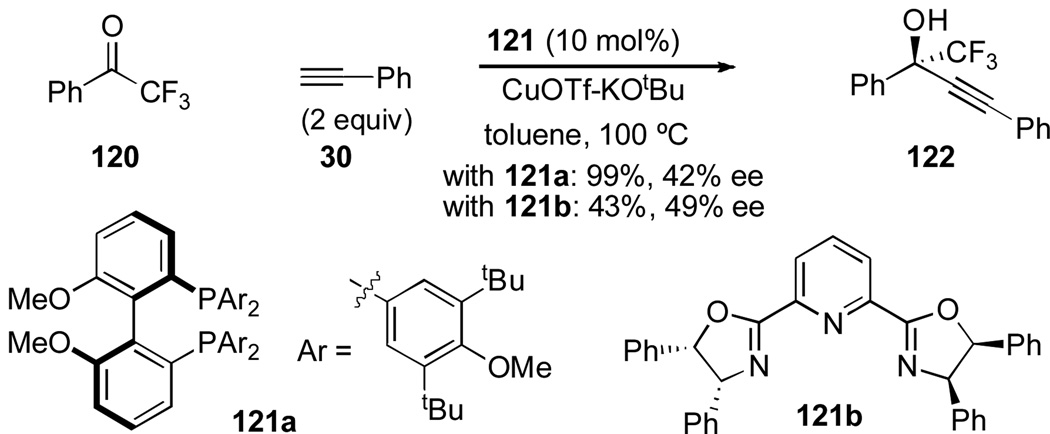
Catalytic enantioselective alkynylation of trifluoromethyl ketones.
Scheme 27
Scheme 27
First example of an enantioselective imine alkynylation.
Scheme 28
Scheme 28
Li’s three-component coupling reaction.
Scheme 29
Scheme 29
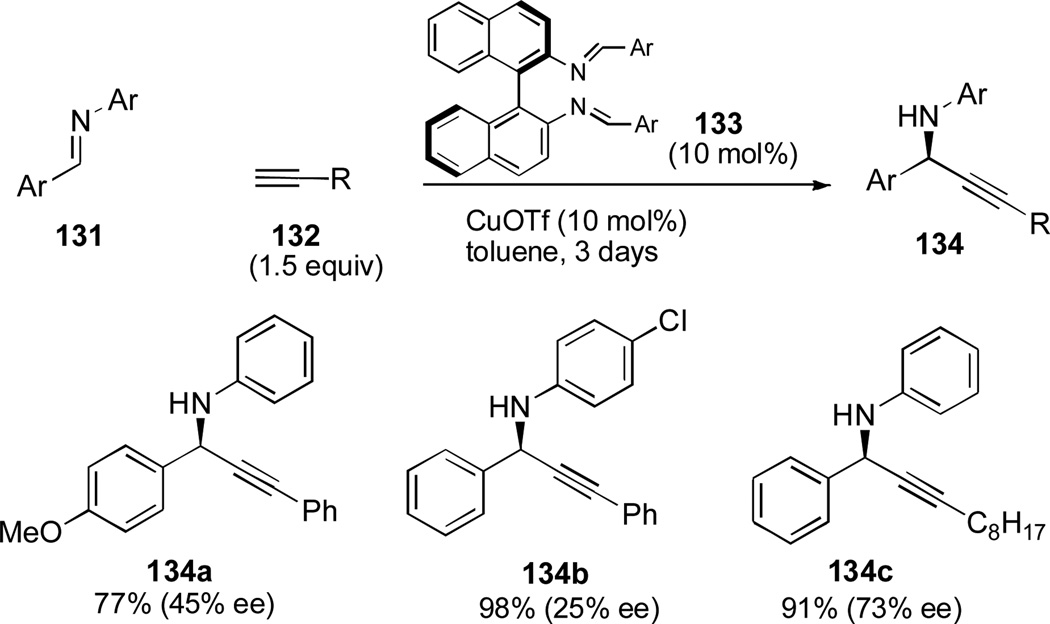
Alternative ligand for alkynylation of N-aryl imines.
Scheme 30
Scheme 30
Knochel’s QUINAP system for the alkynylation of imines.
Scheme 31
Scheme 31
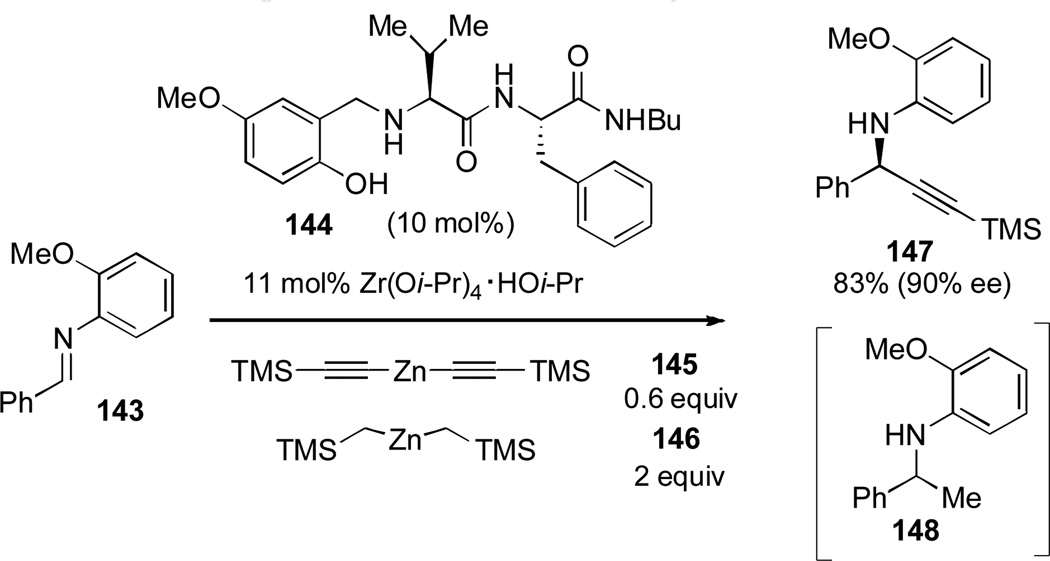
Zirconium-catalyzed alkynylation with mixed zinc species.
Scheme 32
Scheme 32
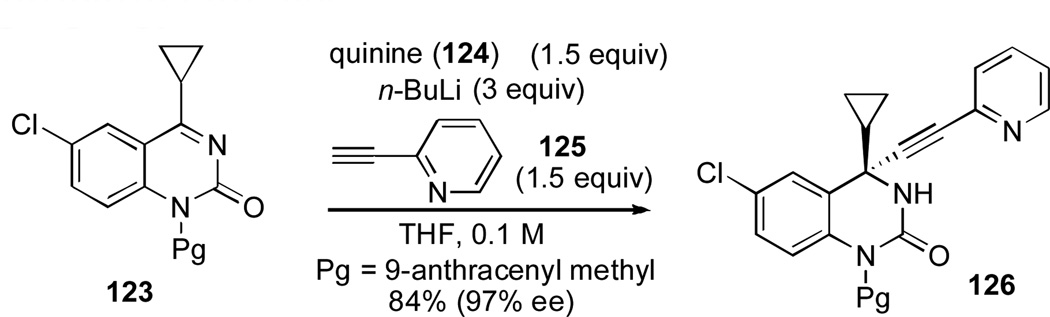
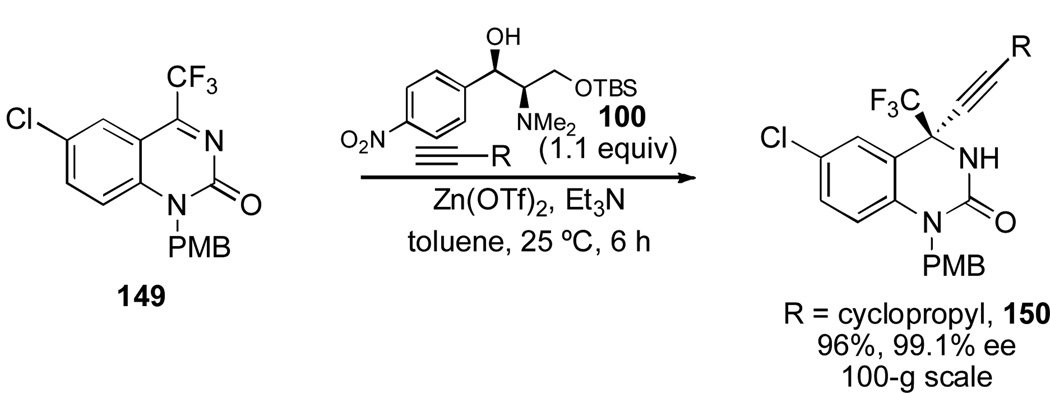
Zinc alkynylide addition to cyclic ketimine 150.
Scheme 33
Scheme 33
Enantioselective addition of alkynyl borane to N-acyl imines.
Scheme 34
Scheme 34
Dimethylzinc-mediated alkynylation of N-tosyl imines.
Scheme 35
Scheme 35
First example of enantioselective conjugate addition of an alkyne.
Scheme 36
Scheme 36
Asymmetric conjugate addition of alkynyl boronates.
Scheme 37
Scheme 37
Corey’s enantioselective conjugate addition to cyclic enone.
Scheme 38
Scheme 38
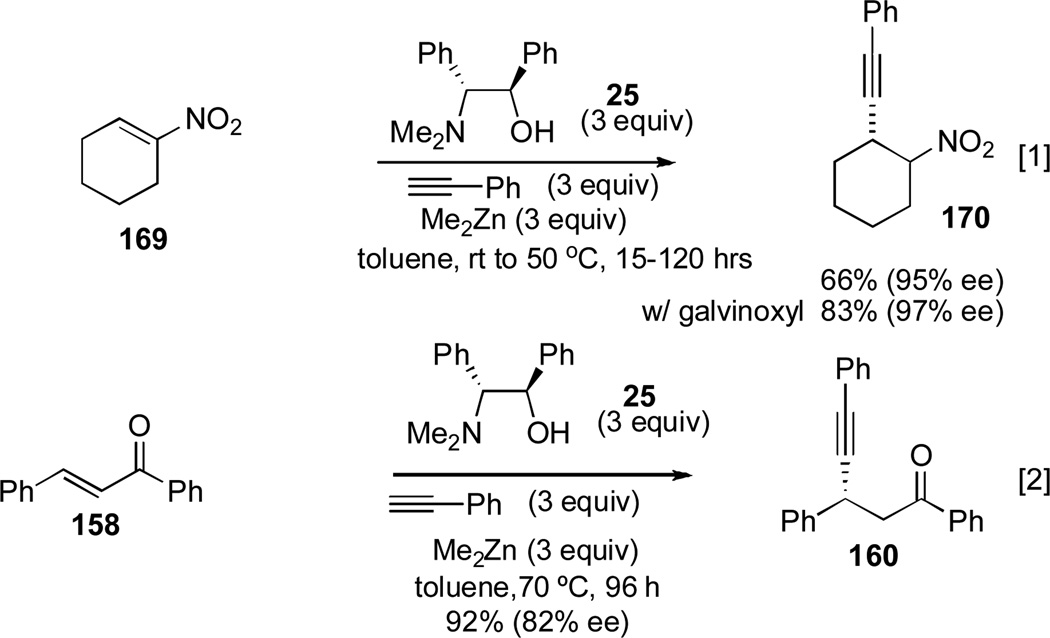
Aminoalcohol zinc alkynylide-mediated asymmetric conjugate additions.
Scheme 39
Scheme 39
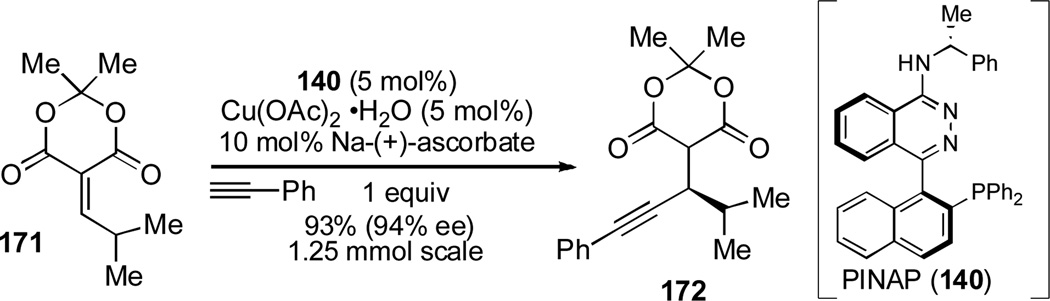
Copper-catalyzed enantioselective conjugate alkynylation of alkylidene Meldrum’s acids.
Scheme 40
Scheme 40
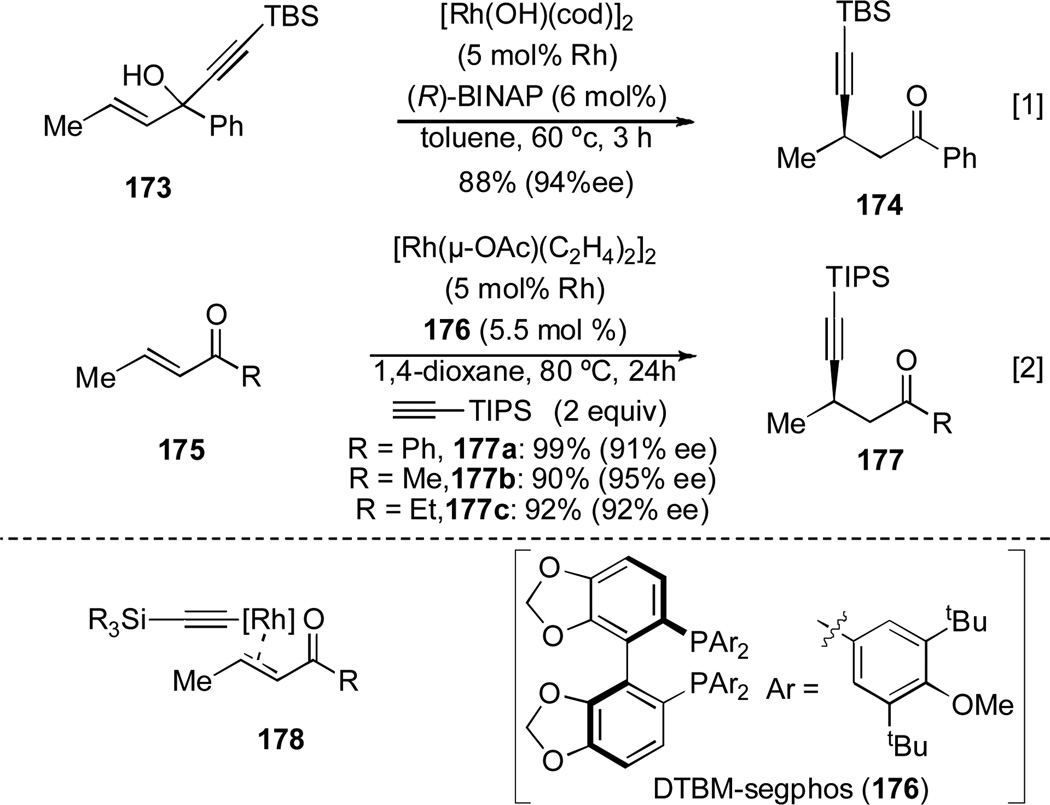
Rh-catalyzed asymmetric conjugate addition of alkynes to enones.

References

    1. Stang PJ, Diederich F, editors. Modern Acetylene Chemistry. Weinheim: VCH; 1995.
    1. For a [2+2+2]: Witulski B, Zimmermann A, Gowans ND. Chem. Commun. 2002:2984–2985.

    1. For a review on hydrometallations, see: Trost BM, Ball ZT. Synthesis. 2005:853–887.

    1. For some representative examples, see: Roethle PA, Trauner D. Org. Lett. 2006;8:345. Trost BM, Mueller TJJ, Martinez J. J. Am. Chem. Soc. 1995;117:1888–1899. Zhu G, Lu X. J. Org. Chem. 1995;60:1087. See also, references and .

    1. Fleming JJ, Du Bois J. J. Am. Chem. Soc. 2006;128:3926. - PubMed

LinkOut - more resources