


Institutions, Politics, and Mental Health Parity
- PMID: 24353902
- PMCID: PMC3864046
- DOI: 10.1177/2156869312455436
Institutions, Politics, and Mental Health Parity
Abstract
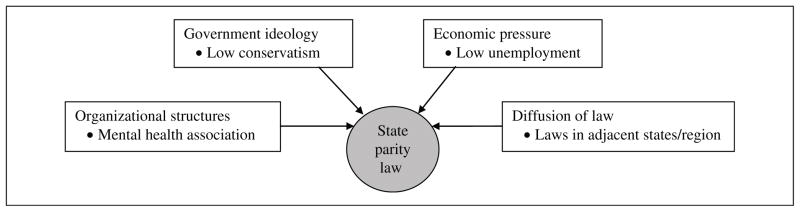
Mental health parity laws require insurers to extend comparable benefits for mental and physical health care. Proponents argue that by placing mental health services alongside physical health services, such laws can help ensure needed treatment and destigmatize mental illness. Opponents counter that such mandates are costly or unnecessary. The authors offer a sociological account of the diffusion and spatial distribution of state mental health parity laws. An event history analysis identifies four factors as especially important: diffusion of law, political ideology, the stability of mental health advocacy organizations and the relative health of state economies. Mental health parity is least likely to be established during times of high state unemployment and under the leadership of conservative state legislatures.
Keywords: mental health; mental health policy; mental health services.
Figures
References
-
- Allison Paul D. Survival Analysis Using SAS®: A Practical Guide. 2. Cary, NC: SAS Institute; 2010.
-
- Amenta Edwin. Bold Relief: Institutional Politics and the Origins of Modern American Social Policy. Princeton, NJ: Princeton University Press; 1998.
-
- Amenta Edwin, Bonastia Chris, Caren Neal. U.S. Social Policy in Comparative and Historical Perspective: Concepts, Images, Arguments, and Research Strategies. Annual Review of Sociology. 2001;27:213–34.
-
- Amenta Edwin, Poulsen Jane D. Social Politics in Context: The Institutional Politics Theory and Social Spending at the End of the New Deal. Social Forces. 1996;75:33–61.
Grants and funding
LinkOut - more resources
Full Text Sources