Review
. 2013 Dec 20:12:128.
doi: 10.1186/1475-2859-12-128.

Can too many copies spoil the broth?

Affiliations
Review

Can too many copies spoil the broth?

Rochelle Aw et al. Microb Cell Fact. .

Abstract

The success of Pichia pastoris as a heterologous expression system lies predominantly in the impressive yields that can be achieved due to high volumetric productivity. However, low specific productivity still inhibits the potential success of this platform. Multi-(gene) copy clones are potentially a quick and convenient method to increase recombinant protein titer, yet they are not without their pitfalls. It has been more than twenty years since the first reported use of multi-copy clones and it is still an active area of research to find the fastest and most efficient method for generating these strains. It has also become apparent that there is not always a linear correlation between copy number and protein titer, leading to in-depth investigations into how to minimize the negative impact of secretory stress and achieve clonal stability.


Figures
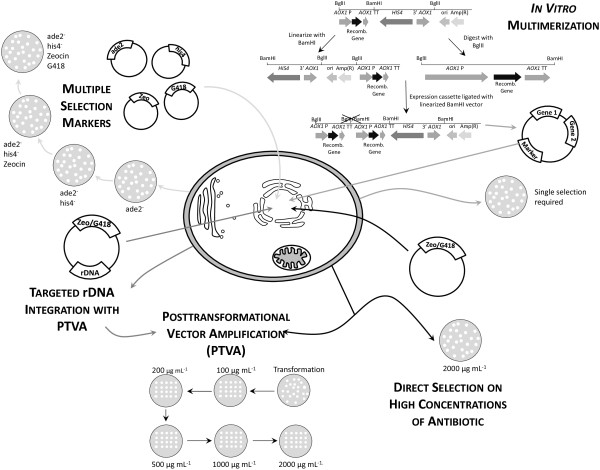
Figure 1
Figure 1
Methods to generate multi-copy clones. Schematic representation of some of the more common methods used to create multi-copy clones. Multiple selection markers can be used when a gene is integrated into the genome through a vector with a single selection marker. This method is limited to the number of selection markers available (either antibiotic or through complementation to auxotrophic genes). Additionally, each vector must be transformed sequentially and the labor associated with selection increases with each additional gene. In vitro multimerization uses the pAO815 vector that isolates an expression cassette containing the promoter, gene of interest and transcription terminator region and ligating this in a head-to-tail orientation into a linearized vector. Copy number is determined prior to integration into the genome. Direct selection on high concentrations of antibiotic uses a single transformation with a vector containing either G418 or Zeocin™ and selection directly onto high concentrations of the antibiotic. This results in jackpot colonies (over 10 copies of the gene) in less than 1% of all clones. Posttransformational vector amplification (PTVA) uses a single vector for transformation (containing either the G418 or Zeocin™ resistance marker). Selection is originally on a low concentration of the corresponding antibiotic, but the cells are increasingly subjected to higher concentrations. Only colonies that have multiple copies of the resistance gene (and therefore multiple copies of the heterologous gene) will be able to survive on the highest concentrations. Jackpot colonies are reported in 6% of all clones tested. Integration into the rDNA locus with PTVA utilizes the repeat sequence of the rDNA (appearing 16 times in GS115), which can prevent tandem head-to-tail integration. Multi-copy clones are generated using PTVA.
Figure 2
Figure 2
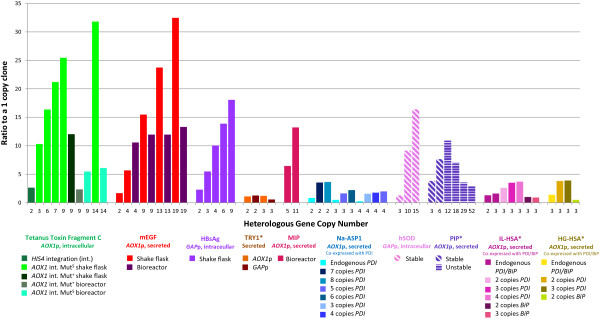
The impact of multi-copy clones on titer levels. Expression or activity levels were determined from published data and are presented as a ratio compared to the expression or activity of a single copy strain (calculated by dividing by the equivalent value of a single copy clone). A star (*) indicates that values were estimated. Tetanus toxin fragment C utilized different integration sites (HIS4 or AOX1) by linearizing the vector with different restriction sites prior to transformation. Intracellular expression using the AOX1 promoter. Samples were grown in either shake flasks or bioreactors [5]. Mouse epidermal growth factor (mEGF) was expressed as a secreted protein using the AOX1 promoter. Samples were grown in shake flasks and bioreactors [19]. Hepatitis B surface antigen (HBsAg) was expressed intracellularly under the GAP promoter in shake flasks [12]. Trypsinogen (TRY1) was expressed extracellularly using the GAP promoter or AOX1 promoter [20]. Miniproinsulin (MPI) was expressed using the AOX1 promoter as a secreted protein [21]. Necator americanus secretory protein (Na-ASP1) was co-expressed with varying copies of protein disulfide-isomerase (PDI) to determine the impact of chaperone coexpression. All variants were secreted and expressed under the AOX1 promoter [22]. Human superoxide dismutase (hSOD) was expressed intracellularly under the GAP promoter. Integration occurred at the rDNA locus with multi-copy clones generated by PTVA. Stability was observed for 28 generations, indicated by the diagonal stripes [17]. Porcine insulin precursor (PIP), using PTVA to generate multi-copy clones, was expressed under the AOX1 promoter and secreted [16]. Instability was observed in clones (under inducible conditions) with a copy number above 6, indicated by the horizontal stripes [23]. Interleukin and human growth hormone proteins were fused with HSA, IL-HSA and HG-HSA respectively, and co-expressed with PDI or BiP. The fusion proteins were secreted under the control of the AOX1 promoter [24].
Figure 3
Figure 3
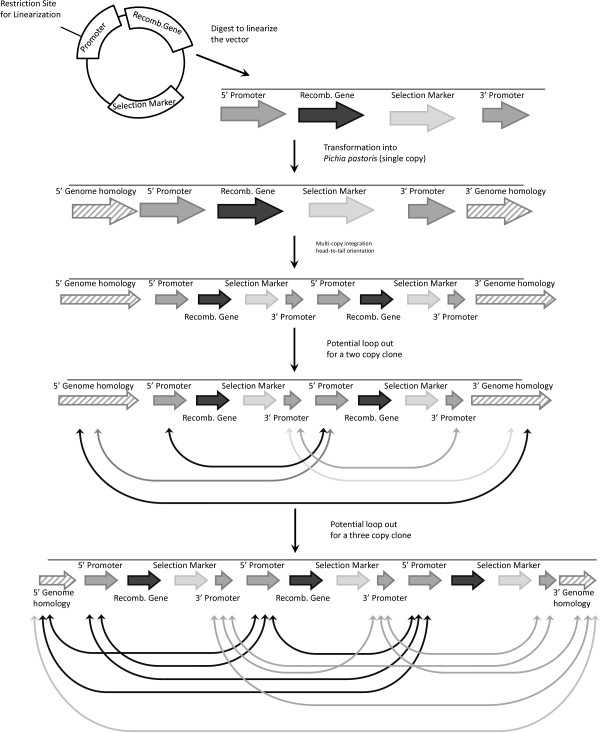
Loop out recombination. Through the highly recombinogenic nature of P. pastoris multiple copies of the vectors can integrate in a head-to-tail orientation. This will create repeat regions of homology which can recombine to remove either the whole or parts of the vector. For a two copy clone there is the potential for at least five loop out regions (based on the design of the vector) and this can increase to at least 11 for a three copy clone.

References

    1. Darby RA, Cartwright SP, Dilworth MV, Bill RM. Which yeast species shall I choose? Saccharomyces cerevisiae versus Pichia pastoris (review) Methods Mol Biol. 2012;12:11–23. doi: 10.1007/978-1-61779-770-5_2. - DOI - PubMed
    1. Cregg JM. Pichia Protocols. 2. Totowa, New Jersey: Humana Press; 2007.
    1. Dale C. Pichia pastoris: a eukaryotic system for the large-scale production of biopharmaceuticals. Biopharm. 1999;12:36.
    1. Romanos M, Scorer C, Sreekrishna K, Clare J. In: Pichia Protocols, Volume 103. Higgins DR, Cregg J, editor. Humana Press; 1998. The Generation of Multicopy Recombinant Strains; pp. 55–72. - PubMed
    1. Clare JJ, Rayment FB, Ballantine SP, Sreekrishna K, Romanos MA. High-level expression of tetanus toxin fragment C in Pichia pastoris strains containing multiple tandem integrations of the gene. Biotechnology (N Y) 1991;12:455–460. doi: 10.1038/nbt0591-455. - DOI - PubMed

Publication types