


A phase I and pharmacodynamic study of AT9283, a small-molecule inhibitor of aurora kinases in patients with relapsed/refractory leukemia or myelofibrosis
- PMID: 24355079
- PMCID: PMC4096861
- DOI: 10.1016/j.clml.2013.11.001
A phase I and pharmacodynamic study of AT9283, a small-molecule inhibitor of aurora kinases in patients with relapsed/refractory leukemia or myelofibrosis
Abstract
Background: This study sought to identify the maximum tolerated dose (MTD) of AT9283, an inhibitor of Aurora kinases A and B, in patients with relapsed or refractory leukemias. Other endpoints included pharmacokinetics, safety and tolerability, pharmacodynamics, and preliminary evidence of efficacy.
Patients and methods: AT9283 was administered as a continuous 72-hour infusion every 21 days. Doses were escalated by a standard 3 + 3 design. After the MTD for the 72-hour infusion was identified, infusion duration was increased incrementally to 96 hours and 120 hours. In total, 48 patients received ≥ 1 cycle of AT9283. Median age was 61 years (range, 22-86 years); 56% were men; 75% were diagnosed with AML; and 89% had received ≥ 3 (up to 16) prior lines of therapy.
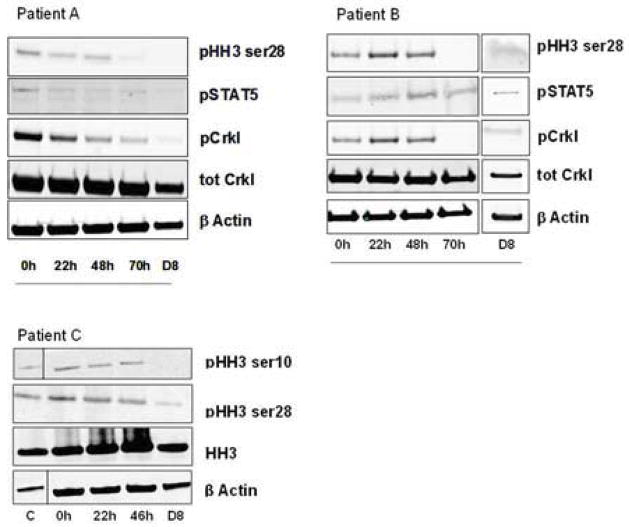
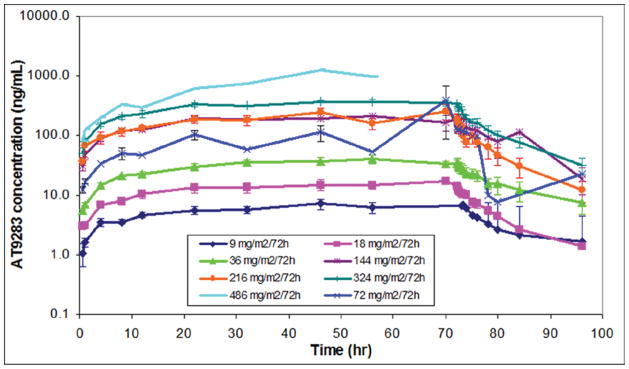
Results: 324 mg/m(2)/72 h AT9283 was determined to be the MTD. Dose-limiting toxicities (DLTs) were myocardial infarction, hypertension, cardiomyopathy, tumor lysis syndrome, pneumonia, and multiorgan failure. Other AT9283-related toxicities (non-DLT) included myelosuppression, predominantly leukopenia and mucositis. Bone marrow blasts decreased ≥ 38% after AT9283 treatment in approximately one-third of patients with relapsed/refractory AML; however, this effect was transient and no objective responses were achieved, despite evidence of Aurora kinase B inhibition. Two patients with accelerated-phase chronic myeloid leukemia showed evidence of benefit, manifested as a cytogenetic response in 1 case; 1 patient completed 6 cycles of treatment. Exposure to AT9283 was generally dose proportional.
Conclusion: AT9283 tolerability was strongly dose-dependent, with reversible myelosuppression predominating at lower doses and events such as cardiovascular toxicities manifesting at higher doses. Clinical trials with AT9283 are ongoing in alternative patient populations.
Keywords: Blood cancer; Clinical; Dose escalation; Response; Tolerability.
Copyright © 2014 Elsevier Inc. All rights reserved.
Conflict of interest statement
James Foran: funding for clinical study by Astex Pharmaceuticals Inc.
Farhad Ravandi: funding for clinical study by Astex Pharmaceuticals Inc.
William Wierda: funding for clinical study by Astex Pharmaceuticals Inc.
Guillermo Garcia-Manero: funding for clinical study by Astex Pharmaceuticals Inc.
Srdan Verstovsek: funding for clinical study by Astex Pharmaceuticals Inc.
Tapan Kadia: funding for clinical study by Astex Pharmaceuticals Inc.
Jan Burger: funding for clinical study by Astex Pharmaceuticals Inc.
Gautham Borthakur: funding for clinical study by Astex Pharmaceuticals Inc.
Jorge Cortes: funding for clinical study by Astex Pharmaceuticals Inc.
Hagop Kantarjian: funding for clinical study by Astex Pharmaceuticals Inc.
Dr. Yule, Dr. Langford, Dr. Lyons, and Dr. Ayrton are employees of or contractors for AstexPharmaceuticals, Inc. Victoria Lock was previously employed by Astex Pharmaceuticals, Inc.
Figures
References
-
- Carmena M, Earnshaw WC. The cellular geography of Aurora Kinases. Nat Rev Mol Cell Biol. 2003;4:842–854. - PubMed
-
- Sen S, Zhou H, White RA. A putative serine/threonine kinase encoding gene BTAK on chromosome 20q13 is amplified and overexpressed in human breast cancer cell lines. Oncogene. 1997;14:2195–200. - PubMed
-
- Katayama H, Ota T, Jisaki F, et al. Mitotic kinase expression and colorectal cancer progression. J Natl Cancer Inst. 1999;91:1160–2. - PubMed
-
- Kamada K, Yamada Y, Hirao T, et al. Amplification/overexpression of Aurora-A in human gastric carcinoma: Potential role in differentiated type gastric carcinogenesis. Oncol Rep. 2004;12:593–9. - PubMed
Publication types
MeSH terms
Substances
Grants and funding
LinkOut - more resources
Full Text Sources
Other Literature Sources
Medical
