


Birth weight, physical morbidity, and mortality: a population-based sibling-comparison study
- PMID: 24355331
- PMCID: PMC3927978
- DOI: 10.1093/aje/kwt304
Birth weight, physical morbidity, and mortality: a population-based sibling-comparison study
Abstract
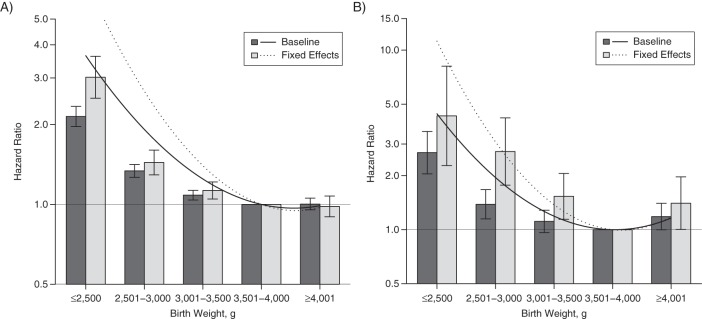
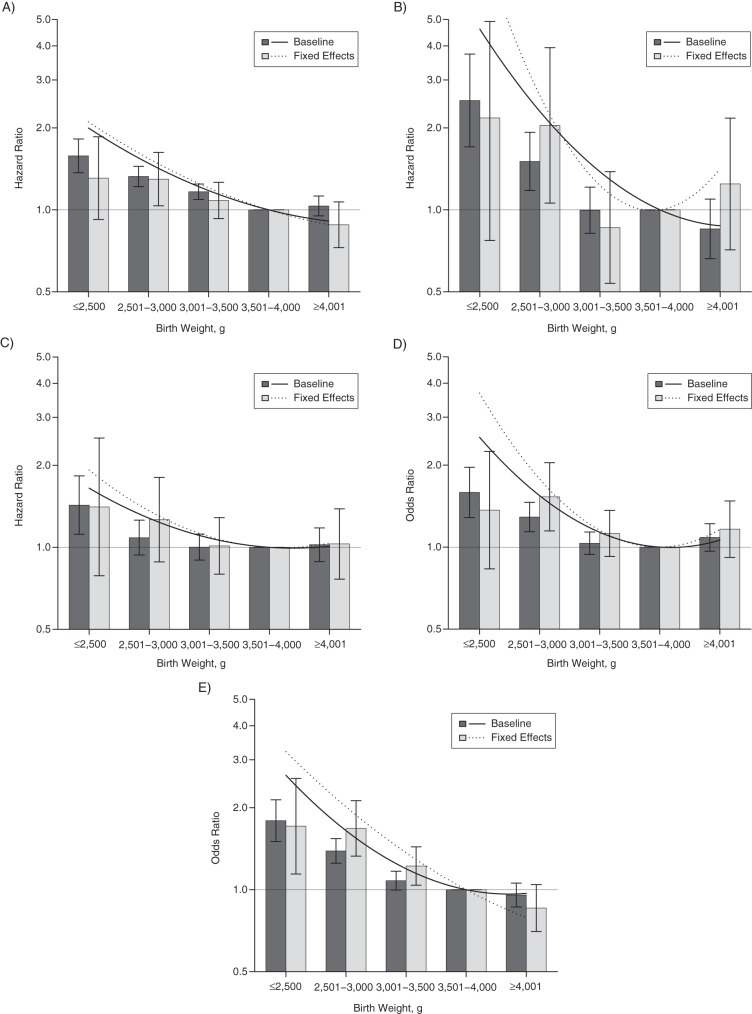
Associations between low birth weight (≤2,500 g) and increased risk of mortality and morbidity provided the foundation for the "developmental origins of health and disease" hypothesis. Previous between-family studies could not control for unmeasured confounders. Therefore, we compared differentially exposed siblings to estimate the extent to which the associations were due to uncontrolled factors. Our population cohort included 3,291,773 persons born in Sweden from 1973 to 2008. Analyses controlled for gestational age, among other covariates, and considered birth weight as both an ordinal and a continuous variable. Outcomes included mortality after 1 year, cardiac-related death, hypertension, ischemic heart disease, pulmonary circulation problems, stroke, and type 2 diabetes mellitus. We fitted fixed-effects models to compare siblings and conducted sensitivity analyses to test alternative explanations. Across the population, the lower the birth weight, the greater the risk of mortality (e.g., cardiac-related death (low birth weight hazard ratio = 2.69, 95% confidence interval: 2.05, 3.53)) and morbidity (e.g., type 2 diabetes mellitus (low birth weight hazard ratio = 1.79, 95% confidence interval: 1.50, 2.14)) outcomes in comparison with normal birth weight. All associations were independent of shared familial confounders and measured covariates. Results emphasize the importance of birth weight as a risk factor for subsequent mortality and morbidity.
Keywords: birth weight; cardiovascular diseases; diabetes mellitus; fetal development; stroke.
Figures
References
-
- Barker DJP. Mothers, Babies and Health in Later Life. 2nd ed. Edinburgh, United Kingdom: Churchill Livingstone; 1998.
-
- World Health Organization. 2008–2013 Action Plan for the Global Strategy for the Prevention and Control of Noncommunicable Diseases. Geneva, Switzerland: World Health Organization; 2008.
-
- Murray CJL, Vos T, Lozano R, et al. Disability-adjusted life years (DALY) for 291 diseases and injuries in 21 regions, 1990–2010: a systematic analysis for Global Burden of Disease Study 2010. Lancet. 2012;380(9859):2197–2223. - PubMed
-
- Baker JL, Olsen LW, Sorensen TIA. Weight at birth and all-cause mortality in adulthood. Epidemiology. 2008;19(2):197–203. - PubMed
Publication types
MeSH terms
Grants and funding
LinkOut - more resources
Full Text Sources
Other Literature Sources
Medical
