


Skeletal muscle morphology and contractile function in relation to muscle denervation in diabetic neuropathy
- PMID: 24356519
- PMCID: PMC3949214
- DOI: 10.1152/japplphysiol.01139.2013
Skeletal muscle morphology and contractile function in relation to muscle denervation in diabetic neuropathy
Abstract
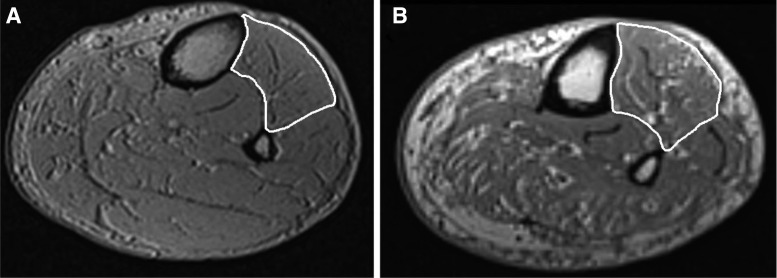
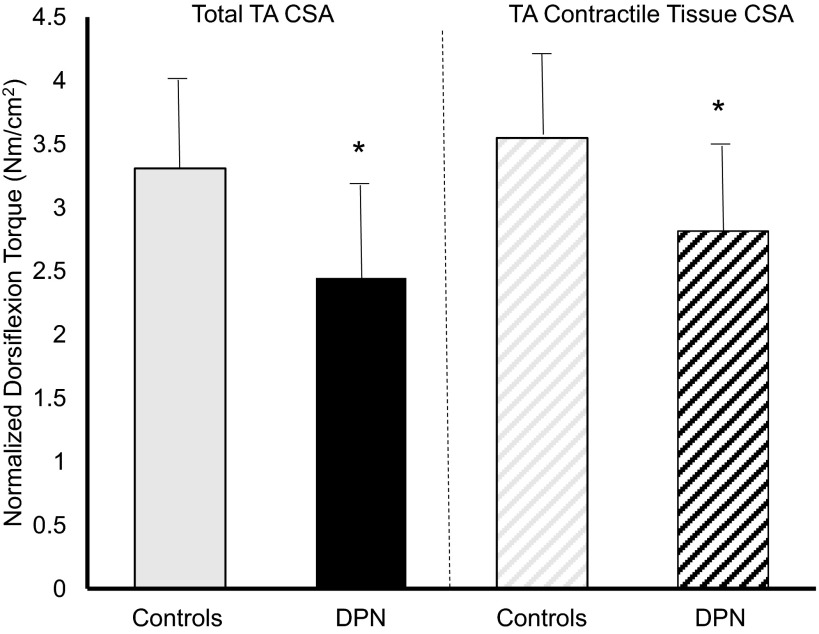
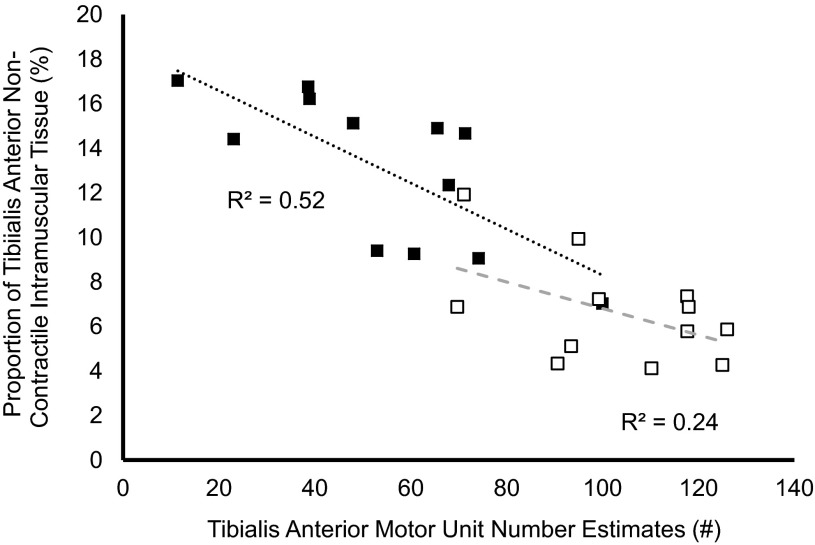
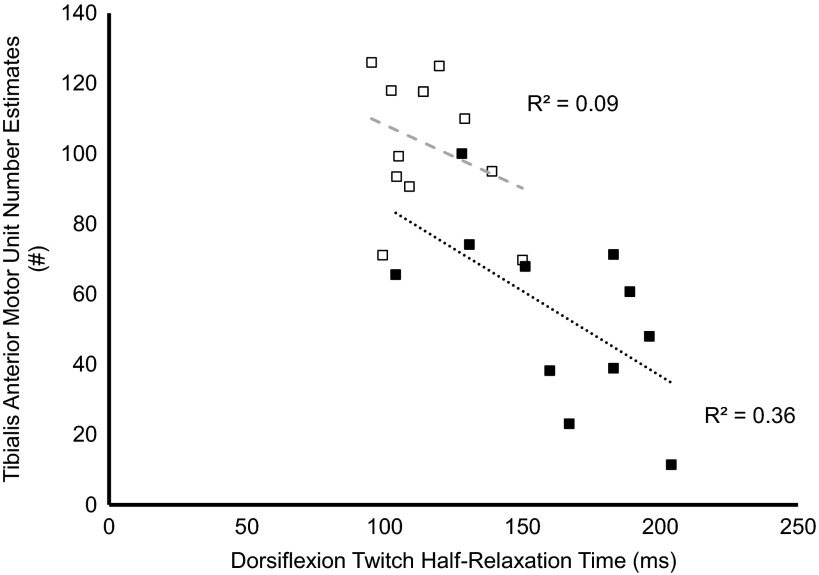
The objective of the study was to assess the effects of diabetic polyneuropathy (DPN) on muscle contractile properties in humans, and how these changes are related to alterations in muscle morphology and denervation. Patients with DPN (n = 12) were compared with age- and sex-matched controls (n = 12). Evoked and voluntary contractile properties, including stimulated twitch responses and maximal voluntary contractions, of the dorsiflexor muscles were assessed using an isometric ankle dynamometer. Motor unit number estimates (MUNE) of the tibialis anterior (TA) were performed via quantitative electromyography and decomposition-enhanced spike-triggered averaging. Peak tibialis anterior (TA) cross-sectional area (CSA; cm(2)), and relative proportion of contractile to noncontractile tissue (%) was determined from magnetic resonance images. Patients with DPN demonstrated decreased strength (-35%) and slower (-45%) dorsiflexion contractile properties for both evoked and voluntary contractions (P < 0.05). These findings were not accounted for by differences in voluntary activation (P > 0.05) or antagonist coactivation (P > 0.05). Additionally, patients with DPN were weaker when strength was normalized to TA total CSA (-30%; P < 0.05) or contractile tissue CSA (-26%; P < 0.05). In the DPN patient group, TA MUNEs were negatively related to both % noncontractile tissue (P < 0.05; r = 0.72) and twitch half-relaxation time (P < 0.05; r = 0.60), whereas no relationships were found between these variables in controls (P > 0.05). We conclude that patients with DPN demonstrated reduced strength and muscle quality as well as contractile slowing. This process may contribute to muscle power loss and functional impairments reported in patients with DPN, beyond the loss of strength commonly observed.
Keywords: coactivation; contractile slowing; diabetes mellitus; postactivation potentiation; weakness.
Figures
References
-
- Allen MD, Choi I, Kimpinski K, Doherty TJ, Rice CL. Motor unit loss and weakness in association with diabetic neuropathy in humans. Muscle Nerve 48: 298–300, 2013 - PubMed
-
- Andersen H, Poulsen PL, Mogensen CE, Jakobsen J. Isokinetic muscle strength in long-term IDDM patients in relation to diabetic complications. Diabetes 45: 440–445, 1996 - PubMed
-
- Andersen H. Motor dysfunction in diabetes. Diabetes Metab Res Rev 28: 89–92, 2012 - PubMed
-
- Andersen H, Gadeberg PC, Brock B, Jakobsen J. Muscular atrophy in diabetic neuropathy: a stereological magnetic resonance imaging study. Diabetologia 40: 1062–1069, 1997 - PubMed
Publication types
MeSH terms
Substances
LinkOut - more resources
Full Text Sources
Other Literature Sources
Medical
