


Increased stiffness and cell-matrix interactions of abdominal aorta in two experimental nonhypertensive models: long-term chemically sympathectomized and sinoaortic denervated rats
- PMID: 24356541
- PMCID: PMC5097123
- DOI: 10.1097/HJH.0000000000000073
Increased stiffness and cell-matrix interactions of abdominal aorta in two experimental nonhypertensive models: long-term chemically sympathectomized and sinoaortic denervated rats
Abstract
Rationale: Sinoaortic denervated (SAD) and chemically sympathectomized (SNX) rats are characterized by a decrease in arterial distensibility without hypertension and would, thus, be relevant for analyzing arterial wall stiffening independently of blood pressure level. The fibronectin network, which plays a pivotal role in cell-matrix interactions, is a major determinant of arterial stiffness. We hypothesized that in SAD and SNX rats, arterial stiffness is increased, due to alterations of cell-matrix anchoring leading to spatial reorganization of the extracellular matrix.
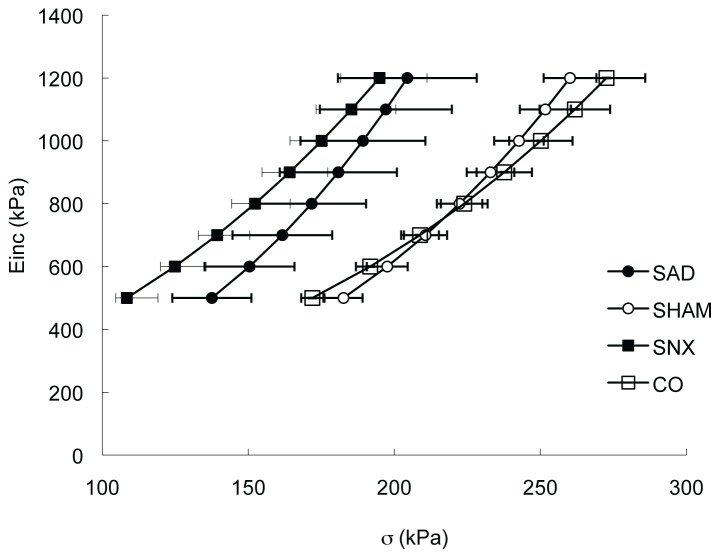
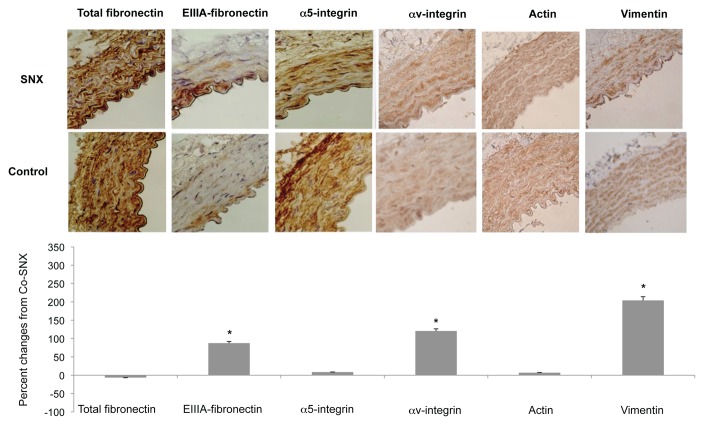
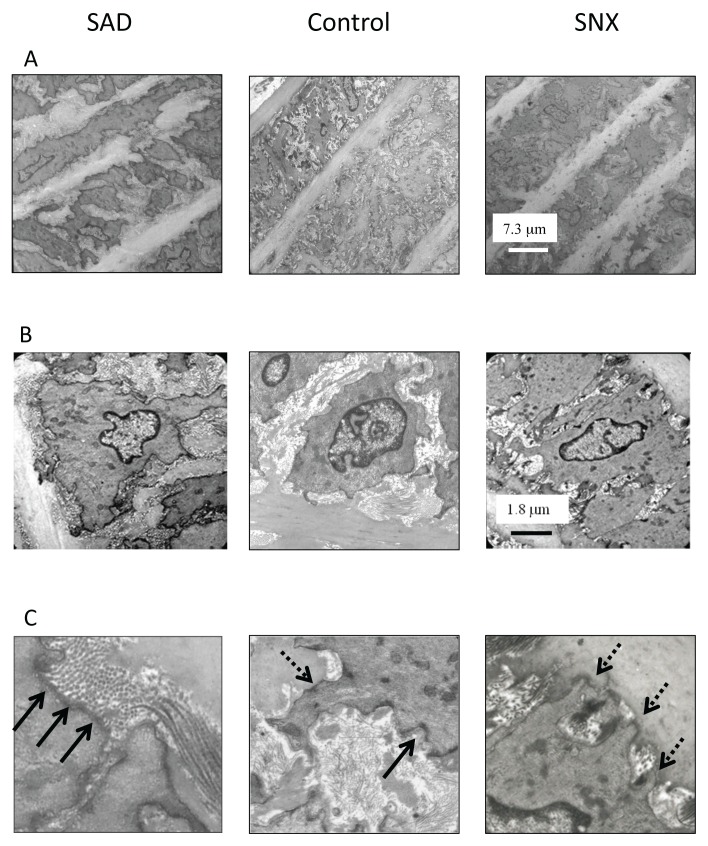
Methods: The intrinsic elastic properties of the arterial wall were evaluated in vivo by the relationship between incremental elastic modulus determined by echotracking and circumferential wall stress. The changes of cell-extracellular matrix links in the abdominal aorta were evaluated by studying fibronectin, vascular integrin receptors, and ultrastructural features of the aorta by immunochemistry.
Results: In both experimental conditions, wall stiffness increased, associated with different modifications of cell-extracellular matrix adhesion. In SAD rats, increased media cross-sectional area was coupled with an increase of muscle cell attachments to its extracellular matrix via fibronectin and its α5-β1 integrin. In SNX rats, reduced media cross-sectional area was associated with upregulation of αv-β3 integrin and more extensive connections between dense bands and elastic fibers despite the disruption of the elastic lamellae.
Conclusion: In aorta of SNX and SAD rats, a similar arterial stiffness is associated to different structural alterations. An increase in αvβ3 or α5β1 integrins together with the already reported increase in the proportion of less distensible (collagen) to more distensible (elastin) components in both models contributes to remodeling and stiffening of the abdominal aorta.
Conflict of interest statement
None
Figures

References
-
- Laurent S, Boutouyrie P, Asmar R, Gautier I, Laloux B, Guize L, et al. Aortic stiffness is an independent predictor of all-cause and cardiovascular mortality in hypertensive patients. Hypertension. 2001 May;37(5):1236–41. - PubMed
-
- Pannier BM, Avolio AP, Hoeks A, Mancia G, Takazawa K. Methods and devices for measuring arterial compliance in humans. Am J Hypertens. 2002 Aug;15(8):743–53. - PubMed
-
- Bezie Y, Lamaziere JM, Laurent S, Challande P, Cunha RS, Bonnet J, et al. Fibronectin expression and aortic wall elastic modulus in spontaneously hypertensive rats. Arteriosclerosis, thrombosis, and vascular biology. 1998 Jul;18(7):1027–34. - PubMed
-
- Lacolley P, Bezie Y, Girerd X, Challande P, Benetos A, Boutouyrie P, et al. Aortic distensibility and structural changes in sinoaortic-denervated rats. Hypertension. 1995 Aug;26(2):337–40. - PubMed
-
- Lacolley P, Glaser E, Challande P, Boutouyrie P, Mignot JP, Duriez M, et al. Structural changes and in situ aortic pressure-diameter relationship in long-term chemical-sympathectomized rats. The American journal of physiology. 1995 Aug;269(2 Pt 2):H407–16. - PubMed
MeSH terms
Substances
LinkOut - more resources
Full Text Sources
Other Literature Sources
Miscellaneous
