Spino-olivary projections in the rat are anatomically separate from postsynaptic dorsal column projections
- PMID: 24357064
- PMCID: PMC4282304
- DOI: 10.1002/cne.23527
Spino-olivary projections in the rat are anatomically separate from postsynaptic dorsal column projections
Abstract
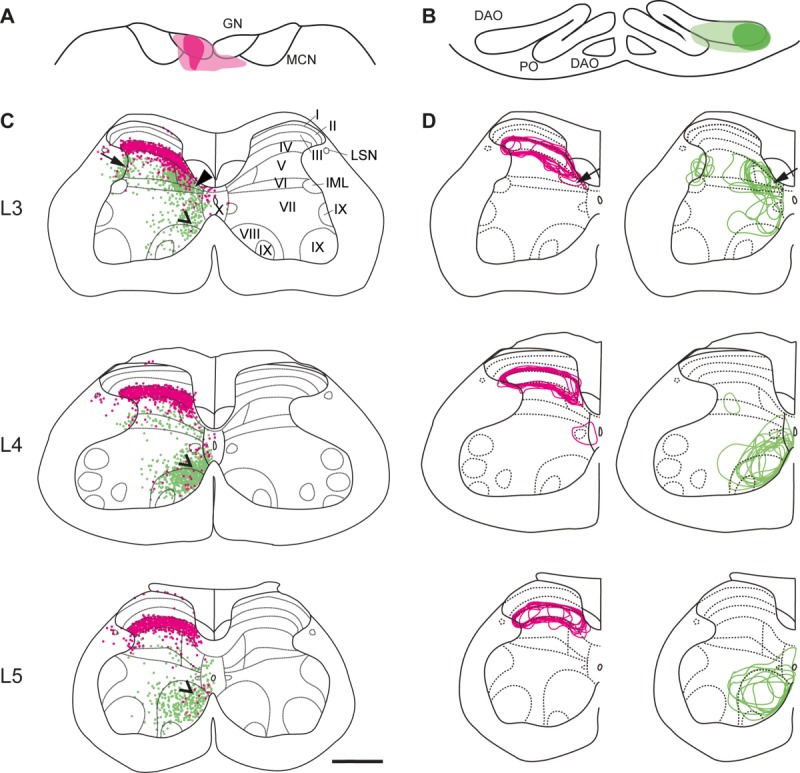
The gracile nucleus (GN) and lateral part of rostral dorsal accessory olive (rDAO) are important relays for indirect, postsynaptic dorsal column, and direct ascending pathways, respectively, that terminate as climbing fibers in the "hindlimb-receiving" parts of the C1 and C3 zones in the cerebellar cortex. While the spinal cells of origin of that project to GN and rDAO are from largely separate territories in the spinal cord, previous studies have indicated that there could be an area of overlap between these two populations in the medial dorsal horn. Given the access of these two ascending tracts to sensory (thalamic) versus sensorimotor (precerebellar) pathways, the present study therefore addresses the important question of whether or not individual neurons have the potential to contribute axons to both ascending pathways. A double-fluorescent tracer strategy was used in rats (red Retrobeads and Fluoro-Ruby or green Retrobeads and Fluoro-Emerald) to map the spatial distribution of cells of origin of the two projections in the lumbar spinal cord. The two pathways were found to receive input from almost entirely separate territories within the lumbar cord (levels L3-L5). GN predominantly receives input from lamina IV, while rDAO receives its input from three cell populations: medial laminae V-VI, lateral lamina V, and medial laminae VII-VIII. Cells that had axons that branched to supply both GN and rDAO represented only about 1% of either single-labeled cell population. Overall, the findings therefore suggest functional independence of the two ascending pathways.
Keywords: cerebellum; gracile; inferior olive; tracer.
Copyright © 2013 Wiley Periodicals, Inc.
Figures




References
-
- Abercrombie M. Estimation of nuclear populations from microtome sections. Anat Rec. 1946;94:239–247. - PubMed
-
- Andersson G. Demonstration of a cuneate relay in a cortico-olivo-cerebellar pathway in the cat. Neurosci Lett. 1984;46:47–52. - PubMed
-
- Andersson G, Sjolund B. The ventral spino-olivocerebellar system in the cat. IV. Spinal transmission after administration of clonidine and L-dopa. Exp Brain Res. 1978;33:227–240. - PubMed
-
- Angaut-Petit D. The dorsal column system: I. Existence of long ascending postsynaptic fibers in the cat’s fasciculus gracilis. Exp Brain Res. 1975;22:457–470. - PubMed
-
- Apps R, Garwicz M. Precise matching of olivo-cortical divergence and cortico-nuclear convergence between somatotopically corresponding areas in the medial C1 and medial C3 zones of the paravermal cerebellum. Eur J Neurosci. 2000;12:205–214. - PubMed
Publication types
MeSH terms
Substances
Grants and funding
LinkOut - more resources
Full Text Sources
Other Literature Sources
Miscellaneous