


Updated assays for inhibin B and AMH provide evidence for regular episodic secretion of inhibin B but not AMH in the follicular phase of the normal menstrual cycle
- PMID: 24357435
- PMCID: PMC3923509
- DOI: 10.1093/humrep/det447
Updated assays for inhibin B and AMH provide evidence for regular episodic secretion of inhibin B but not AMH in the follicular phase of the normal menstrual cycle
Abstract
Study question: What is the daily variation in serum inhibin B (InhB) and anti-Müllerian hormone (AMH) in relation to the LH surge in women of reproductive age.
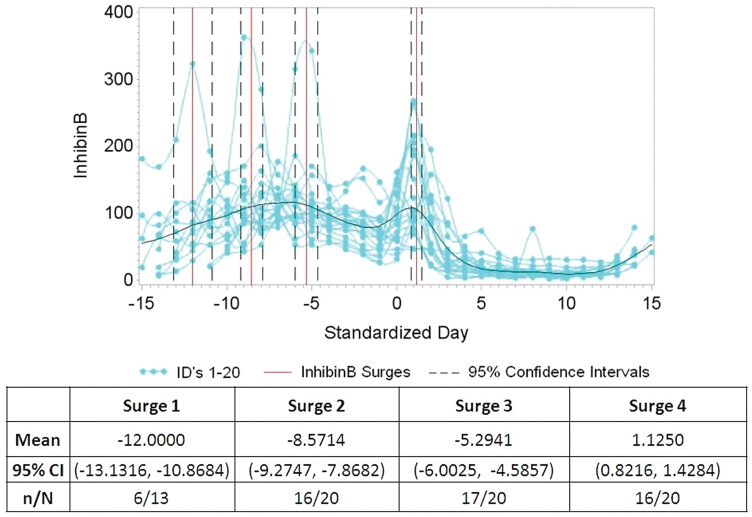
Summary answer: AMH is secreted in a biphasic follicular/luteal pattern in women with higher AMH secretion, while InhB secretion is episodic in the early to mid-follicular phase and immediately after the LH surge but not in the luteal phase.
What is known already: In women of reproductive age with a mean serum AMH >1 ng/ml, levels are highest in Days 2-7 of the cycle. InhB concentrations are highest in the follicular phase of the cycle.
Study design, size, duration: In this cohort study conducted in an academic center, blood samples were collected daily from 20 women during one normal menstrual cycle.
Participants/materials, setting, methods: Regularly menstruating 30- to 40-year-old women had daily serum InhB, AMH, LH and FSH levels measured. Intracycle variability of InhB and AMH were assessed after aligning to the LH surge.
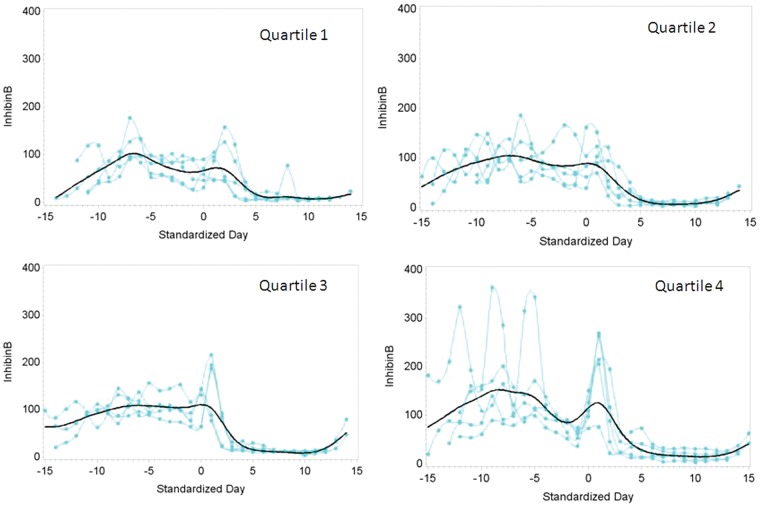
Main results and the role of chance: When classified into quartiles of AMH concentration, the lowest AMH levels did not vary across the cycle; the highest AMH levels showed a mid-follicular increase, mid-cycle decrease and mid-luteal increase. A surge of InhB was noted following the LH surge in 16/20 cycles. Episodic increases in InhB occurred in 17/20 cycles prior to the LH surge. In the luteal phase, InhB decreased or became undetectable and did not demonstrate episodic secretion. Old and new assays for AMH and InhB were compared in all samples, with the AMH assays demonstrating good correlation (Rsq = 0.9625) but the InhB assays showing less correlation (Rsq = 0.4903).
Limitations, reasons for caution: The study population is small and in the mid-to-late reproductive age group. Single daily sampling may not detect more frequent variability (i.e. pulses) in hormone levels.
Wider implications of the findings: These data suggest different regulatory mechanisms for InhB and AMH secretion, and confirm an 'aging ovary' pattern of AMH and InhB secretion, which is consistent with decreased ovarian reserve. We also demonstrated comparability of the AMH Gen II assay with the previous version in standard usage but our data raised concerns about comparability of the InhB Gen II assay.
Study funding/competing interest(s): General Clinical Research Center for phlebotomy work has been supported in part by NIH grant UL1RR024986. Recruitment and data analyses were supported by the Center for Integrated Approaches to Complex Diseases (SD Harlow, Director). The authors report no conflicts of interest.
Trial registration number: N/A.
Keywords: anti-Müllerian hormone; inhibin B; menstrual cycle variability; ovarian reserve; reproductive aging.
Figures


References
-
- Baerwald AR, Adams GP, Pierson RA. Ovarian antral folliculogenesis during the human menstrual cycle: a review. Hum Reprod Update. 2012;18:73–91. doi: 10.1093/humupd/dmr039. - PubMed
-
- Broekmans FJ, Soules MR, Fauser BC. Ovarian aging: mechanisms and clinical consequences. Endocr Rev. 2009;30:465–493. - PubMed
-
- Bungum L, Jacobsson AK, Rosén F, Becker C, Yding Andersen C, Güner N, Giwercman A. Circadian variation in concentration of anti-Müllerian hormone in regularly menstruating females: relation to age, gonadotrophin and sex steroid levels. Hum Reprod. 2011;26:678–684. doi: 10.1093/humrep/deq380. - PubMed
-
- Carlsen E, Olsson C, Petersen JH, Andersson AM, Skakkebaek NE. Diurnal rhythm in serum levels of inhibin B in normal men: relation to testicular steroids and gonadotropins. J Clin Endocrinol Metab. 1999;84:1664–1669. - PubMed
-
- Cook CL, Siow Y, Taylor S, Fallat ME. Serum mullerian-inhibiting substance levels during normal menstrual cycles. Fertil Steril. 2000;73:859–861. - PubMed
Publication types
MeSH terms
Substances
Grants and funding
LinkOut - more resources
Full Text Sources
Other Literature Sources
Medical
Research Materials
