


The role of inner strength in quality of life and self-management in women survivors of cancer
- PMID: 24357538
- PMCID: PMC4126601
- DOI: 10.1002/nur.21579
The role of inner strength in quality of life and self-management in women survivors of cancer
Abstract
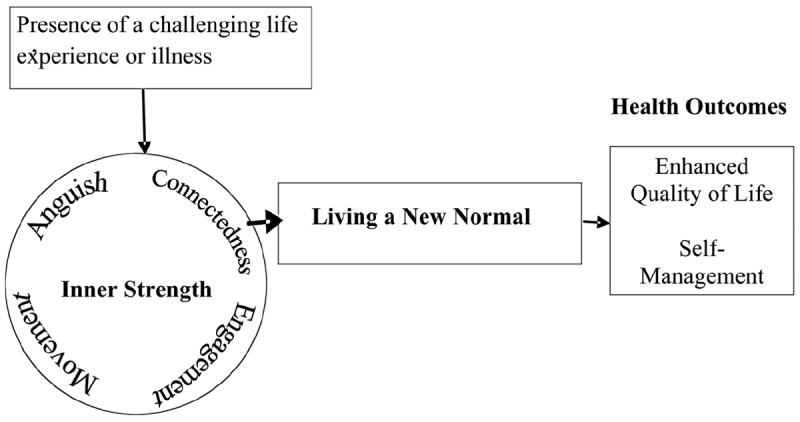
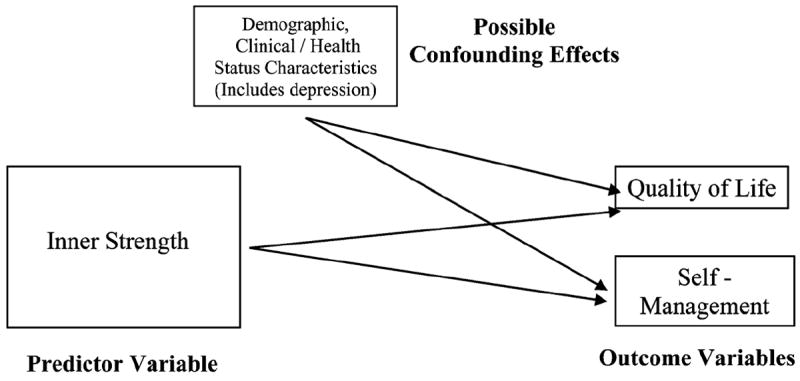
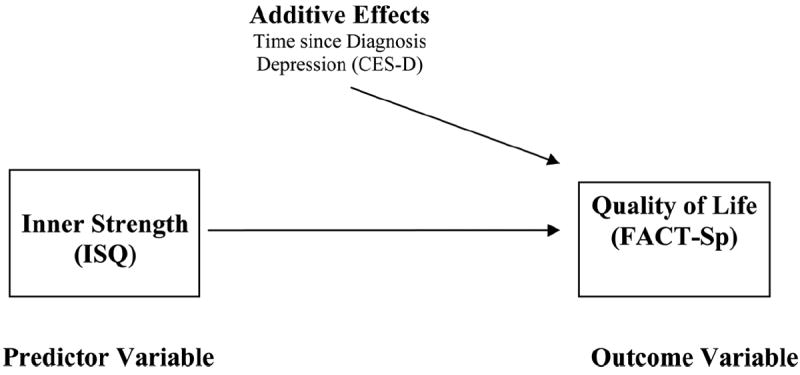
The role of inner strength in quality of life (QOL) and self-management, primary variables in the Theory of Inner Strength, were examined with demographic and clinical characteristics in 107 women with cancer. The strongest predictors of QOL were depressive symptoms, inner strength, and time since diagnosis, respectively, accounting for 82% of the variance in QOL. When depressive symptoms were excluded due to multicollinearity, 64% of variance in QOL was explained by inner strength, time since diagnosis, and comorbidities, with inner strength the strongest predictor. The strongest predictors of self-management were depressive symptoms and inner strength, accounting for 17% of the variance. Results contribute to theory development and suggest the value of supporting inner strength to enhance QOL in cancer survivors.
Keywords: Theory of Inner Strength; cancer; inner strength; quality of life; self-management; women.
© 2013 Wiley Periodicals, Inc.
Figures
References
-
- American Cancer Society. Cancer facts and figures 2011. 2011 Retrieved from http://www.cancer.org/acs/groups/content/@epidemiologysurveilance/docume....
-
- Brady M, Peterman A, Fitchett G, Mo M, Cella D. A case for including spirituality in quality of life measurement in oncology. Pyscho-Oncology. 1999;8:417–428. - PubMed
-
- Campbell DT, Fiske DW. Convergent and discriminant validation by the Multitrait-Multimethod Matrix. Psychological Bulletin. 1959;56:81–101. - PubMed
-
- Cella DF, Tulsky DS, Gray G, Sarafin B, Linn E, Bonomi A, Brannon J, et al. The Functional Assessment of Cancer Therapy Scale: Development and validation of the general measure. Journal of Clinical Oncology. 1993;11:570–579. - PubMed
Publication types
MeSH terms
Grants and funding
LinkOut - more resources
Full Text Sources
Other Literature Sources
Medical