Underuse of the health care system by persons with diabetes mellitus and diabetic macular edema in the United States
- PMID: 24357541
- PMCID: PMC4576971
- DOI: 10.1001/jamaophthalmol.2013.6426
Underuse of the health care system by persons with diabetes mellitus and diabetic macular edema in the United States
Abstract
Importance: Thickening of the center of the retina, diabetic macular edema (DME), is the most common cause of visual loss due to diabetes mellitus. Treatment of DME has improved dramatically, and the prompt diagnosis of DME and referral of these patients have become more critical. Nonetheless, awareness of and care for DME in the US population is uncharacterized.
Objective: To characterize eye care and awareness of eye disease among persons with DME in the general US population.
Design, setting, and participants: Cross-sectional analysis of data from participants in the 2005 to 2008 National Health and Nutrition Examination Survey 40 years or older with diabetes mellitus and fundus photographs.
Main outcomes and measures: Among persons with DME, (1) awareness that diabetes has affected their eyes; (2) report on the last time they visited a diabetes specialist; (3) report on their last eye examination with pupil dilation; and (4) prevalence of visual impairment.
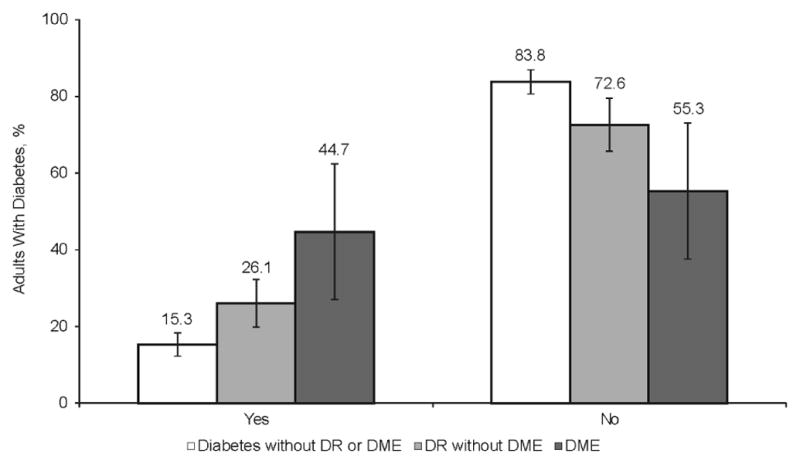
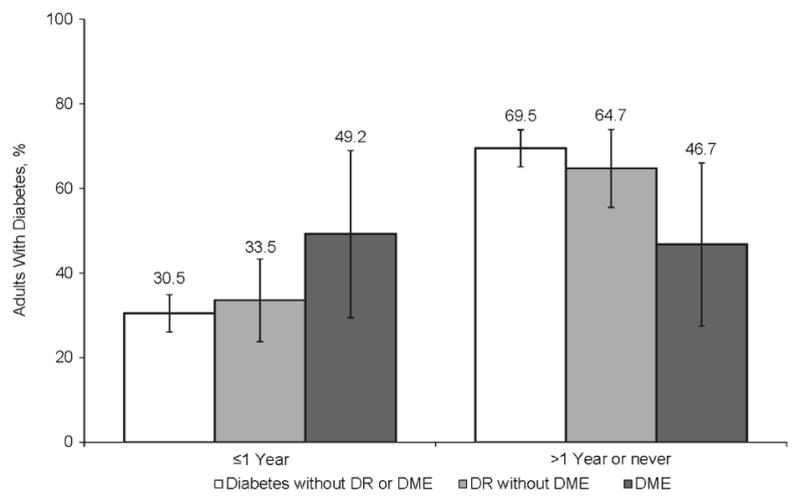
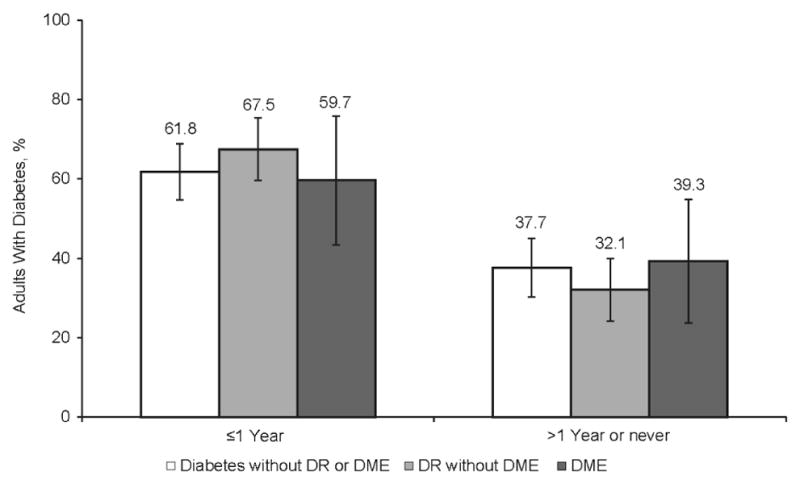
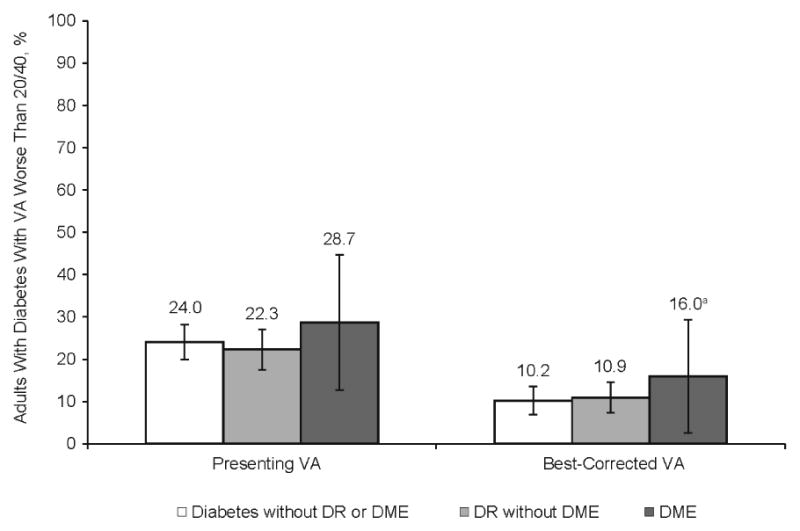
Results: In 2010, only 44.7% (95% CI, 27.0%-62.4%) of US adults 40 years or older with DME reported being told by a physician that diabetes had affected their eyes or that they had retinopathy; 46.7% (95% CI, 27.5%-66.0%), that they had visited a diabetes nurse educator, dietician, or nutritionist for their diabetes mellitus more than 1 year ago or never; and 59.7% (95% CI, 43.5%-75.9%), that they had received an eye examination with pupil dilation in the last year. Among persons with DME, 28.7% (95% CI, 12.7%-44.7%) were visually impaired (defined as visual acuity worse than 20/40 in the eye with DME) based on visual acuity at the initial examination and 16.0% (95% CI, 2.5%-29.4%) based on best-corrected visual acuity.
Conclusions and relevance: Many persons with diabetes mellitus in the United States are not getting care that can prevent visual impairment and blindness. Strategies to increase awareness are warranted, especially given the recent availability of improved therapies for DME.
Conflict of interest statement
Figures
Comment in
-
Vulnerable populations in the underuse of the US Health Care System by persons with diabetes mellitus and diabetic macular edema.JAMA Ophthalmol. 2014 Aug;132(8):1030. doi: 10.1001/jamaophthalmol.2014.1759. JAMA Ophthalmol. 2014. PMID: 25124955 No abstract available.
-
Vulnerable populations in the underuse of the US Health Care System by persons with diabetes mellitus and diabetic macular edema-reply.JAMA Ophthalmol. 2014 Aug;132(8):1030-1. doi: 10.1001/jamaophthalmol.2014.2445. JAMA Ophthalmol. 2014. PMID: 25124956 No abstract available.
References
-
- Centers for Disease Control and Prevention. National diabetes fact sheet. [Accessed April 30, 2013];2011 http://www.cdc.gov/diabetes/pubs/pdf/ndfs_2011.pdf.
-
- Roy MS, Klein R, O'Colmain BJ, Klein BE, Moss SE, Kempen JH. The prevalence of diabetic retinopathy among adult type 1 diabetic persons in the United States. Arch Ophthalmol. 2004;122(4):546–551. - PubMed
-
- Congdon N, O'Colmain B, Klaver CC, et al. Eye Diseases Prevalence Research Group. Causes and prevalence of visual impairment among adults in the United States. Arch Ophthalmol. 2004;122(4):477–485. - PubMed
-
- Prevent Blindness America. Vision problems in the U.S.: prevalence of adult visioni Impairment and age-related eye disease in America [2008] [Accessed April 30, 2013]; http://www.preventblindness.net/site/DocServer/VPUS_2008_update.pdf.
Publication types
MeSH terms
Grants and funding
LinkOut - more resources
Full Text Sources
Other Literature Sources
Medical