


Intraocular pressure regulation: findings of pulse-dependent trabecular meshwork motion lead to unifying concepts of intraocular pressure homeostasis
- PMID: 24359130
- PMCID: PMC3991971
- DOI: 10.1089/jop.2013.0224
Intraocular pressure regulation: findings of pulse-dependent trabecular meshwork motion lead to unifying concepts of intraocular pressure homeostasis
Abstract
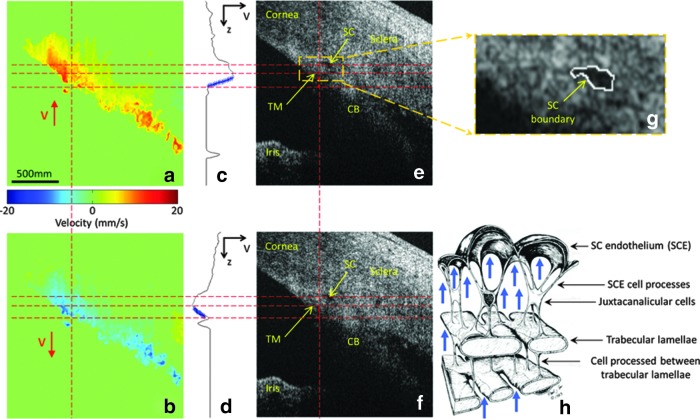
Intraocular pressure (IOP) is the only treatable risk factor in glaucoma, one of the world's leading causes of blindness. Mechanisms that maintain IOP within a normal range have been poorly understood in contrast to intrinsic mechanisms that regulate systemic blood pressure. Vessel walls experience continuous pulse-induced cyclic pressure and flow. Pressure-dependent wall stress and flow-dependent shear stress provide sensory signals that initiate mechanotransduction responses. The responses optimize vessel wall elasticity, compliance and lumen size, providing a feedback loop to maintain intrinsic pressure homeostasis. Aqueous humor is part of a vascular circulatory loop, being secreted into the anterior chamber of the eye from the vasculature, then returning to the vasculature by passing through the trabecular meshwork (TM), a uniquely modified vessel wall interposed between the anterior chamber and a vascular sinus called Schlemm's canal (SC). Since pressure in circulatory loops elsewhere is modulated by cyclic stresses, one might predict similar pressure modulation in the aqueous outflow system. Recent laboratory evidence in fact demonstrates that cyclic IOP changes alter aqueous outflow while increasing cellularity and contractility of TM cells. Cyclic changes also lead to alterations in gene expression, changes in cytoskeletal networks and modulation of signal transduction. A new technology, phase-based optical coherence tomography, demonstrates in vivo pulse-dependent TM motion like that elsewhere in the vasculature. Recognition of pulse-dependent TM motion provides a linkage to well-characterized mechanisms that provide pressure homeostasis in the systemic vasculature. The linkage may permit unifying concepts of pressure control and provide new insights into IOP homeostatic mechanisms.
Figures
References
-
- Li P., et al. Phase-sensitive optical coherence tomography characterization of pulse-induced trabecular meshwork displacement in ex vivo nonhuman primate eyes. J. Biomed. Opt. 17:076026, 2012 - PubMed
MeSH terms
Grants and funding
LinkOut - more resources
Full Text Sources
Other Literature Sources
Medical