. 2013 Dec 17;105(12):2751-9.
doi: 10.1016/j.bpj.2013.11.005.

Liquid general anesthetics lower critical temperatures in plasma membrane vesicles

Affiliations

Liquid general anesthetics lower critical temperatures in plasma membrane vesicles

Ellyn Gray et al. Biophys J. .

Abstract

A large and diverse array of small hydrophobic molecules induce general anesthesia. Their efficacy as anesthetics has been shown to correlate both with their affinity for a hydrophobic environment and with their potency in inhibiting certain ligand-gated ion channels. In this study we explore the effects that n-alcohols and other liquid anesthetics have on the two-dimensional miscibility critical point observed in cell-derived giant plasma membrane vesicles (GPMVs). We show that anesthetics depress the critical temperature (Tc) of these GPMVs without strongly altering the ratio of the two liquid phases found below Tc. The magnitude of this affect is consistent across n-alcohols when their concentration is rescaled by the median anesthetic concentration (AC50) for tadpole anesthesia, but not when plotted against the overall concentration in solution. At AC50 we see a 4°C downward shift in Tc, much larger than is typically seen in the main chain transition at these anesthetic concentrations. GPMV miscibility critical temperatures are also lowered to a similar extent by propofol, phenylethanol, and isopropanol when added at anesthetic concentrations, but not by tetradecanol or 2,6 diterbutylphenol, two structural analogs of general anesthetics that are hydrophobic but have no anesthetic potency. We propose that liquid general anesthetics provide an experimental tool for lowering critical temperatures in plasma membranes of intact cells, which we predict will reduce lipid-mediated heterogeneity in a way that is complimentary to increasing or decreasing cholesterol. Also, several possible implications of our results are discussed in the context of current models of anesthetic action on ligand-gated ion channels.


Figures

Figure 1
Figure 1
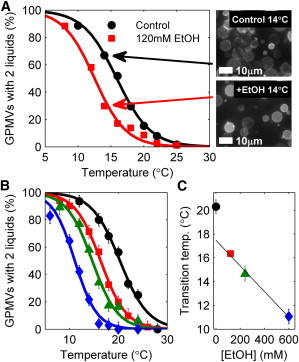
Ethanol lowers transition temperatures in GPMVs. (A) Untreated GPMVs isolated from a single flask of cells show a broad distribution of transition temperatures. We quantify average transition temperatures by measuring the fraction of GPMVs with coexisting phases at multiple temperatures (black circles) and fit this distribution to extract the temperature where 50% of GPMVs contain coexisting liquid phases. When ethanol (EtOH) is added to vesicles from the same flask of cells before imaging, the distribution of phase separated vesicles shifts to a lower temperature (red squares), indicating that the transition temperature is lower. This downward shift in transition temperature is most apparent when comparing fields of vesicles imaged at 14°C in this experiment, where the majority of control GPMVs contain coexisting liquid phases whereas most ethanol-treated vesicles are uniform. (B, C) The transition temperature shift is dependent on the concentration of ethanol incubated with GPMVs. The curves in B are fit to obtain the average transition temperature reported in C and are drawn with the same symbols. To see this figure in color, go online.
Figure 2
Figure 2
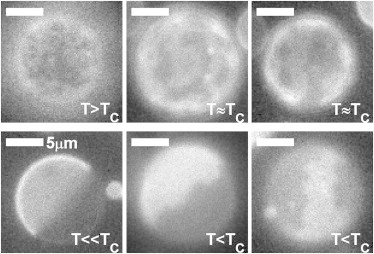
Ethanol-treated vesicles retain critical fluctuations. Representative images of different GPMVs imaged in 120 mM ethanol demonstrating a range of critical phenomena including dynamic supercritical fluctuations for T ≥ Tc and phase boundary fluctuations for T ≤ Tc. At low temperatures (T ≪ Tc), vesicles separate into roughly equal surface fractions of Lo and Ld phases. Vesicle imaged over a range of temperatures between 11° and 16°C.
Figure 3
Figure 3
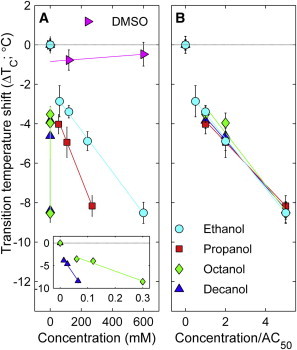
Critical temperature shift in GPMVs scales with anesthetic potency. (A) Measured critical temperature shifts in GPMVs incubated with a series of n-alcohol general anesthetics as a function of aqueous concentration of n-alcohol. Data points represent a weighted average over multiple experiments, as described in Methods and error bounds are propagated through this average. Lines are fits to all points excluding 0mM n-alcohol. (B) Data from A repotted with concentration scaled by the published anesthetic dose (AC50) of these compounds (47). To see this figure in color, go online.
Figure 4
Figure 4
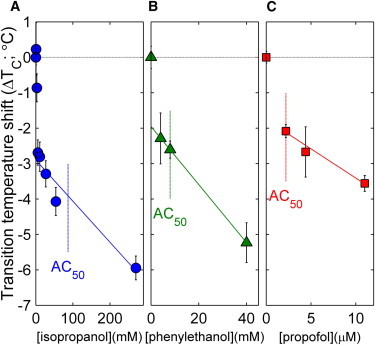
Non–n-alcohol liquid anesthetics lower critical temperatures at their anesthetic dose. Data points represent a weighted average over at least two separate experiments and error bounds are propagated through this average, as described in Methods. Lines are fits to all points excluding 0 mM for phenylethanol and propofol and <50 μM for isopropanol. The estimated anesthetic doses for these compounds are indicated by dashed lines and are determined as described in the main text. To see this figure in color, go online.
Figure 5
Figure 5
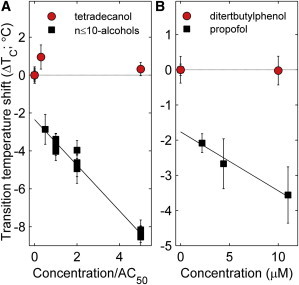
Structurally similar nonanesthetics do not lower critical temperatures. (A) Tetradecanol is an n-alcohol but is not active as a general anesthetic. Tetradecanol does not lower critical temperatures when added to GPMVs. The n-alcohol data for n ≤ 10 is replotted from Fig. 3C. (B) 2,6 diterbutylphenol is structurally similar to propofol but contains two additional methyl groups and is not active as a general anesthetic. 2,6 diterbutylphenol does not lower critical temperatures in GPMVs. The propofol data are replotted from Fig. 4C. To see this figure in color, go online.
Figure 6
Figure 6
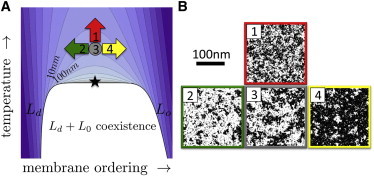
(A) Proposed schematic phase diagram of a cell membrane. Normal physiological conditions (gray circle) reside above a miscibility critical point (star) below which the membrane separates into coexisting Lo and Ld phases. Contours are of constant correlation length as described previously (26) and physiological conditions predicted to have a correlation length of roughly 20 nm. At constant physiological temperature, addition of general anesthetics is expected to shift membranes in the direction of the red arrow (26), increasing the temperature difference from the critical point. The more familiar perturbations of cholesterol depletion (loading) act to decrease (increase) membrane order, acting like the green (yellow) arrows on the phase diagram marked 2 and 4. (B) Perturbations affect the lateral structure of the membrane as depicted schematically with snapshots from a lattice Ising model, which shares broad features of its phase diagram. Under physiological conditions (3), there is no macroscopic phase separation, but supercritical fluctuations lead to structure that is much larger than the size of microscopic components, and there is roughly an equal area of ordered and disordered components. The common perturbations of cholesterol depletion (2) and loading (4) primarily act to increase the surface fraction of disordered (white) or ordered (black) membrane respectively. In contrast, liquid general anesthetics perturb membrane structure but do not affect the ordered to disordered ratio (1). Instead they reduce the size, lifetime, and contrast of fluctuations. To see this figure in color, go online.

References

    1. Meyer H. Zur theorie der alkoholnarkose. Archiv. Exper. Pathol. Pharm. 1899;42:109–118.
    1. Overton C.E., Lipnick R.L. Chapman and Hall; New York: 1991. Studies of narcosis.
    1. Gruner S.M., Shyamsunder E. Is the mechanism of general anesthesia related to lipid membrane spontaneous curvature? Ann. N. Y. Acad. Sci. 1991;625:685–697. - PubMed
    1. Jørgensen K., Ipsen J.H., Zuckermann M.J. The effect of anaesthetics on the dynamic heterogeneity of lipid membranes. Chem. Phys. Lipids. 1993;65:205–216. - PubMed
    1. Jørgensen K., Ipsen J.H., Zuckermann M.J. Anesthetics affect membrane heterogeneity. Ann. N. Y. Acad. Sci. 1991;625:747–750. - PubMed

Publication types

LinkOut - more resources