. 2014 Mar;1839(3):223-33.
doi: 10.1016/j.bbagrm.2013.11.009. Epub 2013 Dec 17.

A nuclear perspective on RNAi pathways in metazoans

Affiliations

A nuclear perspective on RNAi pathways in metazoans

Germano Cecere et al. Biochim Biophys Acta. 2014 Mar.

Abstract

The role of RNA interference (RNAi) in post-transcriptional regulation of complementary targets is well known. However, less is known about transcriptional silencing mechanisms mediated by RNAi. Such mechanisms have been characterized in yeast and plants, which suggests that similar RNA silencing mechanisms might operate in animals. A growing amount of experimental evidence indicates that short RNAs and their co-factor Argonaute proteins can regulate many nuclear processes in metazoans. PIWI-interacting RNAs (piRNAs) initiate transcriptional silencing of transposable elements, which leads to heterochromatin formation and/or DNA methylation. In addition, Argonaute proteins and short RNAs directly regulate Pol II transcription and splicing of euchromatic protein-coding genes and also affect genome architecture. Therefore, RNAi pathways can have a profound global impact on the transcriptional programs in cells during animal development. This article is part of a Special Issue entitled: Chromatin and epigenetic regulation of animal development.

Keywords: Argonaute; Chromatin; RNAi; Transcriptional regulation; endo-siRNAs; piRNAs.


Figures

Figure 1
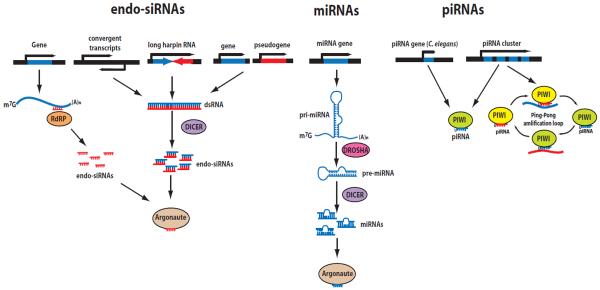
Figure 1. Biogenesis of the three endogenous classes of short RNAs
(left) endo-siRNAs can be produced by RNA-dependent RNA polymerases (RdRPs) using mature mRNAs as templates (in C. elegans), or generated by Dicer from long hairpin RNAs or from double-stranded RNAs that arise from convergent transcription and hybridization between spliced protein-coding transcripts and homologous pseudogenes. (center) miRNAs are transcribed from miRNA genes as long hairpin-structured RNA precursors, which are sequentially processed by RNase III enzymes Drosha and Dicer and loaded onto Argonaute proteins. (right) piRNAs are generated in a Dicer-independent manner from long piRNA precursors, which include multiple piRNAs, or from single piRNA transcriptional units (in C. elegans) and loaded onto PIWI proteins. They can be amplified by PIWI family Argonautes in a ping-pong amplification loop.
Figure 2
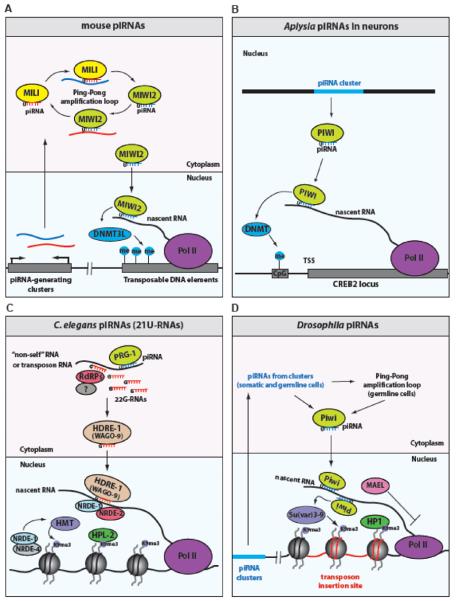
Figure 2. Models of piRNA-mediated transcriptional silencing in different species
(A) Mouse pre-pachytene piRNAs derived from piRNA-generating clusters are amplified by MILI and MIWI2 proteins in a ping-pong amplification loop in the cytoplasm. MIWI2 translocates to the nucleus where it binds transposon target RNAs and induces de novo DNA methylation of transposable elements by DNA methyltransferase 3-like protein DNMT3L. (B) Aplysia piRNAs are loaded onto PIWI protein in neurons. PIWI is recruited to the transcript derived from the CREB2 locus in a piRNA-dependent manner and silences the expression of CREB2 through the methylation of the CpG island at the promoter, possibly through a DNA methyltransferase protein (DNMT). (C) piRNAs in C. elegans can bind transposon RNAs or “non-self” transgenic RNAs and initiate the production of endogenous antisense 22G-RNAs that are loaded onto HRDE-1 Argonaute protein. HRDE-1 translocates to the nucleus where it binds target RNAs and recruits the NRDE proteins to induce transcriptional silencing through H3K9 methylation mediated by H3K9 methyltransferases (HMT) and HPL-2 (HP1-homologue protein) binding to the target locus. (D) Drosophila piRNAs are produced from piRNA-generating clusters, which are enriched in transposon sequences, and are loaded onto Piwi protein to silence transposable elements in trans. Piwi translocates to the nucleus where it binds nascent RNA transcripts derived from active transposons and induces transcriptional silencing through H3K9 methylation, catalyzed by the H3K9 methyltransferase protein Su(var)3–9, and by direct or indirect recruitment of HP1 to the transposon insertion sites. The piRNA pathway component MAEL translocates to the nucleus and inhibits Pol II transcription independently (or downstream) of H3K9 methylation.

References

    1. Fire A, Xu S, Montgomery MK, Kostas SA, Driver SE, Mello CC. Potent and specific genetic interference by double-stranded RNA in Caenorhabditis elegans. Nature. 1998;391:806–811. - PubMed
    1. Cogoni C, Macino G. Isolation of quelling-defective (qde) mutants impaired in posttranscriptional transgene-induced gene silencing in Neurospora crassa. Proceedings of the National Academy of Sciences of the United States of America. 1997;94:10233–10238. - PMC - PubMed
    1. Cogoni C, Romano N, Macino G. Suppression of gene expression by homologous transgenes. Antonie van Leeuwenhoek. 1994;65:205–209. - PubMed
    1. Napoli C, Lemieux C, Jorgensen R. Introduction of a Chimeric Chalcone Synthase Gene into Petunia Results in Reversible Co-Suppression of Homologous Genes in trans. The Plant cell. 1990;2:279–289. - PMC - PubMed
    1. Pal-Bhadra M, Bhadra U, Birchler JA. Cosuppression in Drosophila: gene silencing of Alcohol dehydrogenase by white-Adh transgenes is Polycomb dependent. Cell. 1997;90:479–490. - PubMed

Publication types

LinkOut - more resources