


White light-emitting diodes (LEDs) at domestic lighting levels and retinal injury in a rat model
- PMID: 24362357
- PMCID: PMC3948037
- DOI: 10.1289/ehp.1307294
White light-emitting diodes (LEDs) at domestic lighting levels and retinal injury in a rat model
Abstract
Background: Light-emitting diodes (LEDs) deliver higher levels of blue light to the retina than do conventional domestic light sources. Chronic exposure to high-intensity light (2,000-10,000 lux) has previously been found to result in light-induced retinal injury, but chronic exposure to relatively low-intensity (750 lux) light has not been previously assessed with LEDs in a rodent model.
Objective: We examined LED-induced retinal neuronal cell damage in the Sprague-Dawley rat using functional, histological, and biochemical measurements.
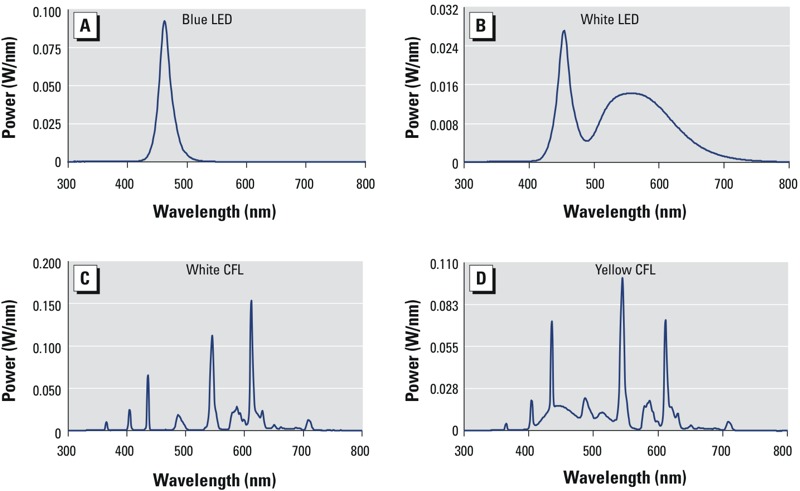
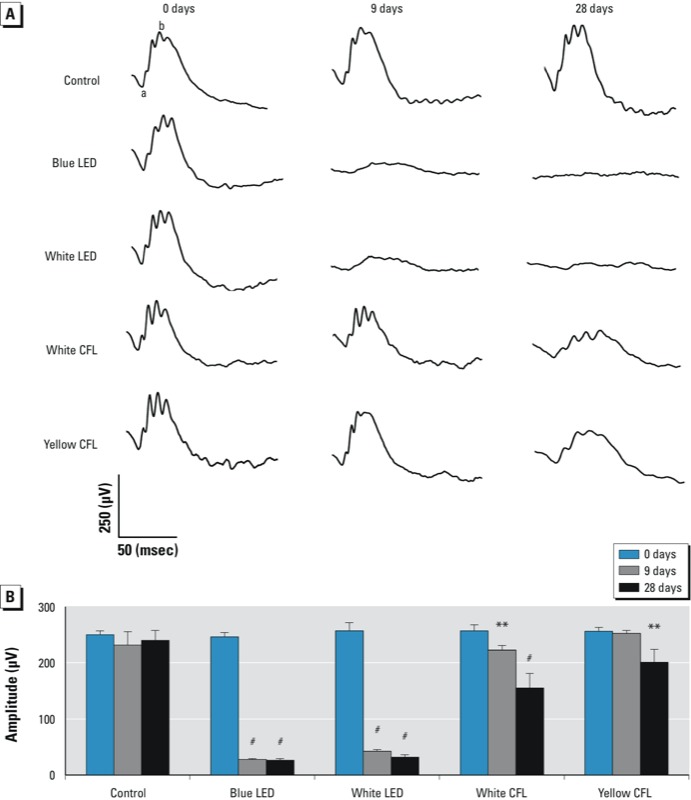
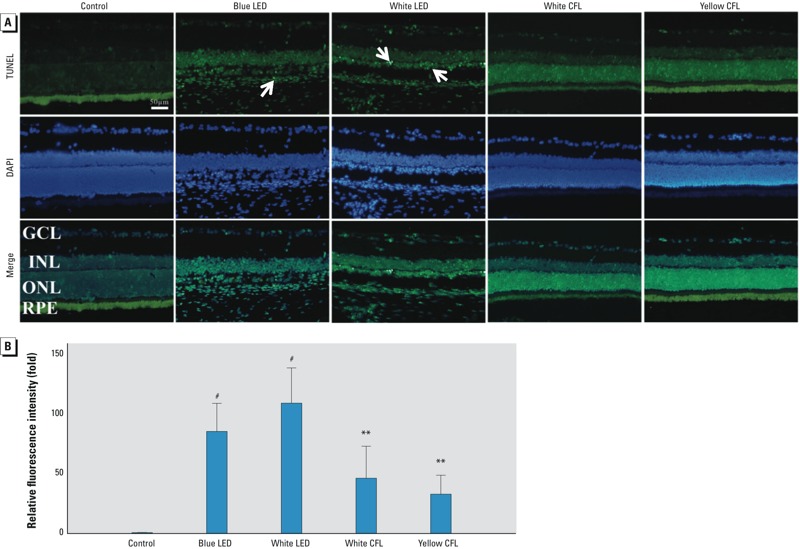
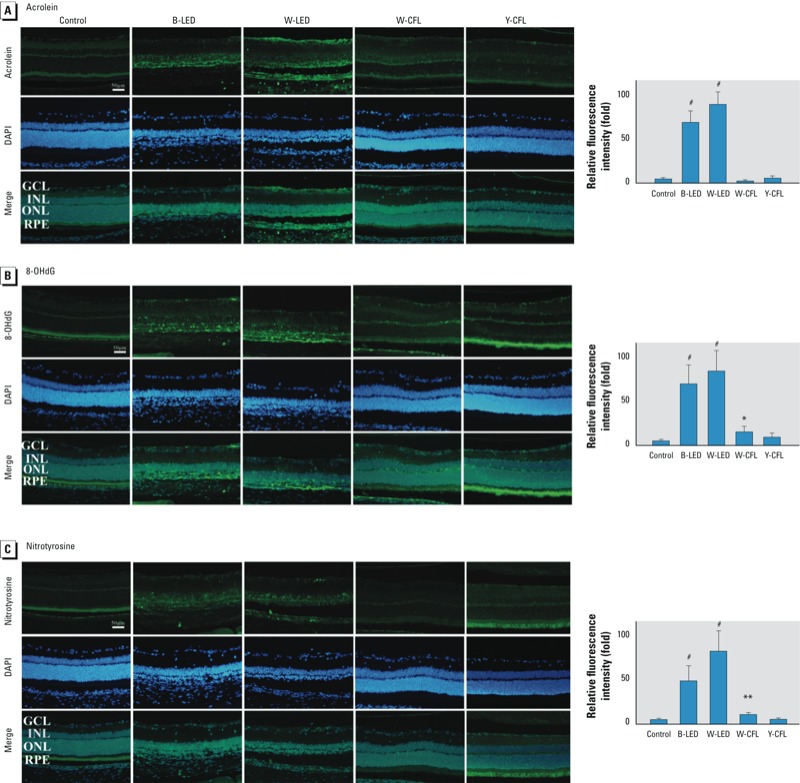
Methods: We used blue LEDs (460 nm) and full-spectrum white LEDs, coupled with matching compact fluorescent lights, for exposures. Pathological examinations included electroretinogram, hematoxylin and eosin (H&E) staining, immunohistochemistry (IHC), and transmission electron microscopy (TEM). We also measured free radical production in the retina to determine the oxidative stress level.
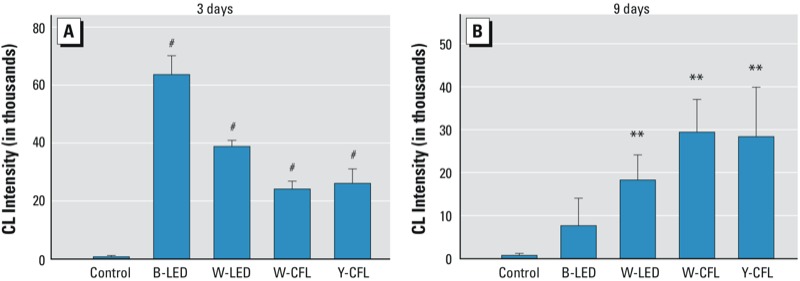
Results: H&E staining and TEM revealed apoptosis and necrosis of photoreceptors, which indicated blue-light induced photochemical injury of the retina. Free radical production in the retina was increased in LED-exposed groups. IHC staining demonstrated that oxidative stress was associated with retinal injury. Although we found serious retinal light injury in LED groups, the compact fluorescent lamp (CFL) groups showed moderate to mild injury.
Conclusion: Our results raise questions about adverse effects on the retina from chronic exposure to LED light compared with other light sources that have less blue light. Thus, we suggest a precautionary approach with regard to the use of blue-rich "white" LEDs for general lighting.
Citation: Shang YM, Wang GS, Sliney D, Yang CH, Lee LL. 2014. White light-emitting diodes (LEDs) at domestic lighting levels and retinal injury in a rat model. Environ Health Perspect 122:269-276; http://dx.doi.org/10.1289/ehp.1307294.
Conflict of interest statement
The authors declare they have no actual or potential competing financial interests.
Figures



Comment in
-
Hidden blue hazard? LED lighting and retinal damage in rats.Environ Health Perspect. 2014 Mar;122(3):A81. doi: 10.1289/ehp.122-A81. Environ Health Perspect. 2014. PMID: 24583823 Free PMC article. No abstract available.
References
-
- ARVO (Association for Research in Vision and Ophthalmology). Statement for the Use of Animals in Ophthalmic and Vision Research. 2013. Available: http://www.arvo.org/About_ARVO/Policies/Statement_for_the_Use_of_Animals... [accessed 21 January 2014]
-
- Beatty S, Koh H, Phil M, Henson D, Boulton M. The role of oxidative stress in the pathogenesis of age-related macular degeneration. Surv Ophthalmol. 2000;45:115–134. - PubMed
-
- Behar-Cohen F, Martinsons C, Vienot F, Zissis G, Barlier-Salsi A, Cesarini JP, et al. Light-emitting diodes (LED) for domestic lighting: any risks for the eye? Prog Retin Eye Res. 2011;30:239–257. - PubMed
-
- Collier RJ, Wang Y, Smith SS, Martin E, Ornberg R, Rhoades K, et al. Complement deposition and microglial activation in the outer retina in light-induced retinopathy: inhibition by a 5-HT1A agonist. Invest Ophthalmol Vis Sci. 2011;52:8108–8116. - PubMed
Publication types
MeSH terms
LinkOut - more resources
Full Text Sources
Other Literature Sources