


Mentoring and the career satisfaction of male and female academic medical faculty
- PMID: 24362376
- PMCID: PMC4341994
- DOI: 10.1097/ACM.0000000000000109
Mentoring and the career satisfaction of male and female academic medical faculty
Abstract
Purpose: To explore aspects of mentoring that might influence medical faculty career satisfaction and to discover whether there are gender differences.
Method: In 2010-2011, the authors surveyed 1,708 clinician-researchers who received (in 2006-2009) National Institutes of Health K08 and K23 awards, which provided mentoring for career development. The authors compared, by gender, the development and nature of mentoring relationships, mentor characteristics, extent of mentoring in various mentor roles, and satisfaction with mentoring. They evaluated associations between mentoring and career satisfaction using multivariable linear regression analysis.
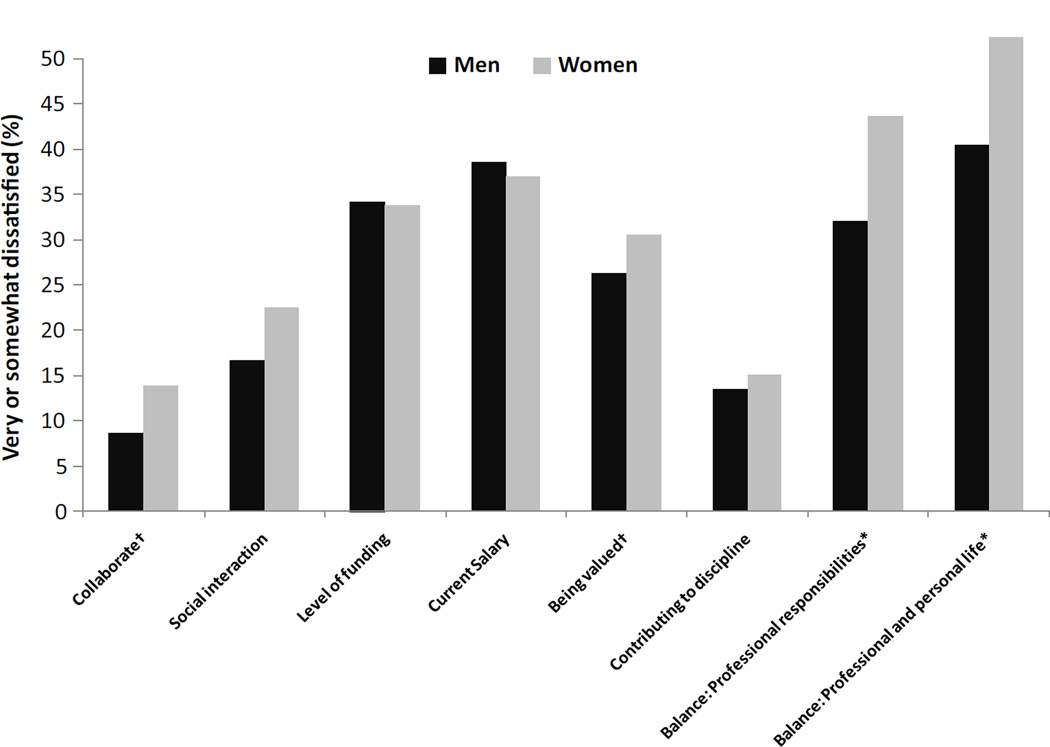
Results: The authors received 1,275 responses (75% response rate). Of these respondents, 1,227 (96%) were receiving K award support at the time and constituted the analytic sample. Many respondents had > 1 designated mentor (440/558 women, 79%; 410/668 men, 61%; P < .001). Few were dissatisfied with mentoring (122/1,220, 10.0%; no significant gender difference). Career dissatisfaction was generally low, but 289/553 women (52%) and 268/663 men (40%) were dissatisfied with work-life balance (P < .001). Time spent meeting or communicating with the mentor, mentor behaviors, mentor prestige, extent of mentoring in various roles, and collegiality of the mentoring relationship were significantly associated with career satisfaction. Mentor gender, gender concordance of the mentoring pair, and number of mentors were not significantly associated with satisfaction.
Conclusions: This study of junior faculty holding mentored career development awards showed strong associations between several aspects of mentoring and career satisfaction, indicating that those concerned about faculty attrition from academic medicine should consider mentor training and development.
Figures
References
-
- Schafer AI, editor. The Vanishing Physician– Scientist? Ithaca, NY: Cornell University Press; 2009.
-
- Zemlo TR, Garrison HH, Partridge NC, Ley TJ. The physician–scientist: Career issues and challenges at the year 2000. FASEB J. 2000;14:221–230. - PubMed
-
- Ley TJ, Hamilton BH. The gender gap in NIH grant applications. Science. 2008;322:1472–1474. - PubMed
-
- Jagsi R, Motomura AR, Griffith KA, Rangarajan S, Ubel PA. Sex differences in attainment of independent funding by career development awardees. Ann Intern Med. 2009;151:804–811. - PubMed
-
- Jagsi R, DeCastro R, Griffith KA, et al. Similarities and differences in the career trajectories of male and female career development award recipients. Acad Med. 2011;86:1415–1421. - PubMed
Publication types
MeSH terms
Grants and funding
LinkOut - more resources
Full Text Sources
Other Literature Sources
