. 2014 Apr;80(7):2042-9.
doi: 10.1128/AEM.03331-13. Epub 2013 Dec 20.

Potentially pathogenic Escherichia coli can form a biofilm under conditions relevant to the food production chain

Affiliations

Potentially pathogenic Escherichia coli can form a biofilm under conditions relevant to the food production chain

Live L Nesse et al. Appl Environ Microbiol. 2014 Apr.

Abstract

The biofilm-producing abilities of potentially human-pathogenic serotypes of Escherichia coli from the ovine reservoir were studied at different temperatures and on different surfaces. A possible influence of the hydrophobicity of the bacterial cells, as well as the presence of two virulence factors, the Shiga toxin-encoding (Stx) bacteriophage and the eae gene, was also studied. A total of 99 E. coli isolates of serotypes O26:H11, O103:H2, and O103:H25 isolated from sheep feces were included. The results show that isolates of all three E. coli serotypes investigated can produce biofilm on stainless steel, glass, and polystyrene at 12, 20, and 37°C. There was a good general correlation between the results obtained on the different surfaces. E. coli O103:H2 isolates produced much more biofilm than those of the other two serotypes at all three temperatures. In addition, isolates of serotype O26:H11 produced more biofilm than those of O103:H25 at 37°C. The hydrophobicity of the isolates varied between serotypes and was also influenced by temperature. The results strongly indicated that hydrophobicity influenced the attachment of the bacteria rather than their ability to form biofilm once attached. Isolates with the eae gene produced less biofilm at 37°C than isolates without this gene. The presence of a Stx bacteriophage did not influence biofilm production. In conclusion, our results show that potentially human-pathogenic E. coli from the ovine reservoir can form biofilm on various surfaces and at several temperatures relevant for food production and handling.


Figures
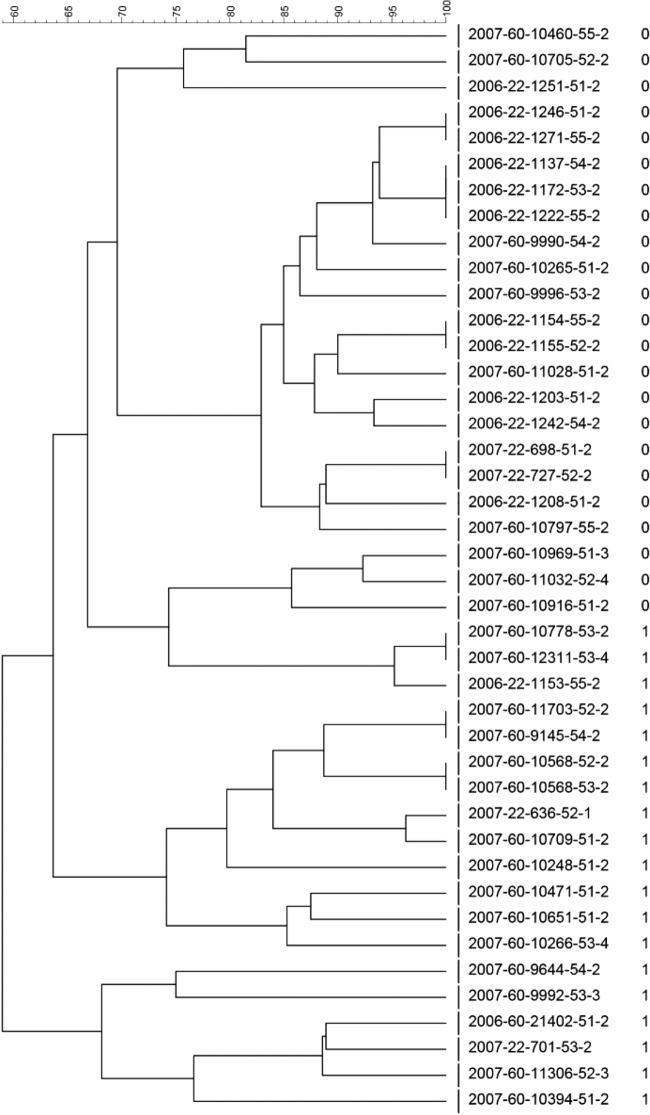
FIG 1
FIG 1
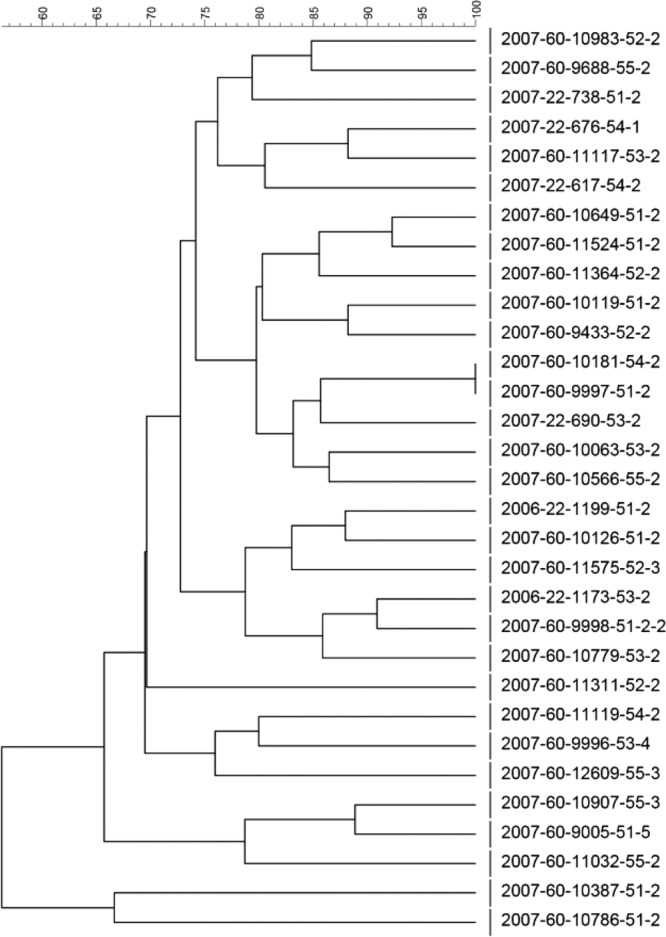
Dendrogram with percent similarity of PFGE profiles of E. coli O103:H2 isolates (isolate numbers are given for all isolates). In addition, the number 0 or 1 to the right of the isolate numbers signifies the absence or presence of the eae gene, respectively.
FIG 2
FIG 2
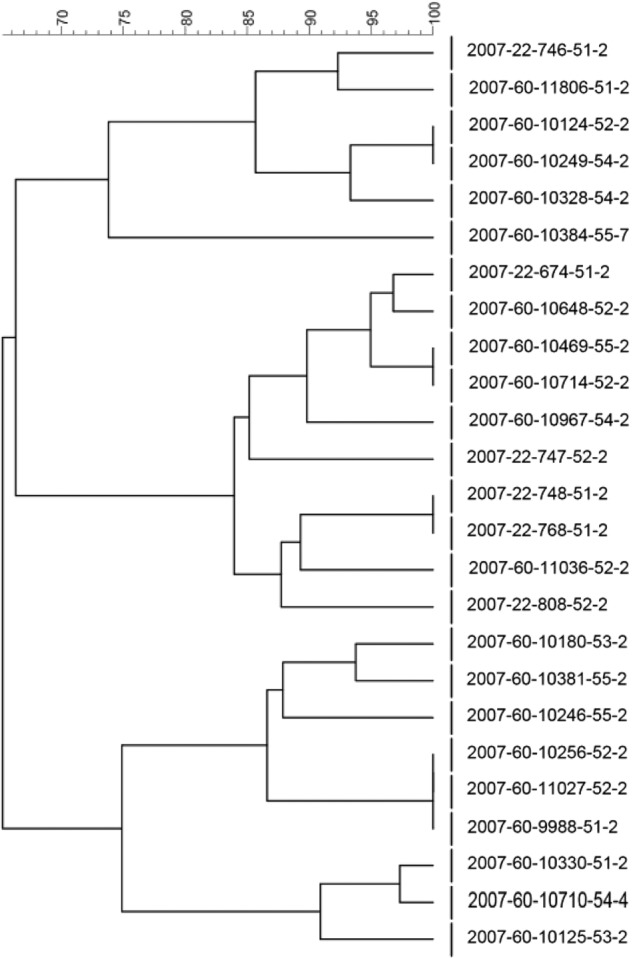
Dendrogram with percent similarity of PFGE profiles of E. coli O103:H25 isolates (isolate numbers are given for all isolates).
FIG 3
FIG 3
Dendrogram with percent similarity of PFGE profiles of E. coli O26:H11 isolates (isolate numbers are given for all isolates).
FIG 4
FIG 4
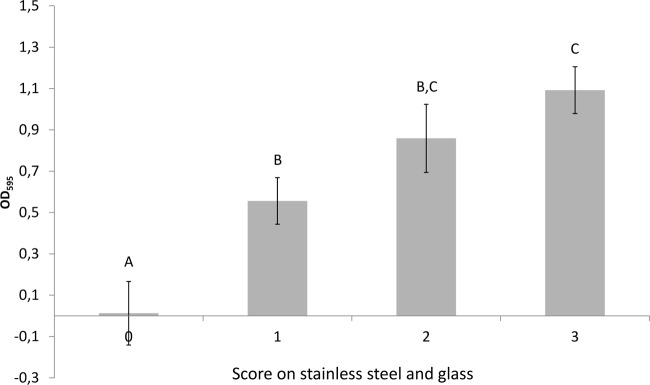
Mean OD595 values in microtiter plate assay of subset of 12 isolates with different biofilm formation scores on glass slides and steel coupons. Results from all temperatures are included. Bars represent standard deviations (SD). Different letters signify that the means are statistically different at a P value of <0.05.
FIG 5
FIG 5
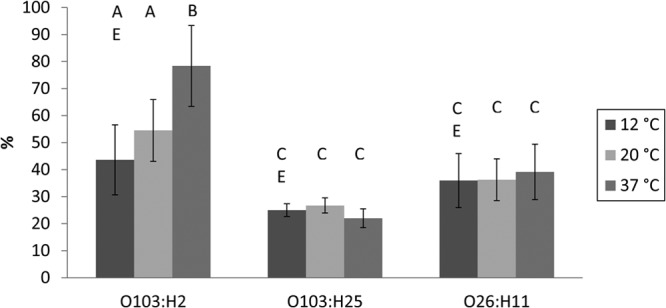
Mean hydrophobicities of different serotypes in subset of 12 isolates at 12, 20, and 37°C. Bars represent standard deviation (SD). Different letters signify that the means are statistically different at a P value of <0.05.

References

    1. Paton JC, Paton AW. 1998. Pathogenesis and diagnosis of Shiga toxin-producing Escherichia coli infections. Clin. Microbiol. Rev. 11:450–479 - PMC - PubMed
    1. Karmali MA. 2004. Infection by Shiga toxin-producing Escherichia coli: an overview. Mol. Biotechnol. 26:117–122. 10.1385/MB:26:2:117 - DOI - PubMed
    1. Girard F, Batisson I, Frankel GM, Harel J, Fairbrother JM. 2005. Interaction of enteropathogenic and Shiga toxin-producing Escherichia coli and porcine intestinal mucosa: role of intimin and Tir in adherence. Infect. Immun. 73:6005–6016. 10.1128/IAI.73.9.6005-6016.2005 - DOI - PMC - PubMed
    1. Tzipori S, Gunzer F, Donnenberg MS, de Montigny L, Kaper JB, Donohue-Rolfe A. 1995. The role of the eaeA gene in diarrhea and neurological complications in a gnotobiotic piglet model of enterohemorrhagic Escherichia coli infection. Infect. Immun. 63:3621–3627 - PMC - PubMed
    1. Fitzhenry RJ, Pickard DJ, Hartland EL, Reece S, Dougan G, Phillips AD, Frankel G. 2002. Intimin type influences the site of human intestinal mucosal colonisation by enterohaemorrhagic Escherichia coli O157:H7. Gut 50:180–185. 10.1136/gut.50.2.180 - DOI - PMC - PubMed

Publication types

MeSH terms

LinkOut - more resources