Review
. 2014 Mar;87(1035):20130685.
doi: 10.1259/bjr.20130685.

DNA DSB repair pathway choice: an orchestrated handover mechanism

Affiliations
Review

DNA DSB repair pathway choice: an orchestrated handover mechanism

A Kakarougkas et al. Br J Radiol. 2014 Mar.

Abstract

DNA double strand breaks (DSBs) are potential lethal lesions but can also lead to chromosome rearrangements, a step promoting carcinogenesis. DNA non-homologous end-joining (NHEJ) is the major DSB rejoining process and occurs in all cell cycle stages. Homologous recombination (HR) can additionally function to repair irradiation-induced two-ended DSBs in G2 phase. In mammalian cells, HR predominantly uses a sister chromatid as a template for DSB repair; thus HR functions only in late S/G2 phase. Here, we review current insight into the interplay between HR and NHEJ in G2 phase. We argue that NHEJ represents the first choice pathway, repairing approximately 80% of X-ray-induced DSBs with rapid kinetics. However, a subset of DSBs undergoes end resection and repair by HR. 53BP1 restricts resection, thereby promoting NHEJ. During the switch from NHEJ to HR, 53BP1 is repositioned to the periphery of enlarged irradiation-induced foci (IRIF) via a BRCA1-dependent process. K63-linked ubiquitin chains, which also form at IRIF, are also repositioned as well as receptor-associated protein 80 (RAP80), a ubiquitin binding protein. RAP80 repositioning requires POH1, a proteasome component. Thus, the interfacing barriers to HR, 53BP1 and RAP80 are relieved by POH1 and BRCA1, respectively. Removal of RAP80 from the IRIF core is required for loss of the ubiquitin chains and 53BP1, and for efficient replication protein A foci formation. We propose that NHEJ is used preferentially to HR because it is a compact process that does not necessitate extensive chromatin changes in the DSB vicinity.


Figures
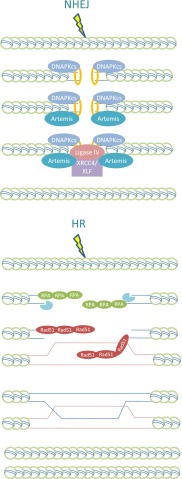
Figure 1.
Figure 1.
Non-homologous end-joining (NHEJ) and homologous recombination (HR) demand different degrees of chromatin remodelling. NHEJ is a compact process that most likely requires little change to the chromatin in the double strand break (DSB) vicinity. HR requires extensive resection, repositioning of damage response proteins and engagement of the sister chromatid. For simplicity, we have shown histone loss in the DSB vicinity. However, the steps in HR may not lead to full histone loss but could involve histone repositioning or modifications to histone proteins. There is extensive evidence that epigenetic changes to histones in the DSB vicinity occur during HR. DNA-PKcs, DNA-protein kinase catalytic subunit; RPA, replication protein A; XLF, XRCC4-like factor; XRCC4, X-ray cross complementing Group 4.
Figure 2.
Figure 2.
Examination of protein repositioning during homologous recombination. At early and late times post ionizing radiation (IR) in G1 phase and at early times in G2 phase, 53BP1 foci arise in a monomodal distribution around the double strand break. Ubiquitin chains (detected by FK2 antibodies) and receptor-associated protein 80 (RAP80) are similarly positioned. At late times in G2 (8 h post IR), 53BP1 is distributed in a bimodal manner together with ubiquitin chains and RAP80. Replication protein A (RPA) forms in the vacant core. BRCA1 is located between 53BP1 and RPA. This repositioning requires BRCA1 and POH1 to relieve barriers posed by 53BP1 and RAP80, respectively. The figure shows how protein distribution is assessed by monitoring the intensity distribution of the specific proteins along a line drawn through the foci. See reference for details. DDR, DNA damage response; DUB, deubiquitylating enzyme.
Figure 3.
Figure 3.
Model showing how BRCA1 and POH1 regulate 53BP1 repositioning. Resection is initiated by CtIP/MRE11 without the need for BRCA1. BRCA1 allows POH1 to access receptor-associated protein 80 (RAP80) by an undefined mechanism. POH1 facilitates proteasome-dependent degradation of RAP80, allowing an undefined deubiquitylating enzyme (DUB) to degrade the ubiquitin chains. 53BP1 is then no longer held in its original position, causing concomitant loss of RIF1 (RAP1 interacting factor) from the irradiation-induced foci core. Ubiquitin chains, RAP80 and 53BP1 become repositioned at the periphery of enlarged foci.
Figure 4.
Figure 4.
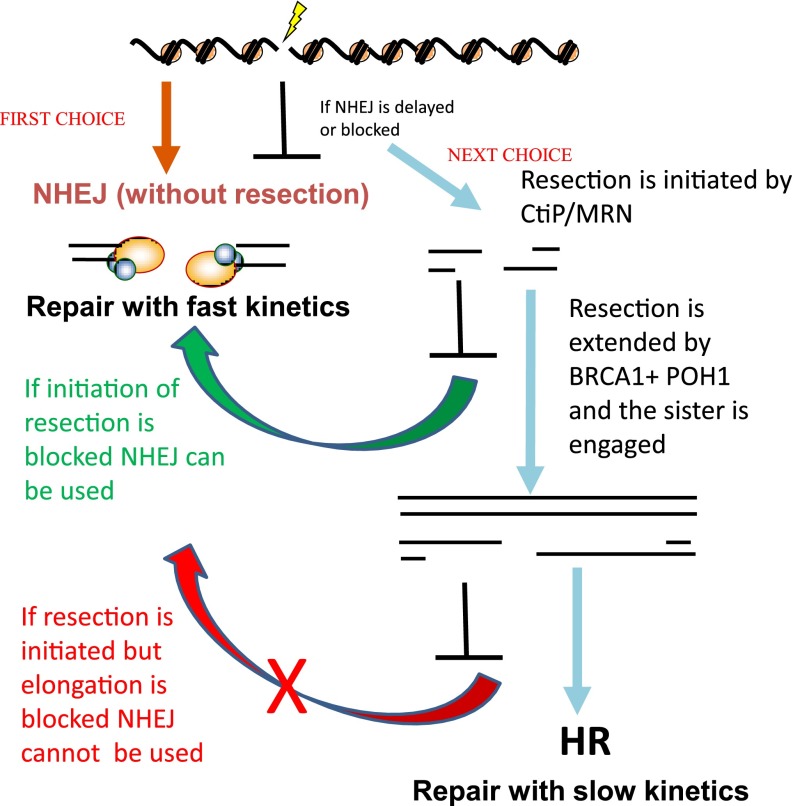
The initiation of resection by CtIP/MRE11 commits to homologous recombination (HR). Non-homologous end-joining (NHEJ) represents the pathway of first choice. If NHEJ is delayed, resection is initiated by CtIP/MRE11. CtIP silencing RNA (siRNA) allows NHEJ to occur. Resection is elongated by a process involving BRCA1, POH1 and Exo/BLM. If this process is blocked, then neither NHEJ nor homologous recombination can proceed, and there is a double strand break repair defect. MRN, MRE11-RAD50-NBS1.

References

    1. Lindahl T. DNA repair enzymes. Annu Rev Biochem 1982; 51: 61–87. doi: 10.1146/annurev.bi.51.070182.000425 - DOI - PubMed
    1. Lindahl T. Instability and decay of the primary structure of DNA. Nature 1993; 362: 709–14. - PubMed
    1. Friedberg EC. Out of the shadows and into the light: the emergence of DNA repair. Trends Biochem Sci 1995; 20: 381. - PubMed
    1. Sargentini NJ, Smith KC. Quantitation of the involvement of the recA, recB, recC, recF, recJ, recN, lexA, radA, radB, uvrD, and umuC genes in Escherichia coli. Radiat Res 1986; 107: 58–72. - PubMed
    1. Horii ZI, Clark AJ. Genetic analysis of the recF pathway to genetic recombination in Escherichia coli K-12: isolation and characterization of mutants. J Mol Biol 1973; 80: 327–44. - PubMed

MeSH terms

Substances