


How antibiotic resistances could change Helicobacter pylori treatment: A matter of geography?
- PMID: 24363506
- PMCID: PMC3857438
- DOI: 10.3748/wjg.v19.i45.8168
How antibiotic resistances could change Helicobacter pylori treatment: A matter of geography?
Abstract
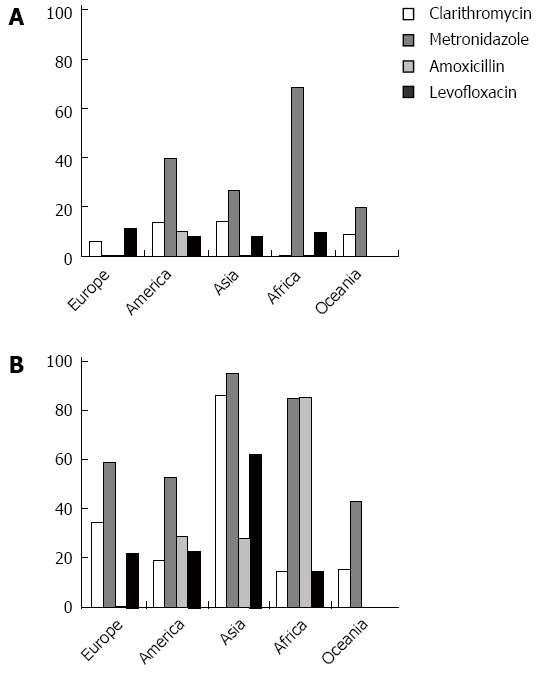
Therapeutic management of Helicobacter pylori (H. pylori) remains an unsolved issue. Indeed, no therapeutic regimen is able to cure the infection in all treated patients, and in many the infection persists despite the administration of several consecutive standard therapies. Although antibiotic resistance reports describe alarming results, the outcome of therapeutic regimens does not seem to parallel this scenario in most cases, since a successful performance is often reached in more than 80% of cases. However, the phenomenon of increasing antibiotic resistance is being closely studied, and the results show controversial aspects even in the same geographic area. For the continents of Europe, America, Asia, Africa, and Oceania, minimal and maximal values of resistance to the main antibiotics (clarithromycin, amoxicillin, metronidazole, and levofloxacin) feature wide ranges in different countries. The real enigma is therefore linked to the several different therapeutic regimens, which show results that often do not parallel the in vitro findings even in the same areas. A first aspect to be emphasized is that some regimens are limited by their use in very small geographic districts. Moreover, not all therapeutic trials have considered bacterial and host factors affecting the therapeutic outcome. The additional use of probiotics may help to reduce adverse events, but their therapeutic impact is doubtful. In conclusion, the "ideal therapy", paradoxically, appears to be a "utopia", despite the unprecedented volume of studies in the field and the real breakthrough in medical practice made by the discovery and treatment of H. pylori. The ample discrepancies observed in the different areas do not encourage the development of therapeutic guidelines that could be valid worldwide. On these bases, one of the main challenges for the future might be identifying a successful solution to overcome antibiotic resistances. In this context, geography must be considered a relevant matter.
Keywords: Antibiotic resistance; Geography; Helicobacter pylori; Therapeutic outcome; Therapeutic regimens.
© 2013 Baishideng Publishing Group Co., Limited. All rights reserved.
Figures
References
-
- Dore MP, Fanciulli G, Tomasi PA, Realdi G, Delitala G, Graham DY, Malaty HM. Gastrointestinal symptoms and Helicobacter pylori infection in school-age children residing in Porto Torres, Sardinia, Italy. Helicobacter. 2012;17:369–373. - PubMed
-
- Bastos J, Peleteiro B, Barros R, Alves L, Severo M, de Fátima Pina M, Pinto H, Carvalho S, Marinho A, Guimarães JT, et al. Sociodemographic Determinants of Prevalence and Incidence of Helicobacter pylori Infection in Portuguese Adults. Helicobacter. 2013;18:413–422. - PubMed
-
- Thjodleifsson B, Asbjörnsdottir H, Sigurjonsdottir RB, Gíslason D, Olafsson I, Cook E, Gíslason T, Jogi R, Janson C. Seroprevalence of Helicobacter pylori and cagA antibodies in Iceland, Estonia and Sweden. Scand J Infect Dis. 2007;39:683–689. - PubMed
Publication types
MeSH terms
Substances
LinkOut - more resources
Full Text Sources
Other Literature Sources
Medical
Miscellaneous
